
By Gia Miller
Photography by Miranda Schloat
Ossining-based artist John “Twyg” Hyde was hovering above the ground on stilts, disguised as what he calls a quad-stilt creature named Mortis. With a raven skull concealing his face and layers of torn cloth draped over a hiking backpack covered in foam, it was impossible to tell where the creature ended and the man began. Hyde, who was in his mid-30s at the time, built the costume specifically for that evening—a Halloween-themed gathering in Northampton, Massachusetts, hosted by his mentor, artist and special effects creator, Carl Johan Bridge. As Hyde moved through the space, he witnessed several partygoers observing him with perplexed yet curious expressions.
“I would just stop and let them come to me,” he remembers. “They would softly pet the mask, and then they’d say, ‘I want to hug you, but I don’t know how.’ So I would gently put my arm out, and they would hug it; some people would cry. The costume was a little scary, yet people would say, ‘I don’t know why I feel so deeply,’ and I would just gently nod and then move on. I eventually realized they were attracted to my gentle kindness. It wasn’t nice. It was just kind. I was giving them the space to interact with me as they needed to, and then I would float off into the distance.”
Hyde was expecting a reaction to this creature, but not such a powerful one. Later, when he was hired to perform in that costume, he was “blown away” by the deeper range of emotions his creature evoked from the general public. One early evening about seven years ago, while performing in Tarrytown, Hyde encountered a woman in her mid-to-late 60s. She approached Hyde and said, “Oh, you poor thing.”
“She came up to me and started crying,” Hyde explains. “She was petting the costume and saying, ‘You poor thing,’ because the costume had been worn down. It was dusk, right after the golden hour, when there’s a bit of sadness that it’s going to become night, and she had a similar kind of deep sadness. But she also had a kind of reverence as though she were thinking, ‘Oh, you are going to be fading soon?’ This creature clearly touched her.”
Hyde did not break character, and he resisted the urge to comfort her with words, understanding that doing so would shatter the very feelings she was processing. Instead, he rested with her in that emotional space, allowing his empathy to be his guide. “She was very, very gentle, and she also kept saying, ‘Thank you, thank you.’” For Hyde, this part of his art is not about him, his character, or his experience, yet every performance is done with determined intent. “I would like people to have their time with the creature,” he explains. “My biggest challenge is figuring out how to convey all that kindness and allow people that space to work with what they feel.”
This is the core of Hyde’s artistic manifesto: his sculptures, masks and costumed characters “explore the union of creepy looks with a friendly soul.” Hyde aims to challenge the viewer to contemplate a difficult concept: Could what we habitually see as unsettling also be kind?
An artist in the making
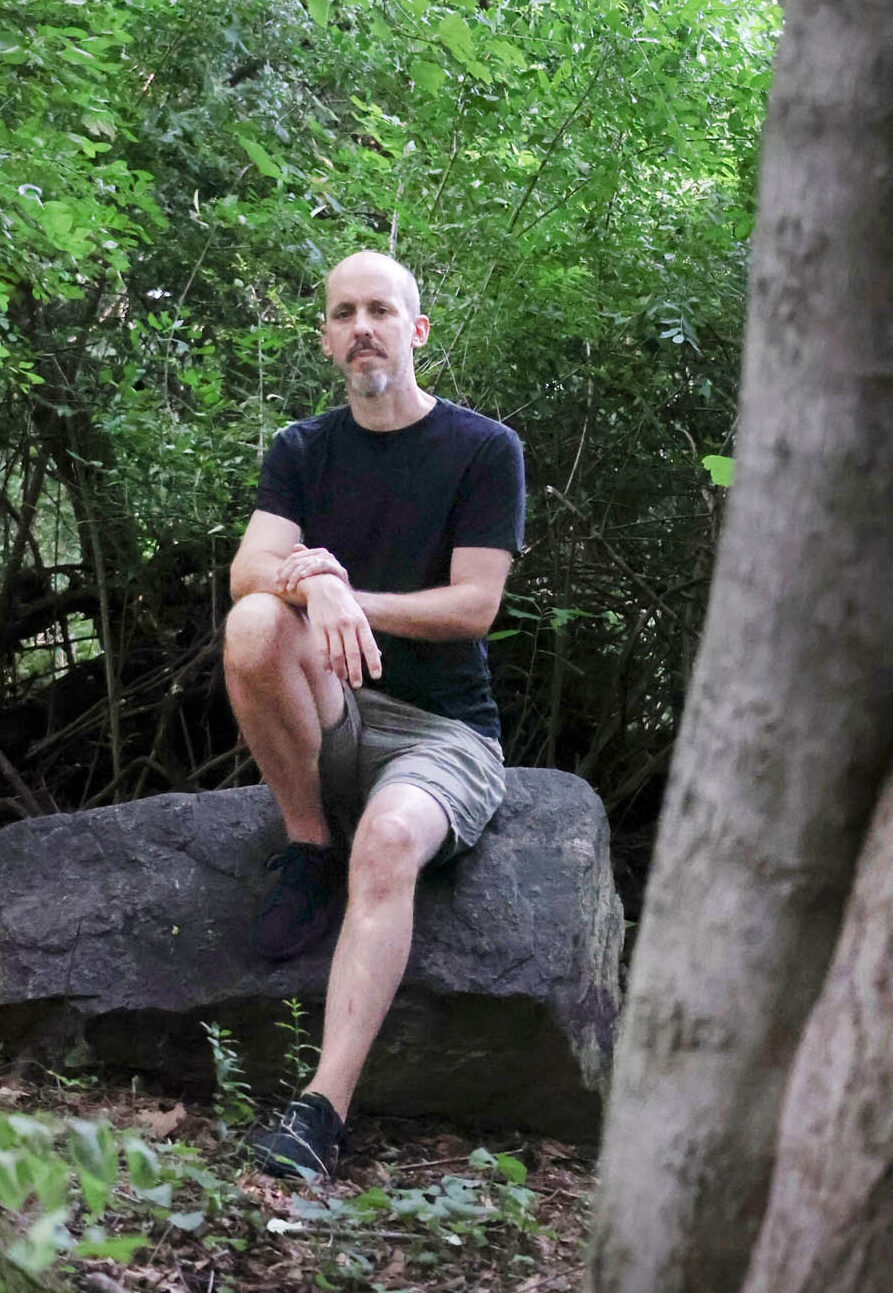
John “Twyg” Hyde at his meditation spot in the woods at Bethany Arts Community.
Hyde took the required art classes at his high school in Greenwich, but technology was where he shined. In fact, it was his technology teacher who encouraged him to enter The Bruce Museum’s annual high school art competition, specifically instructing Hyde to enter his computerized 3D art. It was the late 1990s, and computerized 3D art was not yet considered a true art form by the majority of the art world. But Hyde’s father was an early adopter when it came to technology, so Hyde experimented with the tools at home.
“I was working with a software package that ILM (George Lucas’ motion picture studio) was using to do all of their 3D graphics,” Hyde explains. “I was basically making still lifes, and the wireframes would take 72 hours to complete. Then I found a way to take those still lifes and print them on high-quality photo paper.” Hyde submitted “these spheres of different shapes in perspective,” and he won third place in the new art category. But he didn’t consider himself an artist.
Years later, while he was studying the fundamentals of art and attempting to understand what makes art art, it occurred to him why he had won. “I accidentally ended up creating it in the thirds,” he explains. “The spacing was properly done, and it was then that I actually saw something in that piece.”
Hyde says he “knew computers at a high level,” having taught himself how to navigate complex computer systems at six years old so he could load and unload games onto his father’s computer while his dad was at work. After graduating high school, he began working as an independent contractor, building websites and creating their graphic designs. “I was perfect for small shops, because I was doing their graphic design, and if their computer started acting up, they didn’t have to call the IT guy. Meanwhile, I was doing what I now realize is commercial art. I was literally doing an artist’s job, but I still did not consider myself an artist. It was just mechanical for me.”
Hyde transitioned solely into IT at 20 years old when working for a struggling startup that had lost about 80 percent of their customers. He was creating graphics, troubleshooting tech issues, and helping run their website servers. “They said, ‘Well, we can let you go, but you’re so agile and versatile that we’re going to keep you,’” Hyde explains. “But they added, ‘We’d rather you just keep the computers running because we’re going in a different direction.’” When the company eventually failed, Hyde was the last to go. “I turned out the lights, packed everything up and sold off all the equipment. And that’s when I moved into full-time corporate life.”
After working through the dot-com boom and bust, Hyde eventually landed at a burgeoning advertising agency founded by industry veterans John McGarry and Gordon Bowen, where he says he “got exposure to some very high-powered creatives.” He spent 15 years at McGarryBowen and says he had the opportunity to take in what creative ideas and client pitches succeeded, which ones failed and why. “I once saw somebody in tears because the Pantone red wasn’t showing up properly on the TV screen,” he describes. “This was a grown adult in so much despair, so I waited for everything to calm down, fixed the problem and then asked him to explain what was going on. It helped me understand that it’s okay to feel deeply about what you believe in.”
Creative roots
Hyde’s initial foray into the darker edges of the fantasy world was as a young child, thanks to his grandfather. “He would fall asleep in his La-Z-Boy, snoring, with ‘Conan the Barbarian’ or ‘The Dark Crystal’ on TV, and I would switch it to something else and he’d instantly wake up and say, ‘Nope! I’m watching that,’” Hyde remembers. “I was six or seven years old—it was a pretty critical time period to be watching that kind of stuff. But when you look at the Skeksis (bird-like cruel creatures with sharp teeth) in ‘The Dark Crystal,’ they’re creepy, but they’re not so horrific that an eight- or nine-year-old can’t look at it and think, ‘Okay, I don’t like it, and I am not going to hang out with it, but I can sit with it.’”
Hyde’s other influence was the abundance of fantasy books in his home. While he wasn’t old enough to comprehend the plot, he enjoyed the “old-school D&D art style.” At eight or nine years old, Hyde’s uncles took him to his first Renaissance Faire. “I barely remember it,” he says. “But I do remember being super freaked out by the 11-foot-tall papier-mâché wizard; the puppeteer had two hands he would use to interact with you. He would stay still while doing it, but if you started not feeling well, he would back up and go somewhere else.” Hyde didn’t revisit a Renaissance Faire until he was 16, and he was instantly enthralled. “Everyone’s having fun, and sure, it was a little expensive, but I knew I wanted to go back, and I knew I would make it happen.”
-
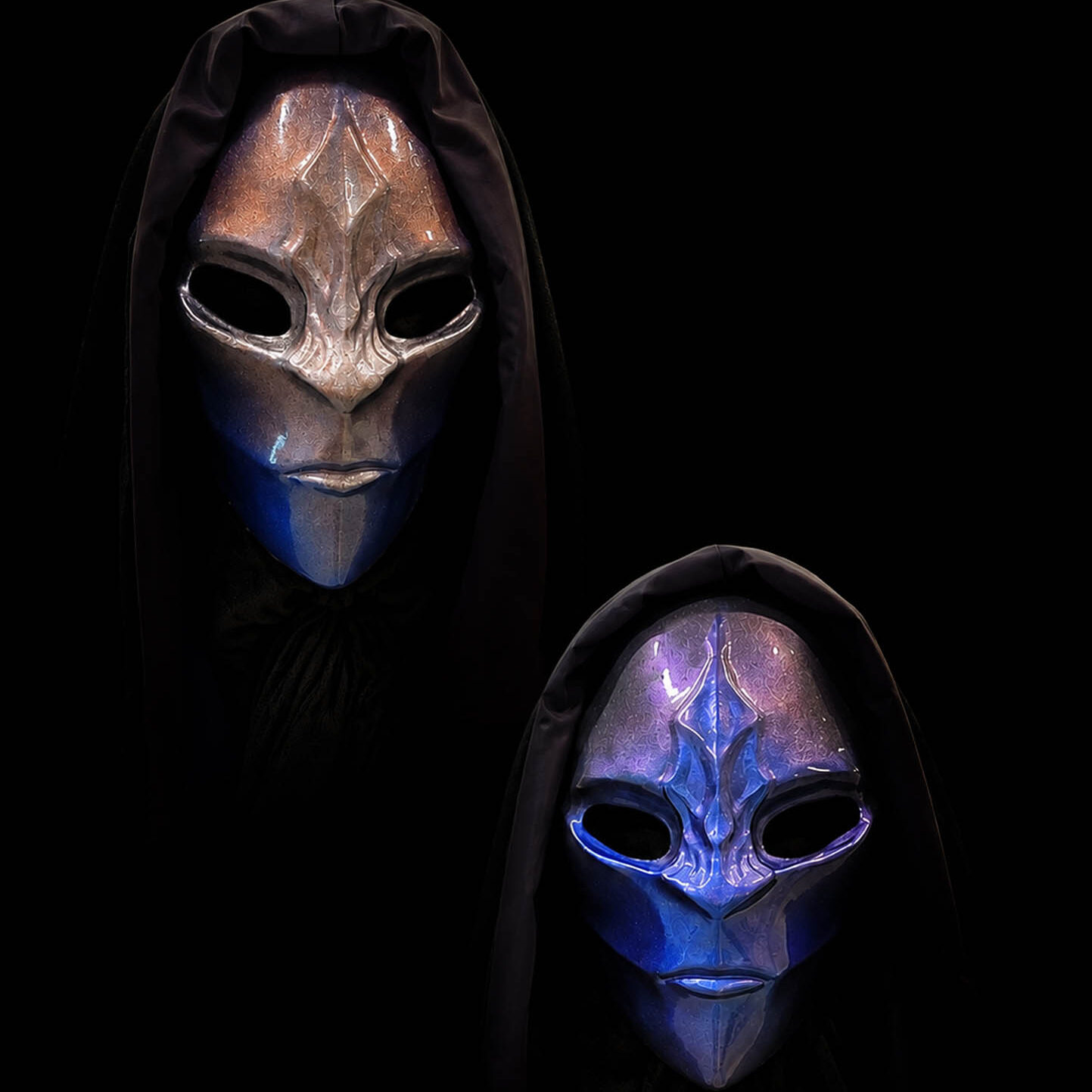
- “Nameless” masks, 3D-printed base finished with epoxy paint.
-
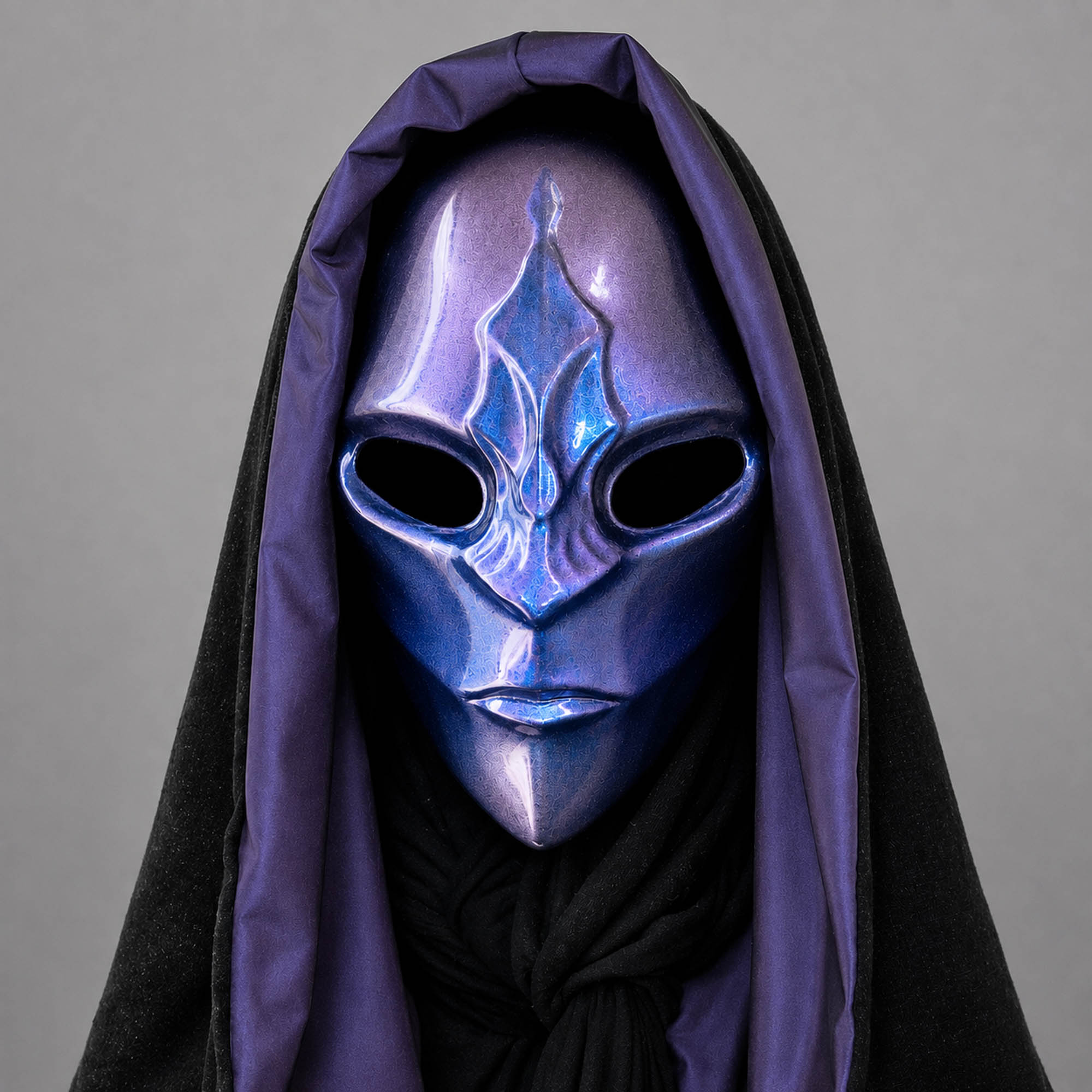
- Close up of one of the masks.
Entering the world of “sacred play”
To afford his new passion, Hyde began making chainmail clothing, initially thinking, “How hard could that be?” The answer, he says, was “hard,” and it was also time-consuming. He quickly began making carnival games, armor for jousters and other items that he could hawk at the Faire. When a master leathersmith took Hyde under his wing, Hyde began crafting belts and pouches for Faire-goers, eventually specializing in crafting custom sheaths for swords.
“People started finding out about me and saying, ‘There is a guy at Ren Faire who, if you bring him your family sword, he will do what you need,’” Hyde explains. “Once, somebody brought me their Union sword from an ancestor who was a member of the cavalry and asked me to sheath it, but I refused—I believed they should keep the original sheath. Instead, I offered to make them a replica of the strap their ancestor would’ve worn. I researched it and made the strap, giving that person a sense of identity in their family history.”
“In my bio on my website, I talk about ‘sacred play,’” Hyde continues. “But what is sacred? You are not just transforming; you are replicating what may have been. When we look back at these items, there’s a sense of your family legacy and pride. People want to feel what it was like to hold those items, and I made that happen. That’s why I viewed myself as a maker, not an artist.”
The New York Renaissance Faire is only eight weeks a year, so Hyde expanded into live action role-playing (LARPing) games. “It allowed me to transform and play with different identities,” he says. “Sometimes, when I was role-playing with someone, they’d have a really genuine moment, and I would stop to ask them if they were okay. They would tell me something occurred that reminded them of their parents, and they weren’t handling the memory well. I would pull them aside so we could talk about it.” So when Hyde began making armor and props for people, he did so knowing that his creations would serve as an anchor point. “They could jump into that identity and play inside a space where they were safe,” Hyde explains. And then, at the end of the weekend, they could put it in a box and return to being a warehouse manager, accountant, etc. Then they could pick that up again the next time.”
Fire, sobriety and the studio
Hyde also began attending intentionally focused art festivals, most notably one called the SpiritFire Festival. Held near the intersection of New York, Massachusetts and Connecticut, the festival is a non-denominational gathering centered around four overnight bonfires. There’s spoken word, drumming and dance, allowing attendees to enter transformative, trance-like states (the events have a drug-free policy). Hyde began contributing masks and performing at the fires, which caught the attention of twin brothers Carl and Martin Bridge, influential artists in that community.
One day, Carl invited Hyde to spend a weekend with him at his studio, where he’s created everything from puppets to special effects for Hollywood studios. “I arrived around eight on a Friday night, we ate dinner, and then worked until 3:30 or four in the morning,” Hyde remembers. “The next morning, we woke up at nine, ate a quick breakfast, then went until four in the morning, working non-stop. I left Sunday evening around eight.”
When Hyde returned home and was talking to his wife, he began to cry. She asked him if he needed a space to create his art, and he responded, “I think so.” “I was just weeping,” he describes. “She asked what was wrong, and I told her that I had never felt that good just making what I wanted.” He rented a non-temperature-controlled, illegal garage beneath a restaurant for approximately six months, creating his Krampus costume there, along with many commissioned pieces as well as props for commercial advertisements and friends’ cosplay.
Eventually, a neighbor told Hyde about David Lyons’ plan to turn a former convent down the road into a community art space. Hyde filled out the Google form and didn’t hear back. About nine months later, Hyde received a phone call. “David said, ‘Hey, you’re in. This will be your room. You can move in on this date. Here’s your rent.’” Hyde became one of the first artists at the Bethany Arts Community (BAC), and when he moved into his approximately 120-square-foot studio, he looked around and wondered what he would do with all that space. “It’s so funny,” he says, “because if you look at my studio, you might think it’s very small, but it is all I need. It’s four times what I had before.”
And a few months later, when Bonnie Bradley, BAC’s executive director, saw Hyde’s Krampus costume, she immediately said, “That’s going to be in my show. I don’t want to hear any more about it.” In that moment, Hyde’s mentality shifted. “It took me until I was about 40 years old to say, I am an artist.”
-
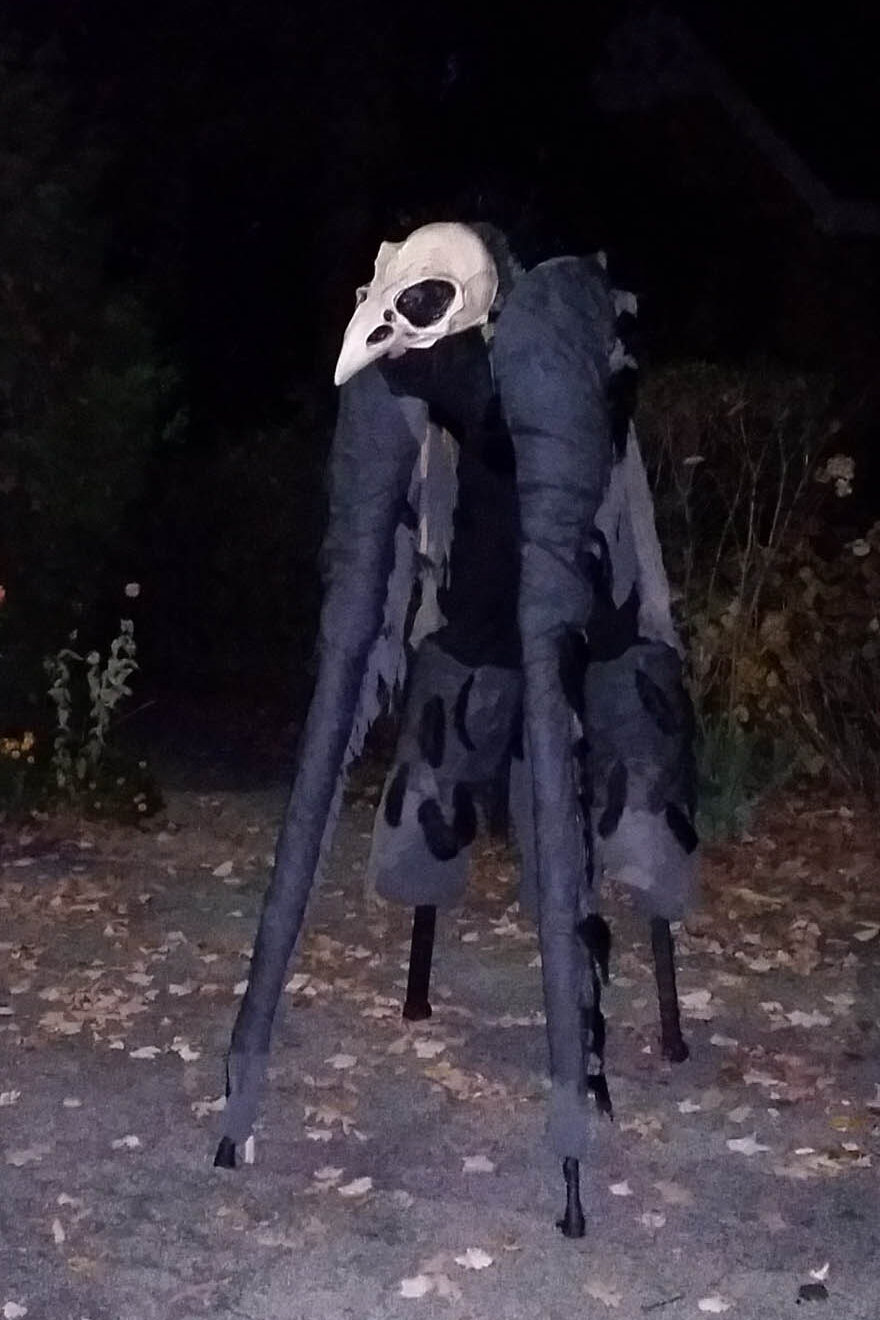
- Hyde dressed as Mortis, a mixed media quad-stilt creature.
-
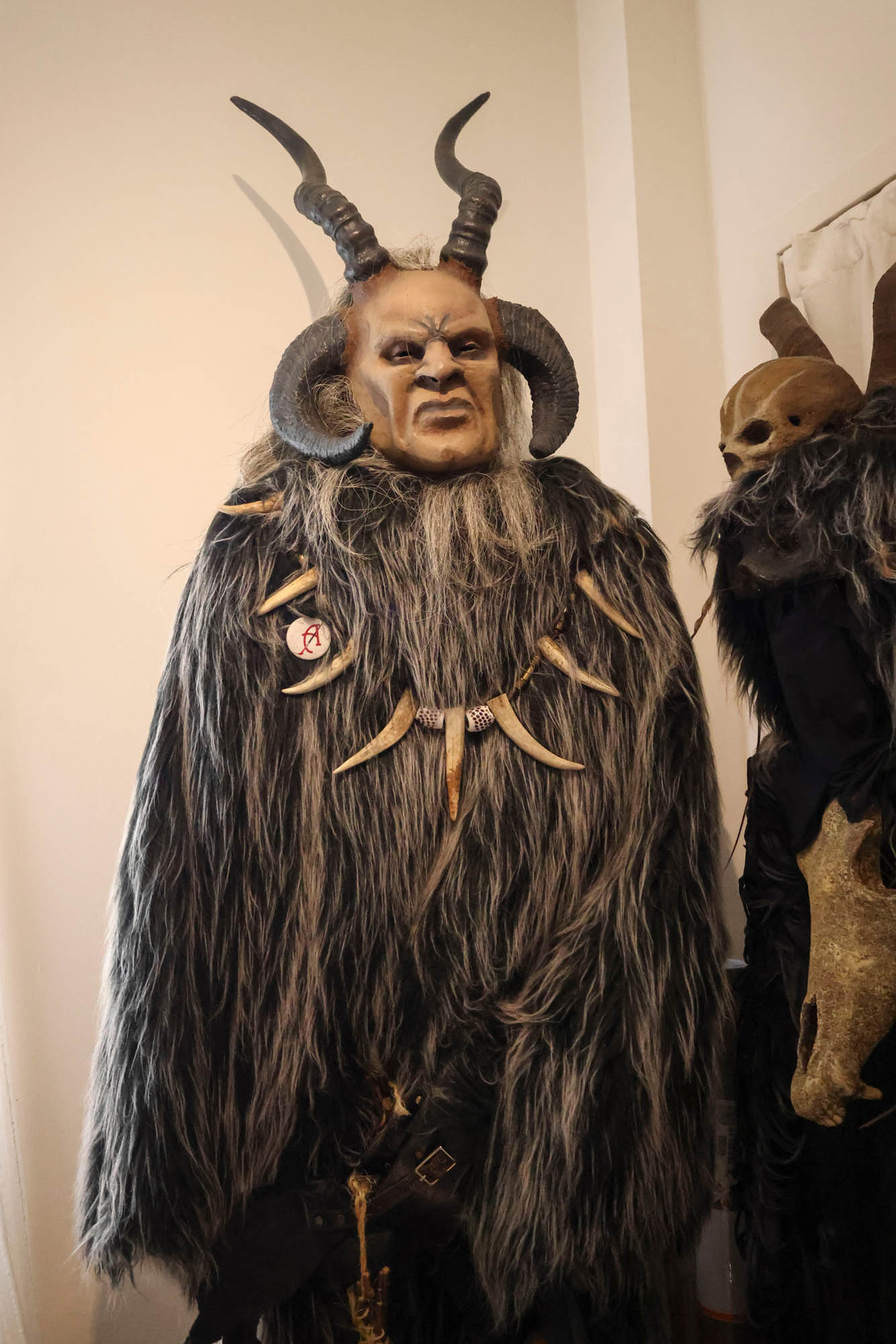
- Hyde’s Krampus costume, featuring a mixed media, paper and clay-sclupted mask, on display in his studio.
The alchemy of the process
Finally having a proper studio afforded Hyde the ability to expand his artwork into areas like metal etching and other techniques that require a piece to dry, untouched, in a stable environment, sometimes for 36 hours, before the next phase can begin. Because Hyde continues to work in IT during the day—a fact he’s not shy about, pointing out that he’s learned a tremendous amount regarding how to run (and not run) a business from those jobs—Hyde mainly works on his art in the evenings. When he arrives, he will often unlock his studio door, put down his things, take a deep breath and then head outside for a brief five-minute nature walk to “his spot”—a very small clearing in the woods on the BAC property. There, as the sunlight begins to fade, he ponders his work. It’s a type of meditation that works with his ADHD brain: his eyes remain open, and instead of clearing his mind, he allows his thoughts to flow.
“There is this stream of consciousness going by, and if a thought really hangs, I let it,” Hyde explains. “And if something moves in the forest, instead of ignoring it, I’ll allow myself to see what just moved, then I’ll return to sitting quietly and listening. That’s when I’ve had my biggest moments of quiet because I am just letting my brain run. I have been deeply rewarded by this practice.” Sometimes, Hyde will hear an unsettling noise that makes him want to leave, but he will force himself to relax and sit in that uncomfortable space. “That allows me to ponder how I can get that feeling into this piece,” he says.
Then Hyde returns to his studio, fully present and ready to work. He usually has music playing in the background, and anything goes. One evening it could be classical (he prefers Bach over Mozart), the next it could be metal (he’s a longtime fan of Tool) and even pop. “I’ll think, ‘What’s Demi Lovato or Taylor Swift up to?’ So I’ll listen to three or four of their new songs, and then I’m like, ‘Yup, I’ve got it,’ and I move on to something else.”
Hyde’s creative process blends his two distinct worlds, tech and fantasy, together. He’ll often begin a new piece by staring at a digital sphere and using pareidolia, a psychological phenomenon of seeing faces in random shapes.
Utilizing 3D modeling software like Blender, ZBrush and Meshmixer, he’ll begin “pushing and pulling,” manipulating the shape until a form reveals itself. Then he will 3D print the image, which, depending on the size, could take one to two weeks.
“A 3D printer is just a glorified hot glue gun,” Hyde explains. “Sometimes, things will sag and look weird, so I spend a lot of time engineering before I print. I aim to build it with the least amount of plastic I can because I’m very cognizant of the fact that I am dumping a bunch of plastic into this. So that might mean that I print something at a weird, wonky angle because that’s the most efficient. This tickles my brain, thinking about how I can Tetris this to use the least amount of plastic and save the most amount of money because I do want to make a profit if I sell it.”
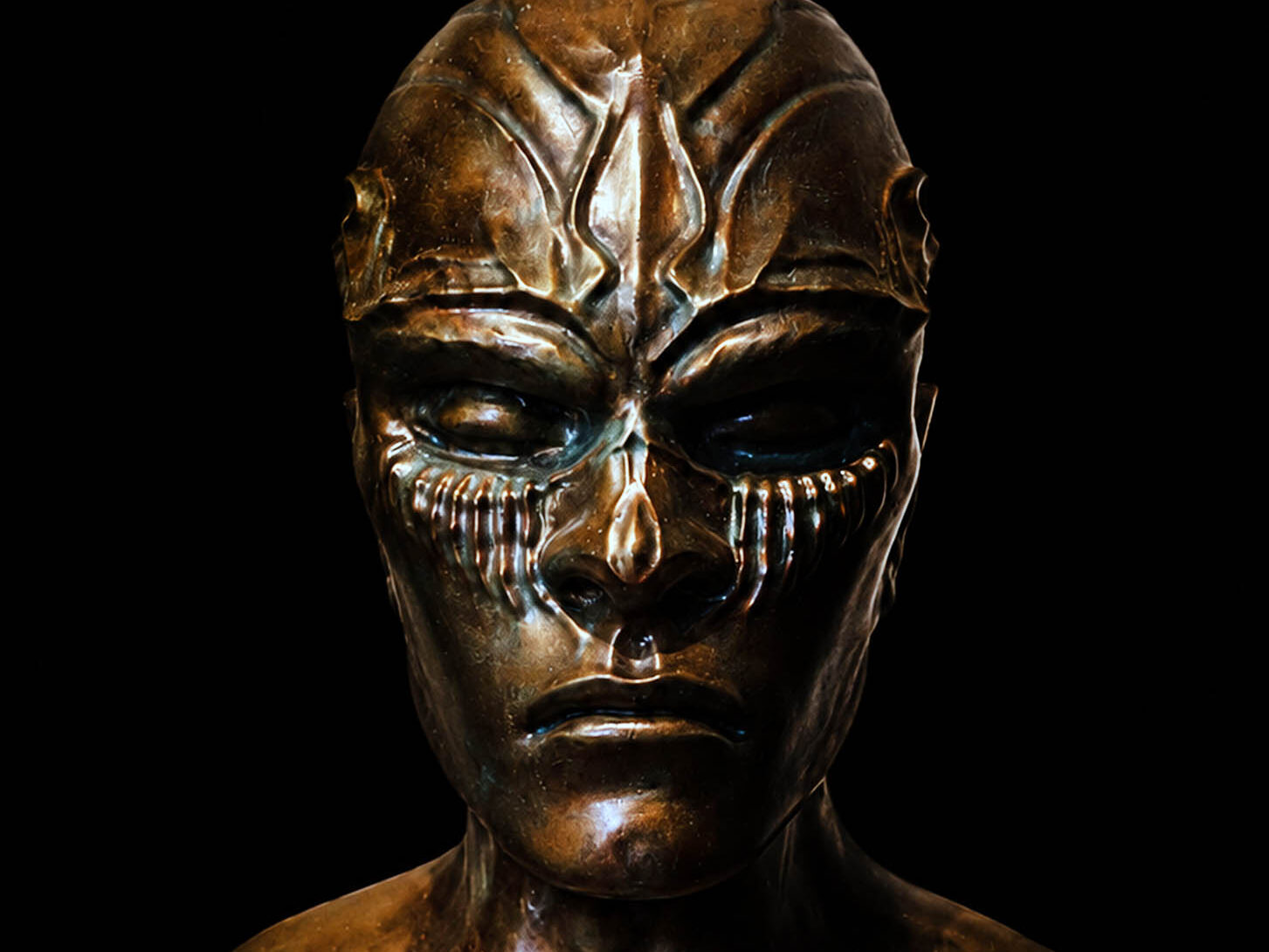
Once the 3D print is complete, Hyde puts the modern technology away and pulls out his tools, challenging himself to see if he can make something that was 3D printed look like real bronze. “I want to remove any hints that it was 3D printed; it should look as natural as possible,” he explains. “So I’ll use a mix of wood glue, wood and powder—which fast-tracks the natural because they’re natural materials. Then I pause to think about where I am going with it. Will it look like it was dug up out of the dirt or water? Where did this come from? I put a loose guideline around it, and then I begin to drive towards that intended find or intended experience with paint, sometimes up to 12 or 15 layers.”
Next, he sands the paint and sprays it with water. “Will that make the paint dribble? Yes, and that’s okay because it will go into the recesses and make the piece look older. Then it won’t look like it just popped out of a 3D printer.”
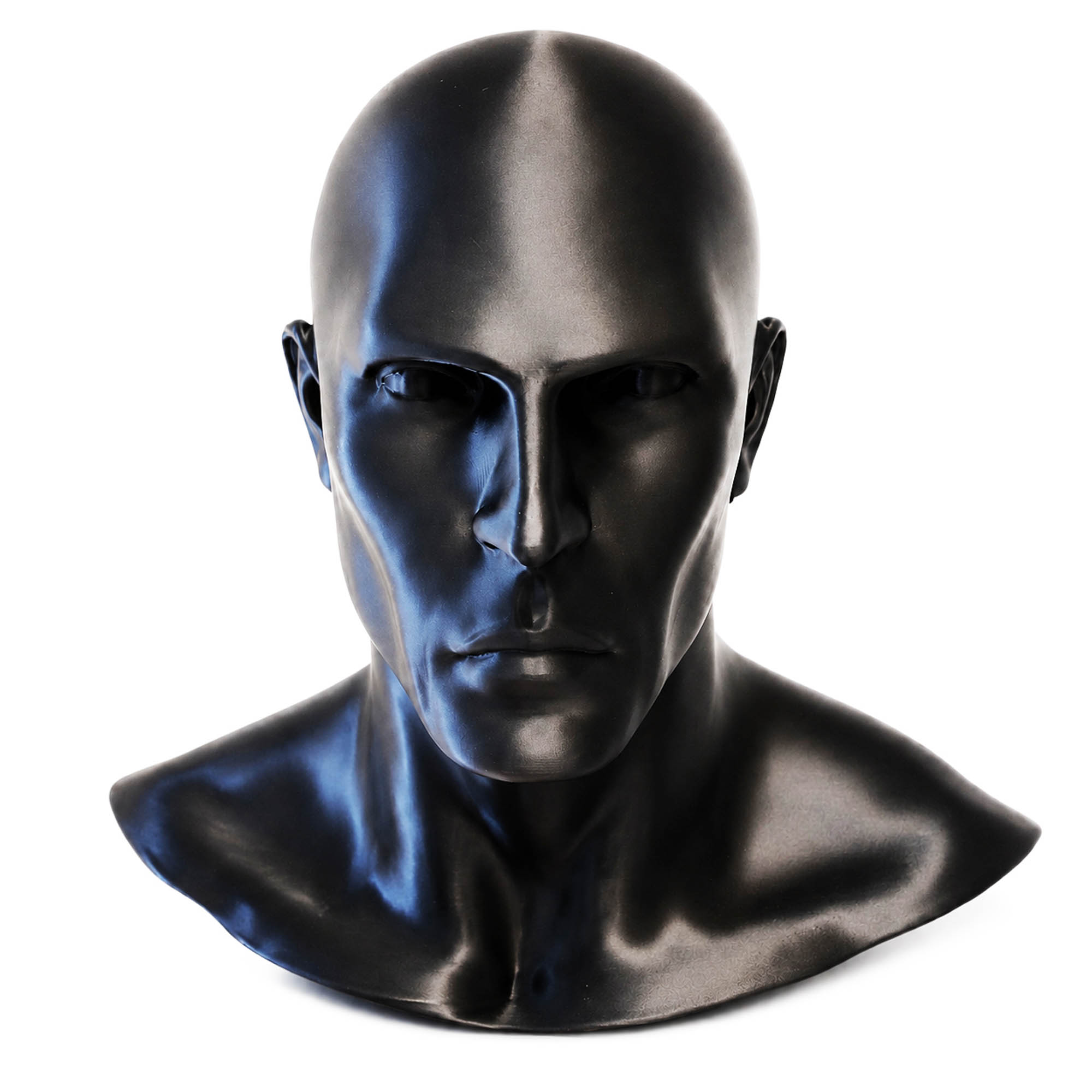
“Hycanthium” 3d print mask.
Crafting the uncomfortable
Hyde, who describes his art as “dark fantasy,” says people often ask him why it’s so creepy. Why doesn’t he make brighter, happier things? He responds with a challenge. “Are you pushed in any direction when you see a landscape? What makes my art different is that it’s not what you see every day. Does it pigeonhole me a bit? Sure. However, I try to make it as open and accessible as possible. And I have those opportunities with my costume characters.”
People have also described his art as evil, which Hyde hypothesizes is because they don’t know how to label it. He points to mythological history and how it’s often portrayed today, referencing Pazuzu, the Mesopotamian mythological “king of the wind demons” who humans believed helped them ward off other demons. But in the movie “The Exorcist,” Pazuzu possesses a young girl named Regan. “In the movie, Pazuzu is a creepy-looking, evil-headed statue with weird wings—but in mythology, it was actually a protector,” says Hyde. “But in our modern world, people looked at it and thought it was evil because they didn’t understand it. Yet in ancient Mesopotamia, people had it in their house, and they wore little pendants with Pazuzu for fertility and protection. Archaeologists have actually found ancient Pazuzu statues and amulets in Iraq. So, originally, it wasn’t evil, just creepy. But if someone wants to call my art evil, then okay, but that’s on them.”
And that’s where Hyde lives—in those spaces. The spaces where he’s making, recreating, transforming, observing, inviting, encouraging, possibly agitating and always offering gentle kindness.
This article was edited by Meryl Kaye and fact-checked by Julie Schwietert Collazo. Photography was captured with Canon optics and edited in Adobe Creative Suite.
This article was published in the September/October 2026 edition of Connect to Northern Westchester.

Gia Miller is an award-winning journalist and the editor-in-chief/co-publisher of Connect to Northern Westchester. She has a magazine journalism degree (yes, that's a real thing) from the University of Georgia and has written for countless national publications, ranging from SELF to The Washington Post. Gia desperately wishes schools still taught grammar. Also, she wants everyone to know they can delete the word "that" from about 90% of their sentences, and there's no such thing as "first annual." When she's not running her media empire, Gia enjoys spending quality time with friends and family, laughing at her crazy dog and listening to a good podcast. She thanks multiple alarms, fermented grapes and her amazing husband for helping her get through each day. Her love languages are food and humor.