
By Gia Miller
Heavy Metal Therapy
“Listen,” says Metallica’s frontman James Hetfield to northern Westchester resident and acclaimed documentary filmmaker Joe Berlinger. “The film is very painful to watch. I’m not sure I am ever going to watch it again.”
It’s late September 2003; Berlinger and his co-director/co-producer, Bruce Sinofsky, have spent the past three years filming the renowned heavy metal band during a period of near-total psychological collapse, intense therapy and internal strife. The band and their management watched the three-hour rough cut earlier in the day. Band members sat in separate corners while management huddled in the back. Throughout the screening, the room was dead silent. “There were some funny moments on screen, but you could hear a pin drop,” Berlinger remembers.
When the film ended, Hetfield quietly walked out. Drummer Lars Ulrich followed. The band’s management scrambled out of the room looking pale. Hours later, the group has reconvened, and some of the band members are flipping out. They’re concerned about fans seeing their vulnerabilities; Berlinger and Sinofsky feel like their masterpiece is crumbling. After three hours defending the existence and meaning of every single scene, a look washes over Hetfield’s face, and he delivers that line.
A few minutes later, Hetfield says, “You know what, release whatever film you want.” Then the band stands up to leave. On his way out, Ulrich, who remained quiet during the discussion because he liked the film, pats Berlinger on the shoulder and says, “Congratulations, you got the film.” It premiered at Sundance, and the band came. “It was an incredible premiere,” Berlinger remembers. “People were so moved.” To understand how Berlinger found himself in this extraordinary position—and how he navigates the complex world of documentary storytelling—we sat down with the legendary filmmaker to discuss his life and his craft.
You’ve had such an incredible, decades-long career. But you started out studying German in college. How did you make the jump from a German major to a pioneering documentary filmmaker?
After college, my goal was simply to get someone to pay me to live in German-speaking Europe, and I convinced the Ogilvy and Mather ad agency in Frankfurt to hire me. They needed someone who spoke multiple languages; I spoke French, German and English. I became a junior producer on TV commercial shoots, greasing the wheels for American clients. The first time I was ever on a film set, I saw the lights, the cameras, the director, and I thought, “To hell with this language focus; I want to become a filmmaker.”
Back in New York in 1985, I suggested we hire the famous Maysles brothers, who were documentarians, to shoot a documentary-style commercial. I hit it off with them, and they hired me to do their marketing. I used my time working with them as my own personal film school, which ultimately led to me directing my first feature documentary, “Brother’s Keeper.” For me, the irony of being one of the leading documentarians around is that the whole thing was happenstance. Had I thought of hiring a big Hollywood guy, I could have taken a different direction. Which is a nice lesson: when the door opens, you just have to step through and take it.
With films like “Brother’s Keeper” and “Paradise Lost,” you are often considered the pioneer of the true crime genre. But you consider yourself a social justice filmmaker. Why do you make that differentiation?
I like the “pioneer” part, but the “true crime” label makes me cringe a little bit. There is a lot of irresponsible true crime out there right now. The tonality is often light and funny, but there is absolutely nothing funny about the worst day in somebody’s life. Many podcasts and shows seem irreverent and take no care with the victims. I always ask victims for permission; if a victim has a problem with me doing a show, I won’t do it.
Furthermore, I always view my work through a social justice lens; true crime isn’t necessarily social justice. A true crime documentary might just focus on telling a story about a crime, but a social justice filmmaker actively wants to make a change in the world. With my work, I always ask myself, “What needle can I move? How can I impact a case?” I’ve actually helped get seven people out of prison through my work, including the West Memphis Three from “Paradise Lost.” Most recently, I helped a man named Richard Glossip who was on Oklahoma’s death row for 31 years. My film raised a lot of attention and changed the hearts and minds of Oklahoma legislators, who are very Republican in a state that is very pro-death penalty. He just got out of prison a couple weeks ago.
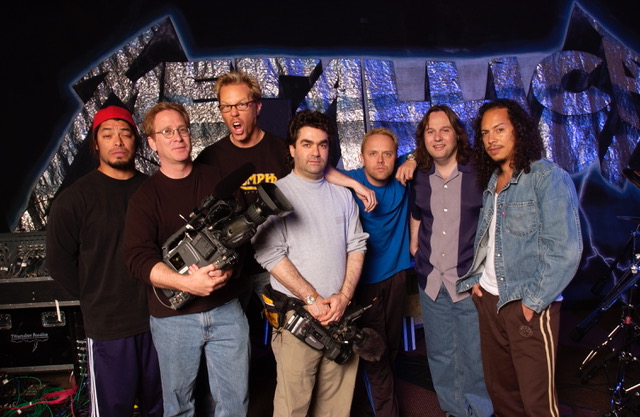
Members of Metallica and the film crew during the filming of “Some Kind of Monster.” From left to right: Robert Trujillo (bassist), Bob Richman, James Hetfield (lead singer & guitarist), Joe Berlinger, Lars Ulrich (drummer), Bruce Sinofsky and Kirk Hammett (lead guitarist). Photo by AnnaMaria DiSanto.
You deal with such complex human behaviors and difficult stories. How do you choose what stories you tell as a filmmaker?
It depends on the stage of my career, but for the most part, I find that the subjects choose me; I don’t choose them. Sometimes I’ll try to get a film off the ground, but something is just off. On a deeper level—and this is something I haven’t talked about a lot—I had a very difficult childhood with an abusive father. I view my career as a way to process the PTSD from my abusive childhood. The films that mean the most to me often present the exact lessons I need to learn at that specific moment in my life. For example, I lacked male camaraderie as a teen, and being with Metallica meant I was hanging out with a band of guys. Plus, being part of their therapy process on camera actually helped me process some of my own issues. The films that truly mean something to me are the ones where the doors just naturally open and the subject chooses me.
On a more structural level when selecting a film, I look for stories that have an inciting incident with the promise of unfolding action that will change over time, allowing you to mark the drama. A film about a thesis isn’t as compelling as following a trial with a clear beginning, middle and end.
Speaking of Metallica, let’s switch to “Some Kind of Monster.” How did you end up spending three years with the biggest heavy metal band in the world?
It started when we were editing “Paradise Lost,” a story of three teenagers who dressed in black, listened to Metallica and lived on the wrong side of town. They were accused of the devil-worshipping murders of three eight-year-old boys who were found gagged, bound and naked in a stream with terrible wounds on them. The prosecution alleged that the incident was a satanic ritual killing by these three teenagers.
We went down there thinking we were making a film about guilty teenagers because that’s what the press was reporting. But we became convinced that the boys were innocent. We never imagined the trial would actually end up convicting them because the whole thing seemed so farcical. Yet we sat through this murder trial where there was no forensic evidence to link them to the crime and no blood at the crime scene. The prosecution actually introduced into evidence the fact that they read Stephen King books, knew about Anton LaVey and listened to Metallica music! It was offensive on so many levels. Metallica lyrics have nothing to do with Satanism or devil worship, and since when does your musical taste define you as a killer?
I was not necessarily a Metallica fan when I made the film, but we fell completely in love with how their complex, multi-layered music worked with the scenes, so I decided to write a letter to their management company, explaining that heavy metal music was on trial just as much as these kids, and Metallica should be aware of it. I honestly expected it to go unanswered, but their manager, Cliff Burnstein, called me. It turned out he was a massive fan of my first film, “Brother’s Keeper.” After seeing a rough cut of “Paradise Lost,” the band, which had always refused to license their music, graciously let us use it for free. That incredible act of generosity sparked a lifelong friendship between us.
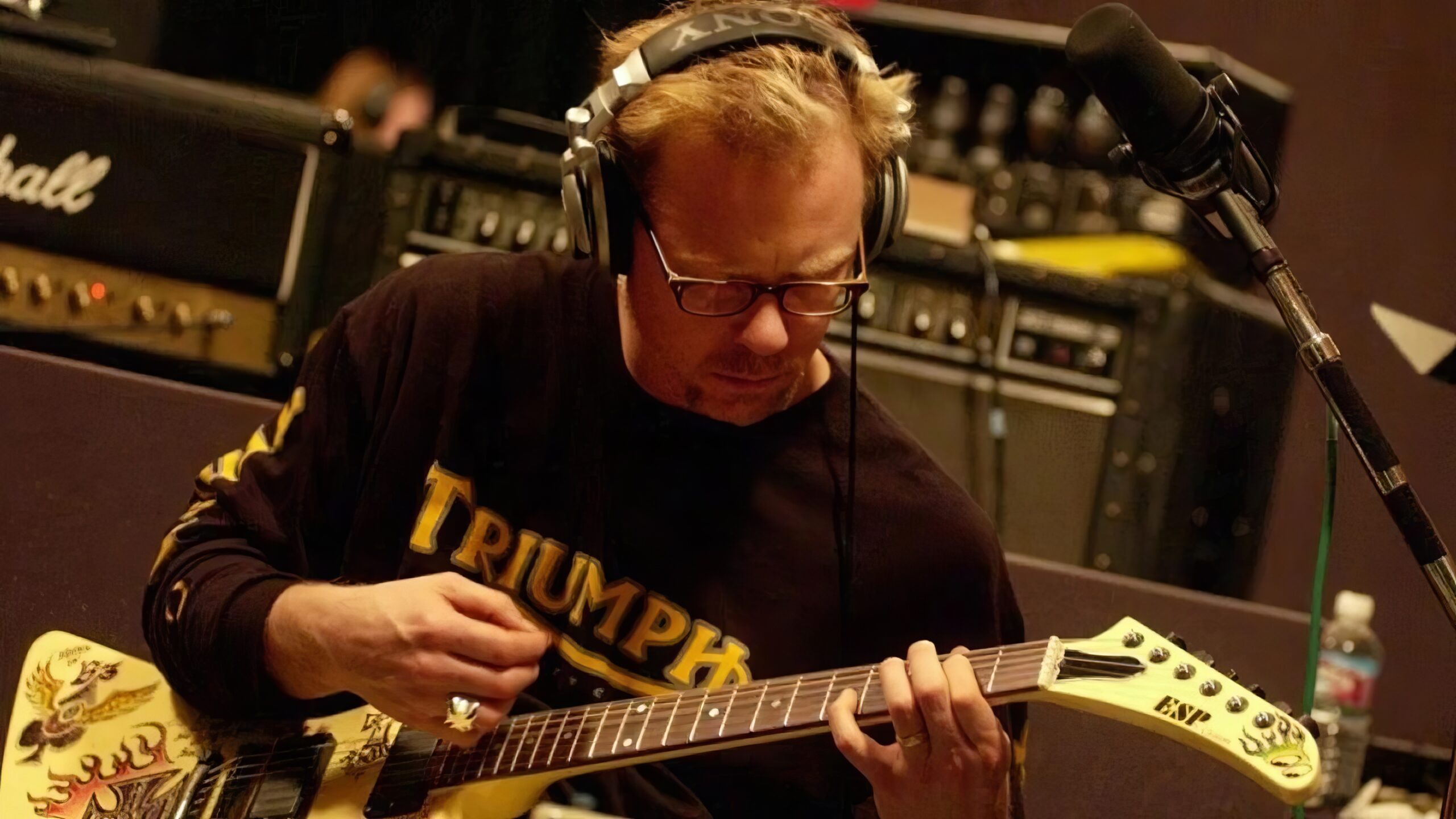
Lead singer & guitarist James Hetfield. Photo by AnnaMaria DiSanto.
So how did that friendship lead to a documentary about their near-collapse? I understand it was originally supposed to just be a short promotional video?
Exactly. Fast-forward a few years, and they were getting ready to record their eighth studio album. Digital downloading was just becoming a threat to the industry, so they asked me to shoot some simple B-roll of them going into the studio. They wanted to include it as a bonus on the physical CD to encourage people to buy the album. I agreed and flew in. I called Lars when I landed and said, “Well, I am here with my crew. When do we start?” And he said, “Oh man, I forgot you were coming. Jason (the bassist) just quit the band. James and I aren’t getting along. The management has hired a shrink, and I don’t think there is a record happening. Sorry, dude.” So I thought, “The management hired a shrink? This needs to be filmed, this heavy metal therapy.” And I convinced them to let me film that first therapy session.
That pivot is incredible. What was that like for you?
It was a profoundly healing experience. I had just come off a critical failure, “Blair Witch 2.” I had lost control of the film, and the studio recut it in ways that I didn’t recognize as my film. Thankfully, the film was still a business success, grossing $50 million worldwide and $25 million on DVD sales when it only cost $10 million to make, but the reviews were terrible, and I was being blamed for them.
Plus, I just had a messy breakup with my long-time filmmaking partner, Bruce Sinofsky. Filming these absolute icons of male testosterone opening up in a Ritz-Carlton suite made me realize I needed to hear their lessons.
I called Bruce, invited him to come out and co-direct, and we used the process to heal our own fractured relationship. At night, we would go back to our hotel rooms and talk about our own relationship. It was a very magical film because, one, it was never intended to happen; these guys were very brave to let us film it. And two, it allowed me to heal my relationship with Bruce.
I read that Lars believed your cameras enabled their therapy because it forced them to be honest. As a documentarian, how did you balance being an objective observer with the knowledge that your presence was actively shifting the group’s psychology?
Up until that point, I always thought that the role of the documentarian was to observe and not to change the outcome, and that generally should be the case. But I realized that sometimes the presence of the camera does change how people act. And as long as you’re still capturing a reality, that’s okay.
At some point in the process, Lars pulled me aside and said the guys trusted us and liked that we were observing them. They felt that if the cameras hadn’t been there, they probably would have clammed up and not talked, and the therapy wouldn’t have worked. But somehow, the presence of the cameras allowed them to talk to each other because they did so through the cameras. So the act of filming was actually an essential part of the therapy for them.
I think one of the beautiful things about the film is that, whether you like Metallica or not, this was the moment when a very famous group of musicians was going to either fall apart and we’d never hear of Metallica again or continue in a healthy way. They were shackled by the image of sex, drugs and rock and roll, but now they were becoming family guys; they were getting older and wanted to perform but did not want to live that self-destructive ethos. And for them to bravely confront it, I thought, was incredibly powerful.
Tell me about what happened when the record label pushed back and wanted to take the film in a different direction.
Elektra Records was originally footing the bill for the film, and during a break in filming while James was in rehab, the label executives wanted to pivot. MTV’s “The Osbournes” had just become a huge hit, and Elektra wanted to hire additional editors to turn our footage into a reality show. I thought it was a terrible idea, so I said, “That would be a horrible mistake. It will look like filming therapy was a premeditated television concept rather than what’s beautiful about this film: it was never meant to be. It’s happening organically, and we don’t want to end the filming to fit a production schedule. The filming should take as long as it needs to take.”
Was it really that simple?
No. Elektra kept pressuring us, so I went to the band and said, “Look, I think your record label is going to ruin your image. The idea that we’re going to quickly jam this into a TV show will make it look like you invited people to film therapy for an MTV television show, instead of it being a more thoughtful movie that takes its time and ends when it should end. This will be terrible for you guys.”
They agreed and gave Elektra a check for $1.2 million, which is how much had been spent up until that point, and they told Elektra they were no longer involved. But it then put us in a very odd philosophical and ethical dilemma: now the subjects of our film were paying for it. We made it clear to Metallica that we could only make this film if we had the final cut. They agreed to that, but the truth is, it’s their music. So, technically speaking, if they said they hated the film and refused to license their music, then we couldn’t use it. And, in this case, that would destroy the film.
Thankfully, they gave you permission. What was the overall reaction to the film? Was it well-received?
I would say ten percent of Metallica fans were like, “Oh, these pussies. I don’t want to hear these pussies whining.” But most of the fans were like, “Wow!” I can’t tell you how many people have said to me over the years and at those screenings, “You know, I used to drink heavily, too. I am struggling with my drinking problem. But if James can struggle with his and try to resolve it, then I am going to resolve mine too.” I’ve always said the fans who dismissed this film weren’t truly fans. If you can’t watch your heroes go from eighteen to forty and grow and change and still make really aggressive, great music, then you are not a fan.
But what was beautiful about the film is so many people who weren’t Metallica fans have embraced the film because it’s really about creative and existential crises, as well as the challenges that occur in relationships. This became the moment where Metallica would go on forever. And now, at shows, you see three generations of Metallica fans: father, son and grandson.
The other thing that’s been incredible is that so many well-known musicians—Eddie Vedder, Lenny Kravitz, Dave Grohl, Paul Simon, Dave Navarro—have come up to me over the years and said, “You have no idea what that film did. It allowed us to kind of heal wounds that were open and have healthy conversations about addiction and collaboration and relationships.”
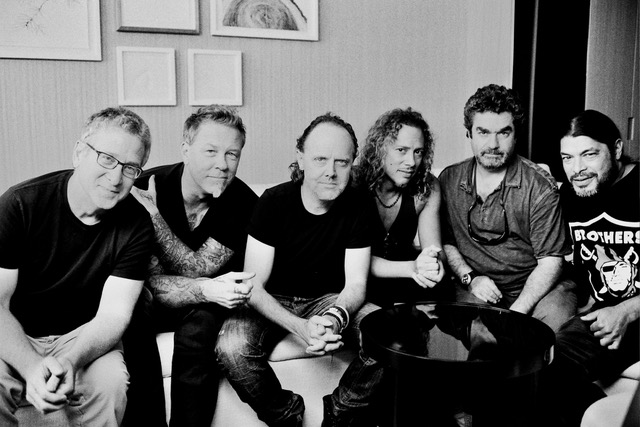
During the follow-up film 10 years later. From left to right: Bob Richman, James Hetfield, Lars Ulrich, Kirk Hammett, and Robert Trujillo. Photo courtesy of Third Eye Motion Picture Company.
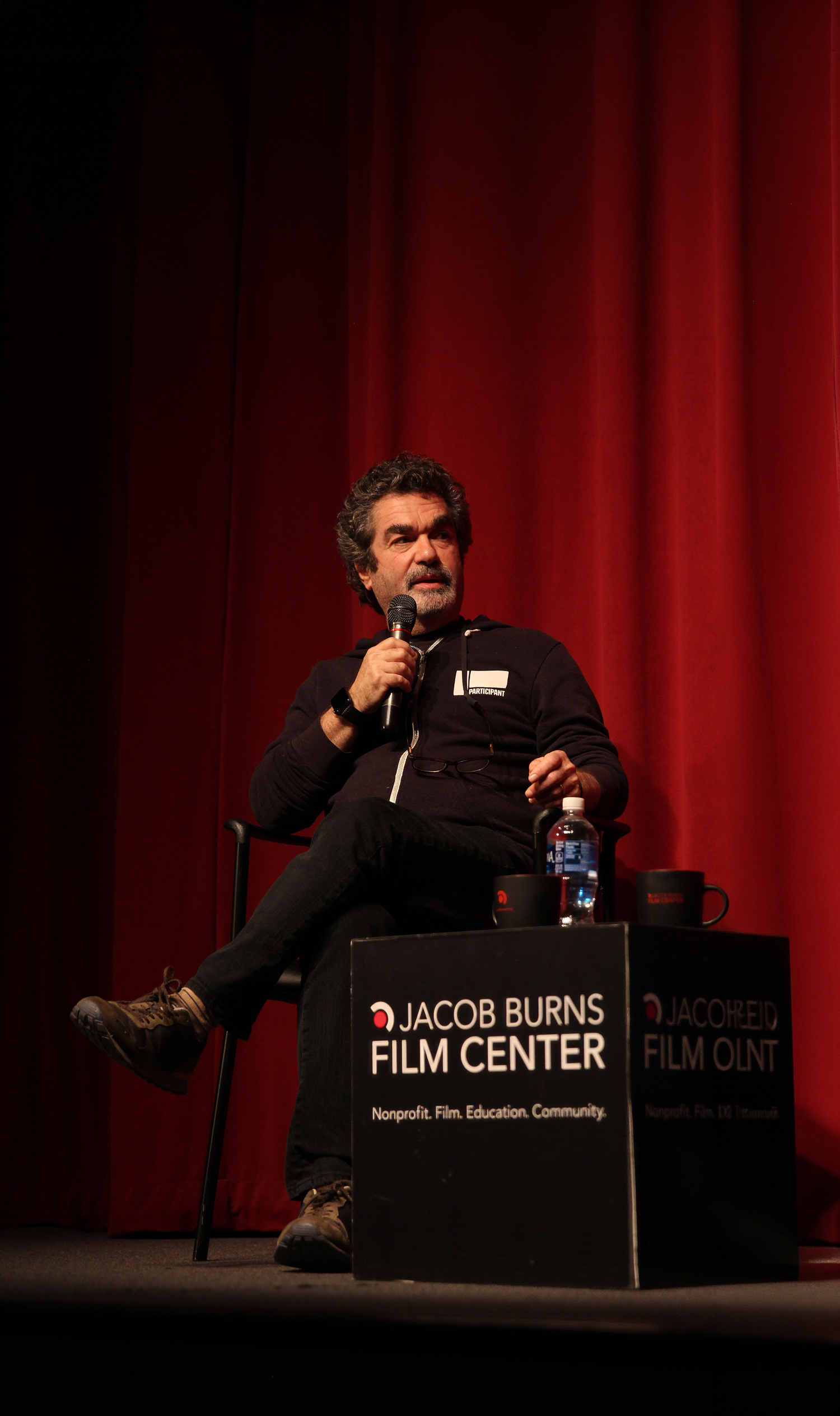
As part of Jacob Burns Film Center’s Sounds of Summer series, Berlinger will show his personal 35 mm print of “Some Kind of Monster” on July 2 at 7 p.m. There will be a Q&A with Berlinger after the film, followed by a reception upstairs at Take 3 Wine Bar & Café. The film series will run through September 6.
This article was edited by Julie Schwietert Collazo and fact-checked by Isabella Aranda Garcia. Featured image courtesy of Jacob Burns Film Center.
This article was published in the July/August 2026 edition of Connect to Northern Westchester.

Gia Miller is an award-winning journalist and the editor-in-chief/co-publisher of Connect to Northern Westchester. She has a magazine journalism degree (yes, that's a real thing) from the University of Georgia and has written for countless national publications, ranging from SELF to The Washington Post. Gia desperately wishes schools still taught grammar. Also, she wants everyone to know they can delete the word "that" from about 90% of their sentences, and there's no such thing as "first annual." When she's not running her media empire, Gia enjoys spending quality time with friends and family, laughing at her crazy dog and listening to a good podcast. She thanks multiple alarms, fermented grapes and her amazing husband for helping her get through each day. Her love languages are food and humor.