
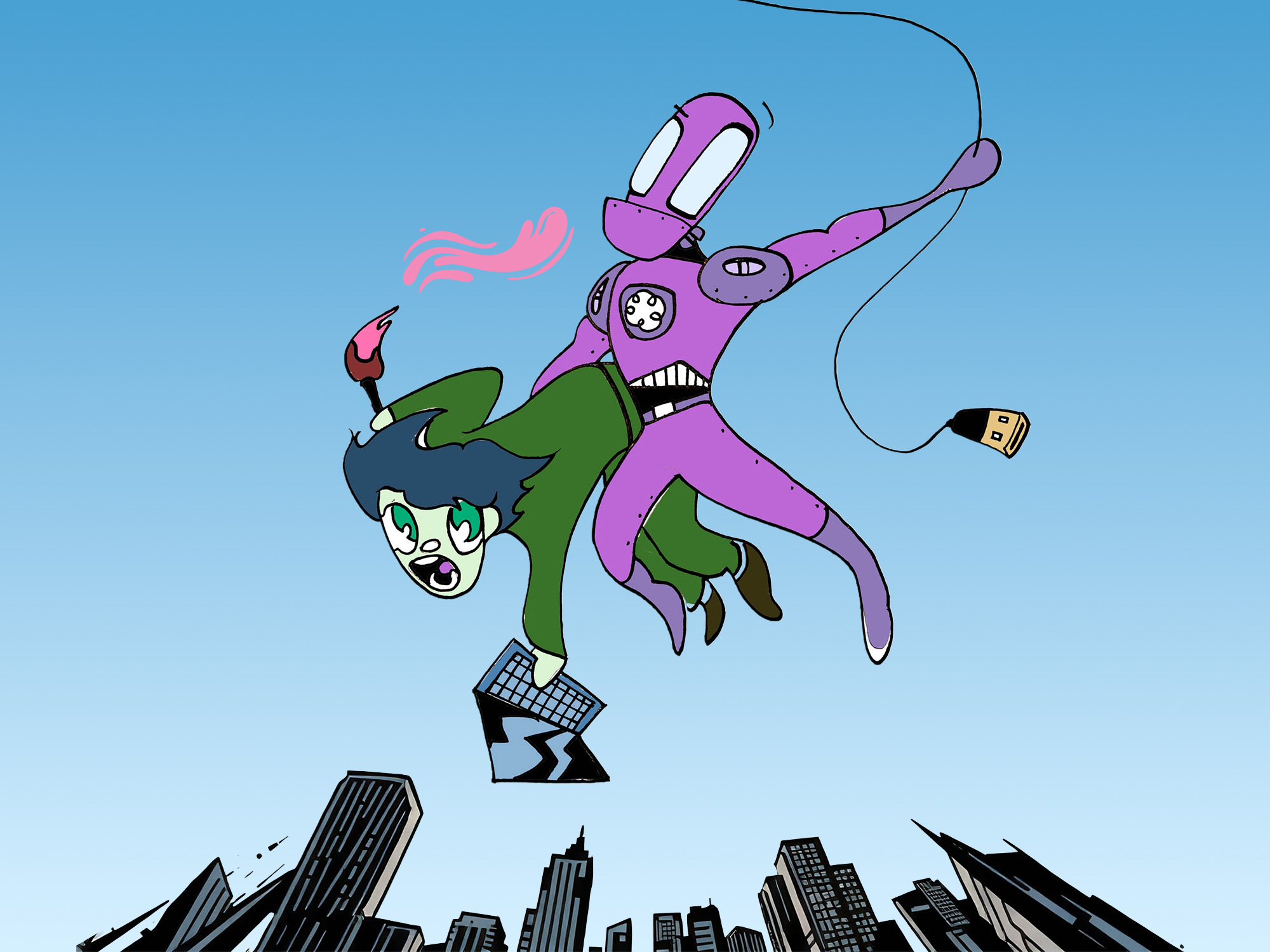
A Marvel Comics writer who journeyed into the world of AI production and a games professor who studies the ethics of the medium are teaching themselves, and their students, exactly which parts of the work can be handed to a machine and which parts cannot.
By Liz Colombini
Artwork by Justin Negard
Generative AI has moved from novelty to fixture in nearly every creative industry since ChatGPT went public in 2022, and the numbers now tell a story sharply at odds with the marketing. Adobe’s October 2025 Creators’ Toolkit Report, a global survey of 16,000 creators conducted in conjunction with the Harris Poll, indicated that 86 percent of respondents are now actively using creative generative AI, most often to polish existing work, generate new assets or brainstorm, not to replace their own creative decisions. A follow-up Adobe report this June that focused specifically on working creative professionals in the U.S. and U.K. indicated that the same tools are used differently when a paycheck is attached: 84.8 percent of U.S. creative pros still feel positive about AI overall, but nearly half, 46.2 percent, also call it a threat to their profession. As one brand designer told Adobe’s researchers, plenty of her peers are still dismissed as “very anti-AI” for resisting the shift, even as she argues the writing’s on the wall. Others describe using AI almost defensively as an originality check: One creative director explained that his team runs client briefs through AI first, and if the tool comes up with any of their ideas, they start over because they theorize that if a machine could think of it, it wasn’t original enough to begin with.
According to the Game Developers Conference’s (GDC) 2026 State of the Game Industry report, more than a third of surveyed game professionals personally use generative AI in some part of their work, most often for research and brainstorming (81 percent) or code assistance (47 percent). Toonstar, an AI-first animation studio HarperCollins recently hired to adapt a children’s book series into digital shows, told The New York Times last year that by leaning into AI, it could produce full episodes “80 percent faster and 90 percent cheaper than industry norms.” Yet, in the same GDC survey, 52 percent of game workers said they believe generative AI is having a negative impact on their industry, up from 18 percent two years earlier.
The workers most opposed—visual and technical artists at 64 percent—are the same ones being cut at the highest rates. Industry trackers put total gaming sector job losses at roughly 45,000 between 2022 and mid-2025, and layoffs continued into 2026. On July 6, Microsoft announced it was cutting 4,800 jobs—2.1 percent of its workforce—with about a fifth of Xbox employees among them, roughly 3,200 in total. Microsoft’s chief people officer, Amy Coleman, told employees that AI was not directly replacing anyone, but that “AI is changing how work gets done. Some of the tasks we do every day can now be automated.” It was the company’s second major round of gaming cuts in a year. A 2025 wave eliminated 9,000 jobs.
Audiences are drawing a similar line, often more ruthlessly than any professional code of ethics would. An August 2025 Goldman Sachs consumer survey found 54 percent of Gen Z respondents wanted no AI involvement in creative work, even though only 13 percent felt that way about AI in shopping. A Harris Poll conducted this summer reported that 73 percent of consumers said they would be less likely to trust an ad they suspected was made with AI. And when Activision quietly used generative AI to produce cosmetic items and background art for its Call of Duty game, which costs $15, it created a backlash among both players and creatives who raised concerns about the threat to jobs and intellectual property rights in the gaming community.
The industry’s own guardrails have started to codify the same distinction. The Writers Guild of America’s 2023 strike settlement permitted individual writers to use AI as an assistive tool but barred them from crediting AI as a writer or using AI-generated material to displace a human writer’s job. The New York Times’ updated 2026 freelance policy went further, barring contributors from submitting any AI-generated text or images at all. The line varies by shop, but the message is remarkably consistent: assist, do not originate; credit humans, never the machine.
What a surprising number of creative professionals seem to have arrived at is that artificial intelligence is extremely good at making some things and often incapable of the rest of it. And the whole professional skill of this moment is learning, quickly and specifically, where that boundary falls in one’s own practice. To understand how working creators are actually drawing that line, we spoke with two local creatives who have thought hard about the question, arriving at nearly identical conclusions from opposite directions.
The writer
Yorktown Heights resident Ben Earl, a writer, producer and IP developer who spent nearly a decade writing for Marvel Comics, received early developer access to OpenAI’s models in late 2020 while trying to solve a continuity problem in a Spider-Man pitch: too many decades of stories, too much canon, no good way to keep it all straight in his head. He emailed OpenAI cold. “I’m a Marvel writer,” Earl told them, “and I’m working on a new pitch for a Spider-Man story.” The engineer who wrote back just happened to be reading one of his comics at the time and was a fan. Suffice it to say, Earl and his team were given developer access to OpenAI’s early LLM models. These were the days before ChatGPT, and Earl describes the period as “the Wild West of AI.”
He now splits his work between Lore Machine and Weirdbunch. The latter is a production studio he founded in Riyadh, Saudi Arabia, where he is turning a graphic novel that their studio financed into an AI-assisted trailer using an artist’s original comic book art and panels as training material. While the former is a text-to-comic story visualization platform he considers “one of the best novel-intelligent storytelling formats for IP incubation he has worked with,” he sits on the core creative team, working directly with the founder to build the system, prove it out and stress-test what it can do. Earl talks the way one would expect a comic book lifer who spent years tinkering with artificial intelligence to talk: fast, unfiltered and prone to riffs about Pixar versus Disney.
Earl knows where his own line falls because he tested it early in a recent project he now describes with something between amusement and relief. He recently released an original series called “Bad Dragons” using Lore Machine; this project was, in part, designed to really push the platform. Originally, his goal was to fully automate his scene prompting through Claude. Even a few years ago, Earl points out, this kind of solo project couldn’t have existed; it would have required a small team to create something he could share with a test audience. Today, Lore Machine lets him move from a written scene to a fully rendered visual in minutes, iterating on tone and pacing in real-time.
The tedious part, he says, is writing out “prompt gens” (a.k.a. prompt generations), very specific instructions for an AI, which, in Earl’s case, is Lore Machine. The platform requires detailed block-by-block scene descriptions to create the proper visuals. Earl estimated he would need approximately 300 initial prompt gens, so his plan was to be efficient. He would use Claude to batch generate prompts, break out visuals for an entire episode in an afternoon, and then focus on writing. “I figured I could chunk out a massive amount of prompt gens, plug them in, and iterate an entire series from start to finish in a very short amount of time,” he says. It didn’t work the way he hoped. “I realized that the prompts Claude gave me more or less sucked,” he chuckles. The AI could not visualize a story that was, in his words, “fun, engaging and interesting” and, more to the point, in his style and tone. After a few failed tests, he threw the automation idea away and went back to writing it himself, one prompt at a time, the slow way.
The professor
Karen “Kat” Schrier, Ed.D., professor and founding director of the Games and Emerging Media Program at Marist University, arrived at nearly the same place from the opposite direction. Where Earl has spent five years inside the machinery, Schrier studies what it does to the people using it. She consults for UNICEF on child safety in games and for the World Health Organization on training simulations for health workers. One of the classes she teaches at Marist is called Ethics of Gaming, where one of the topics students debate is exactly the question Earl resolved for himself in one afternoon: How much of the making can you hand over before it stops being yours?
Their vocabularies barely overlap. Earl talks about an obsessive focus on shot-by-shot precision and Pinterest boards. Schrier talks about “human curation” and “trust and safety.” But the shape of what they’re both describing is identical. Used one way, AI clears space for a person to do their best work. Used another way, it quietly replaces the creator and the whole point of doing the work in the first place.
Where AI earns its keep
There are plenty of examples where AI is a useful complement to the work, not a substitute for it. Earl describes his own version of it as “text in, comic out,” taking a script that exists only as words and quickly turning it into something a room full of executives can actually see because, in his experience, “Hollywood doesn’t like to read.”
He used to do this with Pinterest boards, pulling together other people’s art to pitch a show. AI tools do the same job faster and closer to what’s actually in his head. He also uses programs like Midjourney to help create pitch decks to illustrate and communicate ideas. He is fond of a system called Brimstone AI, which builds mind maps out of massive bodies of text, highlighting both macro and micro details, ranging from what issues specific characters appear in to every time a particular magical spell is used; it’s the kind of continuity tracking he wished he’d had when he was developing the pitch for Spider-Man that prompted him to reach out to OpenAI.
“You can map it,” he says, “and visually see that there are 500 interactions between two characters over the past 20 years.” For Earl, this is not a creative act. It is closer to what a good research assistant does, and it’s the kind of continuity work that an independent creator developing a project on spec would never have had access to before.
Schrier’s version of the same thing shows up on the visual side of game design, where a designer who can’t draw might describe a scene, generate a few rough AI renderings of a background or a color palette, and hand the result to an actual illustrator as a starting point. “Here’s a sketch from my brain,” is how she puts it, “just to start the conversation.” The AI output isn’t art in that scenario. It functions more like a translation device between two people who don’t yet share a visual vocabulary, and the artist still does the actual rendering. She also uses it for what she calls “busywork,” like listing game design tools that are available, something she describes as “almost like a deeper search” that gets her “from point A to point B” faster, without replacing her own judgment on what’s actually useful.
Why the line falls where it does
Where Earl and Schrier get specific, and interesting, is on the question of why the line falls where it does. Earl’s answer is essentially existential. An AI system, he argues, cannot originate anything, because origination requires having lived, and it hasn’t. “It doesn’t know what love is,” he says. “It only knows what love is by reading. It’s never had a heartbreak.” He compares outsourcing your own sentences to hiring someone to go to the gym on your behalf. “The surrogate gets fit, not you,” he jokes. His writing, he says, has a cadence, a rhythm he can recognize on the page as his own, and it is precisely that quality, the thing that makes his sentences sound like nobody else’s, that dissolves the moment the sentence is generated rather than written.
Schrier’s version of the boundary comes out of watching several years’ worth of student projects. She says it’s fine to use AI when you’re stuck with writer’s block and when an exam asks you to use it to revise and argue with it, but it’s not fine to let it replace what she calls human curation or the accumulated judgment calls about whether a thing is actually good. “The best games are ones made about your own personal experience,” she says, “from your own perspective, and AI doesn’t live, right?” But letting someone, or something, else do the work for you isn’t new. Schrier says that years before generative AI existed, students handed in what was supposed to be an original game for an assignment, but she’d receive projects that were, for example, a re-skinned game of Monopoly.
What’s actually yours
What neither Earl nor Schrier expected, but both brought up unprompted, is that audiences are enforcing the boundary described in the previously mentioned survey data on their own, sometimes more sharply than any professional guideline would. Schrier has been tracking this in AI chatbots used in an educational game and audience reactions within the competitive gaming communities. The reaction, she says, is close to universal: the moment players sense AI in the expressive parts of a game, such as the writing, the art or the music, their trust in the whole product collapses. “If players even sniff a little bit that a game used AI,” she says, “they don’t want to play it anymore.” She has watched this up close with her own 13-year-old daughter, an anime-obsessed young artist who draws her own art and wants nothing to do with anything AI-touched in the media she consumes. “She wants to feel like a human is expressing themselves through a game,” Schrier says, “and not an AI generating it.”
Interestingly, this instinct isn’t a blanket objection to the technology. It’s calibrated to where the technology touched the work. Schrier thinks AI used for accessibility, like a generated script for text-to-speech, is more forgiving because it doesn’t touch anything anyone is there to feel. But writing, art or storytelling that reads as machine-made gets rejected outright, and fast. “There’s no one set formula,” she explains, because the answer changes project by project.
Ownership, for both of them, turns out to be less a legal question than a practical one. Earl is unsentimental about the copyright status of anything an AI generates along the way. In his view, it was never his to begin with, and a professional project will eventually need to replace any AI-assisted asset with something commissioned and original. “Make sure that your story is yours,” he says, “and it wasn’t something that was generated from a bunch of prompts.” The AI-generated pieces are scaffolding, and in this framing, they are disposable by design. Schrier is more permissive about early use as long as it’s used ethically and doesn’t replace the creative process. She frames it explicitly as training wheels. “You might start with the training wheels of AI,” she says, “but then slowly take them off so that you can make your own stuff for the public.”
The future of AI
Neither expert treats layoff numbers as an abstract debate. Schrier’s reading of the cause is blunt: companies overestimate how much of the creative work AI can actually manage, and the workers who remain absorb the shortfall. “It’s not going to be the same caliber, in the same way,” she says. She points out, too, that sentiment data now runs sharply against management’s bet: on the GDC survey, the share of gaming workers who believe generative AI has a negative effect on their industry has nearly tripled in two years.
Earl sees a version of the same pattern stretching back decades in animation; through each wave of technology that quietly shifted departments, the in-betweeners who used to hand-paint every frame between one pose and the next were replaced by software that used the keyframe to do the “tweening.” As technology becomes more accessible and AI is integrated into free tools like Unreal Engine and Blender through Claude via its Python API, along with AI-native platforms such as Lore Machine, independent creators have the kind of production capacity that used to belong exclusively to studios. “This is a time for a lot of entrepreneurs to create their stories and get them to an audience much more quickly than any studio could,” he says. “That’s the greatest upside in this current creator economy.”
How to use it without losing it
Earl’s and Schrier’s practical advice is almost identical: Use the tool to storyboard, not to write the ending. Use it to generate 50 backgrounds before an artist paints the one that’s right. Use it to map a fictional universe, not to decide what happens in it. Use it to get past a blank page, never to fill the page.
The professionals doing this well aren’t the ones who’ve found more to hand off. They’re the ones who can, say, specifically and without hedging, what has to stay theirs. Schrier’s own framing extends easily beyond games. A painter could use AI to test a palette or composition before touching canvas. A ceramicist could use it to explore glaze combinations or study proportions before ever touching clay. The tool sketches the possibility space, but the hands still do the work.
Earl puts it best, describing what he looks for in any tool, not just AI. “It needs to constantly inspire you,” he says. “I think that’s the goal. And you should be playing. It should be fun and it should be creative. When you’re playing, you’re going to get your best work.
This article was edited by Julie Schwietert Collazo and fact-checked by Isabella Aranda Garcia. The artist used Adobe Creative Suite.
This article was published in the September/October 2026 edition of Connect to Northern Westchester.

Liz Colombini
Based in Yorktown Heights, Liz lives in the mountains with her partner, two kids, a few black cats and her dog Delta, who likes to herd their small flock of chickens. A self-proclaimed news junkie, she’s passionate about gardening, fitness and collecting tattoos, with each one telling its own story.

Justin is an award-winning designer and photographer. He was the owner and creative director at Future Boy Design, producing work for clients such as National Parks Service, Vintage Cinemas, The Tarrytown Music Hall, and others. His work has appeared in Bloomberg TV, South by Southwest (SXSW), Edible Magazine, Westchester Magazine, Refinery 29, the Art Directors Club, AIGA and more.
Justin is a two-time winner of the International Design Awards, American Photography and Latin America Fotografia. Vice News has called Justin Negard as “one of the best artists working today.”
He is the author of two books, On Design, which discusses principles and the business of design, and Bogotà which is a photographic journey through the Colombian capital.
Additionally, Justin has served as Creative Director at CityMouse Inc., an NYC-based design firm which provides accessible design for people with disabilities, and has been awarded by the City of New York, MIT Media Lab and South By Southwest.
He lives in Katonah with his wonderfully patient wife, son and daughter.