
By Anastasia Mills Healy
Photography by Justin Negard
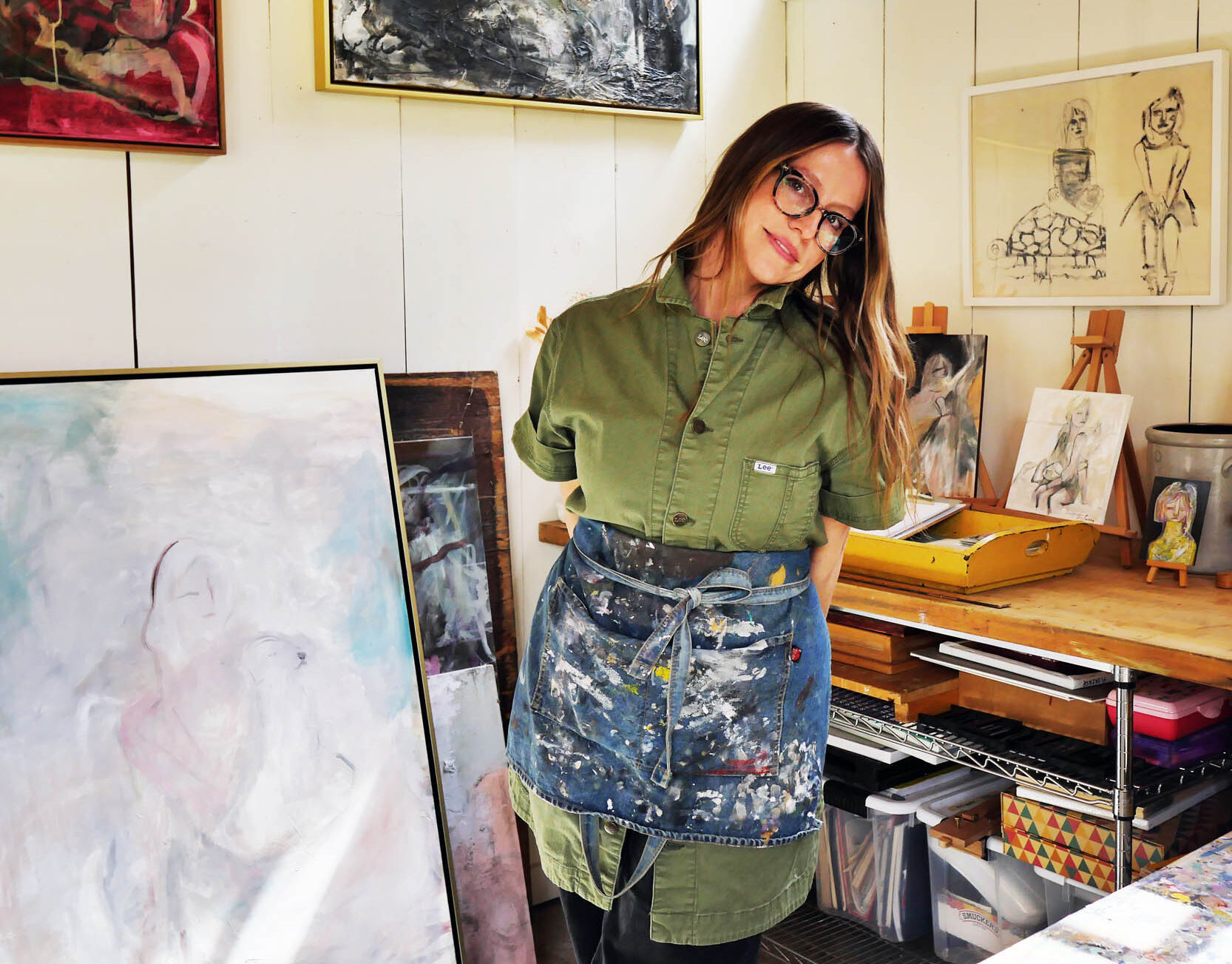
“I think my spirit animal would be a bird,” Megan Cedro tells me as we sit in her Bedford studio surrounded by her art—mostly paintings of women and animals. “I’ve got a birdlike tendency to me. And I’ve still, to this day, not figured out if I’m more canine or feline, which is something that I think about all the time. I guess I could be a fox because foxes are both. So, I’m kind of like a fox-bird.”
Animals often appear in Cedro’s work—dogs, cats, lizards and a lot of birds. In a series of illustrations she titled “The Women of the Wilderness,” one features a woman flanked by profiles of herons. “I love long-legged birds like cranes, egrets and herons,” Cedro says. “If there’s one around, I will not pay attention to anything else.” Another in that series depicts a woman balancing atop an alligator while holding her black dress in a curtsy style and wearing an armadillo curved around the top of her head. “I always loved fashion shoots with beautiful women surrounded by animals in magazines like Vogue,” Cedro notes.
Cedro has also painted a series of girls with bird legs, as well as birds like pigeons and crows. “I love the creatures that have a bad rap like pigeons and rats,” she says. “I will pick up a frog the second I see it. I really am an animal lover. I’m always looking for them.”
Cedro, who also fosters and boards dogs whenever she can, enjoys incorporating canines into her art. There’s a painting she calls “Mother Canine,” featuring a woman draped in a flowing cape with a pack of dogs at her feet, some looking up at her and some looking at the viewer in a protective stance. Like many of her human subjects, this character seems not of this time. “I like classic, timeless fashions so as not to put a date on things. I love collars and hats and clothes with puffy sleeves.” Yet although Cedro would like her subjects to be timeless, she subconsciously creates them “to be representative of me, my demographic and this time.”
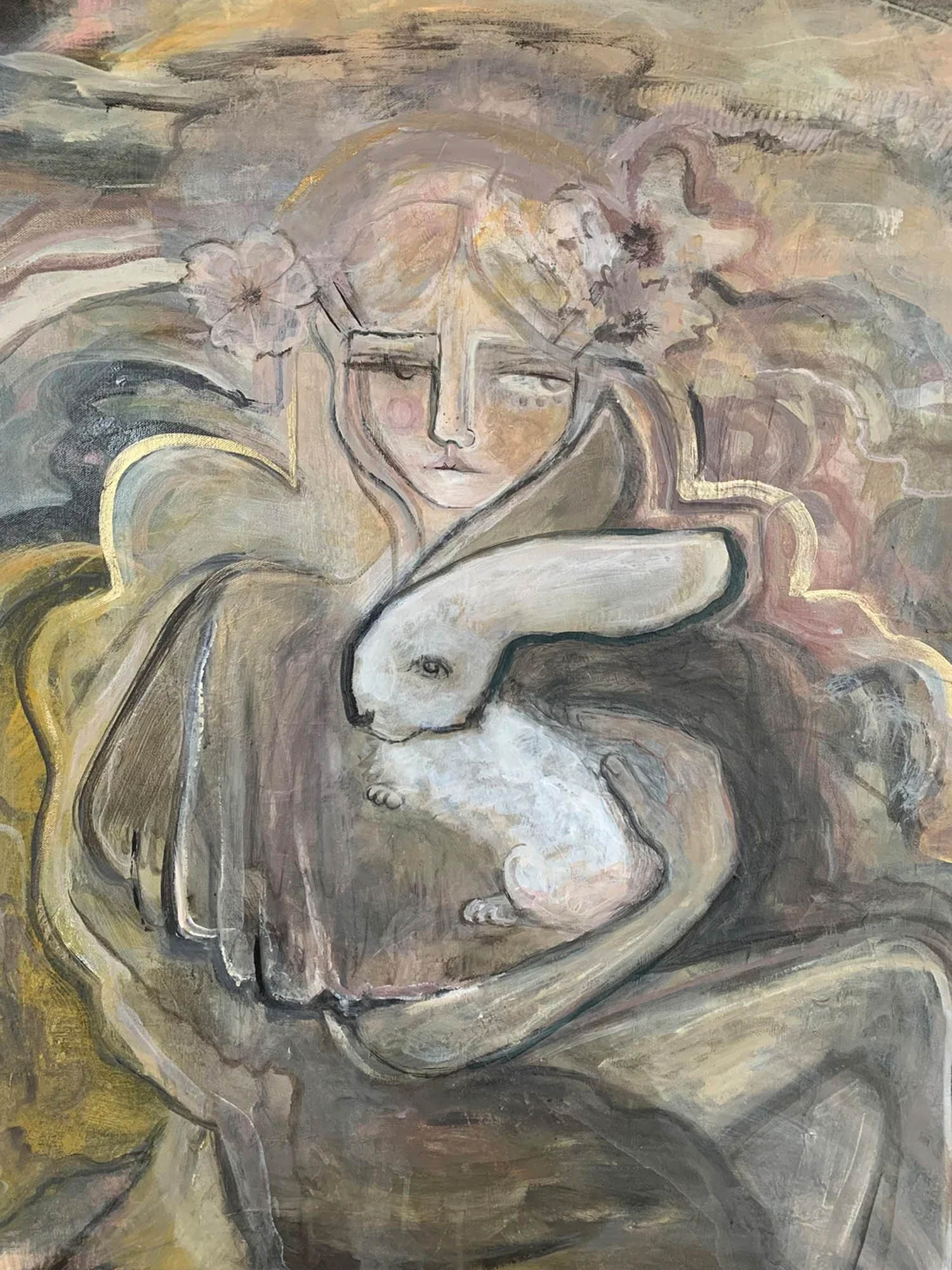
“Handle with Care,” acrylic, gouache and watercolor on canvas.
A creative detour (or two)
Cedro originally dreamed of making a name for herself in the fashion industry, earning a degree in fashion design at the Art Institute of Fort Lauderdale. “I always knew that I was going to do art in some way. I drew nonstop.” While in school, she concluded that the technical aspects of fashion, like construction and draping, were not appealing to her. So after graduation, Cedro moved to New York for a magazine internship at ELLEgirl. But Cedro dreamed of creating window displays for large department stores.
“One day, I walked into Macy’s Herald Square with my big portfolio,” she explains. “But they said, ‘Since you are creative and an artist, you should work at the MAC counter. So I started working as a makeup artist. We had these face charts, and I would turn mine into a character—I always drew my girls.” Soon, Cedro’s coworkers were asking for her drawings. “It was MAC who really pushed me into fine artistry,” she explains. “The top people gave me a lot of outlets to showcase my work. For example, one time, they hired me to be a featured artist at an event. Makeup artistry became my window into fine art.”
Cedro found a supportive, creative community at MAC. With the encouragement of colleagues, she found a studio space at Brooklyn Art Studios in Greenpoint, Brooklyn, and she began producing art. Cedro transitioned into working freelance jobs as a makeup artist and walking dogs so she could focus on her art full-time. In July 2010, Cedro had her first solo show at Yashar Gallery (part of the Brooklyn Art Studios space), featuring about 20 pieces of her work; it sold out.
The freedom to transform
Cedro describes her creative process as similar to how “a kid approaches art: experimenting, being creative, and trial and error. I need time. And I need boredom, and it’s hard when you’re a mom.”
She doesn’t sketch first, and she constantly paints over her paintings so they morph into something that’s often quite different. A caution to readers: If you are drawn to one of Cedro’s paintings on Instagram or in a gallery, don’t hesitate. “People will ask if a painting is still available,” she says. “Nope. It’s gone. It’s turned into something else.” Pointing to one canvas, she says, “It was two bird ladies at first with a Tuscan backdrop, which I named Ladybirds. Then it was a woman with a lizard over her head; I called it Lizard Lady. Now it’s a Renaissance-style woman, and it’s my favorite painting of all time, and I will never change it. I love it.” Then, referencing a different canvas, she explains, “That was a huge bunny, and then I recently changed it into my daughter. I really am just so free with the paint.”
“I don’t go into anything with a plan,” Cedro continues. “It’s all organic. I begin with a layer of paint color. Then I’ll start to see shapes. I’ll see a shoulder or a nose. That’s how I start all my pieces. Even with the works on paper, I’ll put some color down. I’ll see the form. My process is freedom, just total freedom.”
Once, the process even became a keepsake for the artwork’s owner. A collector commissioned Cedro to create two paintings for her foyer, providing Cedro with no direction other than that they should go together. “It was full creative trust,” says Cedro. “She showed me some of her favorite works of mine, and that was that. I worked on them for over six months, changing the canvases over and over, taking lots of pictures to share the process with her.” In the end, Cedro’s client mounted the progression in a single frame, which she keeps separately in her bedroom.
Currently, Cedro is trying to resist the urge to turn two paintings of flowers, which she’s had for four years, into anything else. “I’ve never been able to keep something abstract,” she says. “I’ll always see a face. I touched those up the other day. I added some lines, and I’m happier with them. I like it when I see artists do other things, like Picasso’s still-life paintings. So, I’m trying to leave them alone. I should have paintings that aren’t girls, but I can see the faces in this painting, so I try not to look.”
-
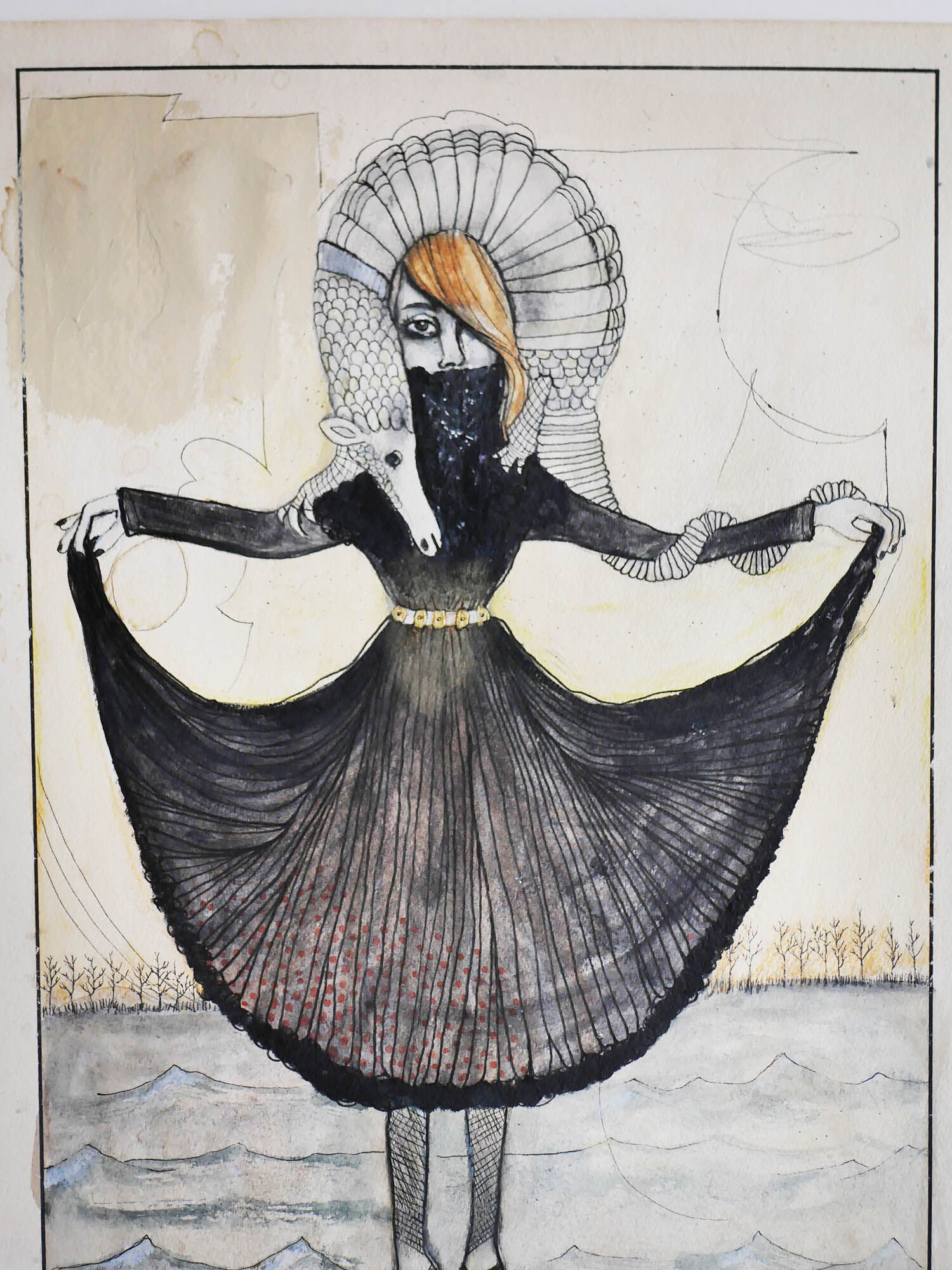
- “Armadillo Lady,” pen & ink.
-
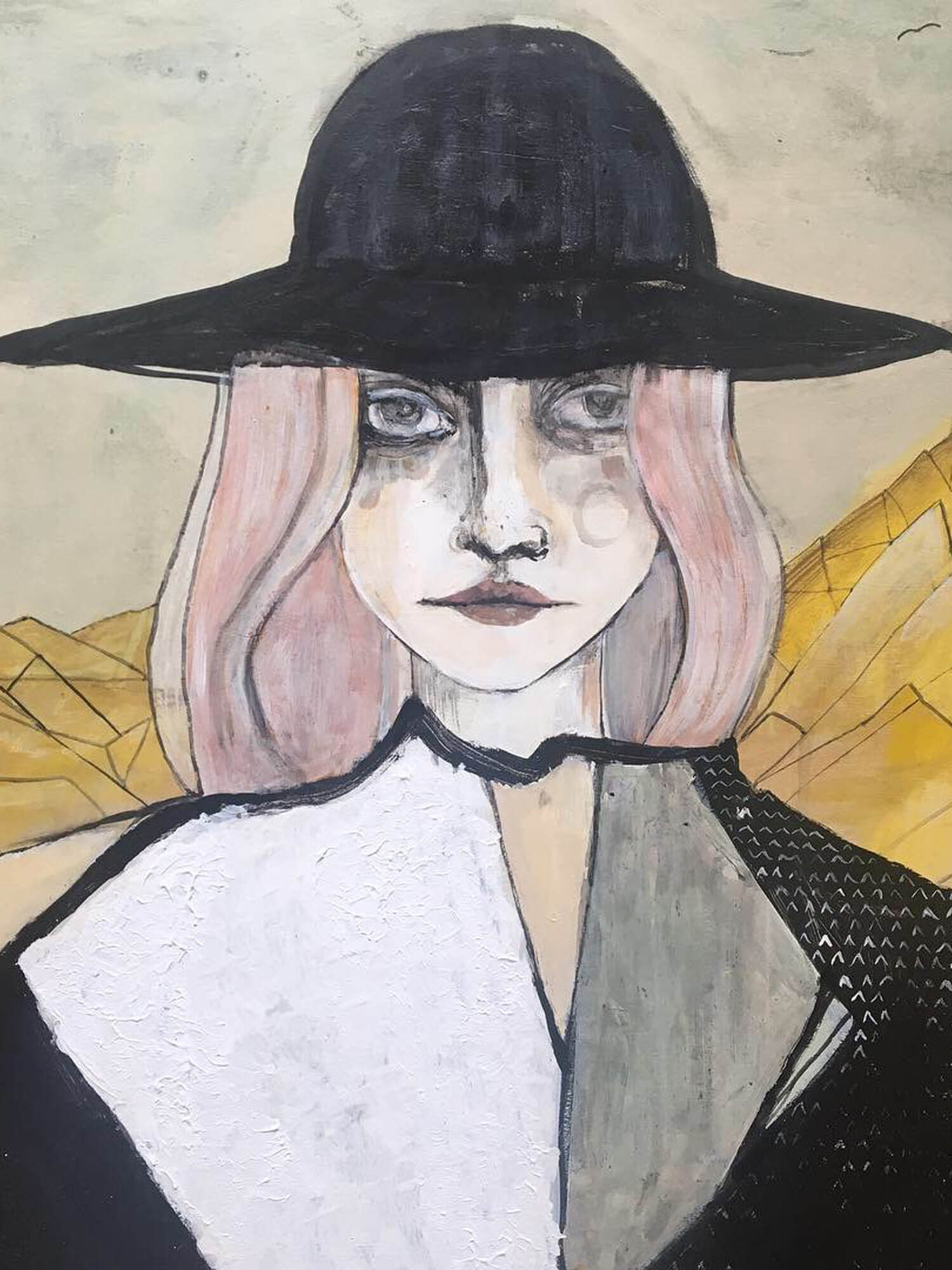
- “August Jane,” acrylic, gouache and ink.
As for materials, she prefers watered-down acrylics, gouache and watercolors, always aiming for the look of watercolor. “People use the word ‘ethereal’ a lot to describe my work,” she explains. “I like things looking kind of soft at some points.” But Cedro’s style has morphed over the years. Before she moved to Bedford, her paintings featured more color, and her style was more “expressive, almost cartoony; now it’s more muted.”
Now, Cedro is going in a new direction, aiming for a more abstract look that’s softer overall. “I love simple,” Cedro says, “but I have yet to be able to make these drawings big, with big, gorgeous lines. Whenever I try to hold onto an idea or make a sketch into a bigger painting, which I normally don’t do, they end up morphing into other things. For me, this just happens with scale and texture—it doesn’t translate well. So I’ll just paint over it and start something new, but with the old lines and shapes showing through. That allows the magic to happen. It starts coming together.”
When asked if she intentionally sets time aside to paint as a busy mother of two daughters, a substitute teacher, a dog foster parent, a dog sitter and occasionally helping her husband with his company, Bedford-based Mast Market and Mast Chocolate, she replies, “I paint when I can. I’ll go through moments when I’m really creative, really working, and I’ll go through six months of not doing too much. But I’ll always draw—I always have sketchbooks, and I draw, but painting comes and goes.”
Cedro says the previously mentioned “Mother Canine” took six months to finish, but “some can take six years because I’ll literally keep adding stuff. I think the shortest I’ll work on a painting is three to six months, and the longest could be ten years.”
Unless she has a deadline for an upcoming show, she works at her own pace. “I feel like I don’t have to force it. I get overly stimulated fast, and I tend not to want to push myself too much. It’s a sacred thing for me.”
Her muse wears many hats
Cedro draws inspiration from nature, fashion, beauty, music, folklore and experiences. Going to an art show always motivates her to get back in the studio. A recent excursion to see the Pablo Picasso exhibition, “Picasso Tete-a-Tete” at the Gagosian Gallery, left Cedro inspired by how he saw the world and developed his own style of art. “No one was doing what he was doing,” she says. “I came home really excited to think that my own work is very identifiable.” Early in her career, people often mentioned Austrian symbolist painter Gustav Klimt and Austrian expressionist painter Egon Schiele when viewing her work, and they are two artists she still admires today. But she’s also inspired by numerous other artists, including Claire Tabouret, Danielle McKinney and Peggy Kuiper. And she is quick to state that she loves all art, including landscapes and abstract work, which are different styles than her own.
Cedro also finds inspiration in folklore with unusual premises. “I love weird stories like a lady turning into a bird,” she says, segueing into a conversation about a piece she made in 2011 called “The Black Seals.” This 36” x 36” acrylic-on-canvas painting features three women on the beach in the foreground with what appears to be an 18th-century ship floating behind them. The painting gets its name from the women, who are seals from the waist down—a reference to a sailing trip she took that year from Cape Cod to the Dominican Republic on a 70-foot schooner called The Black Seal. But it’s inspired by the Celtic legends of creatures who shapeshift from humans to seals. “It’s a trippy piece,” she notes. “I was way more experimental with my work back then. It’s very cartoony and children’s book-like.”
Some of Cedro’s art is itself mystical. When I tell her that “August June,” a painting featuring a mysterious/brooding woman in a hat with gold mountains in the background, reminds me of the actresses Dakota and Elle Fanning, Cedro responds, “That’s so funny you say that. My girls remind me of them.” However, neither served as inspiration as Cedro began the piece during her first pregnancy and finished it during her second. The resemblance simply happened. Given the painting’s significance, it’s a work Cedro says she’ll never sell.
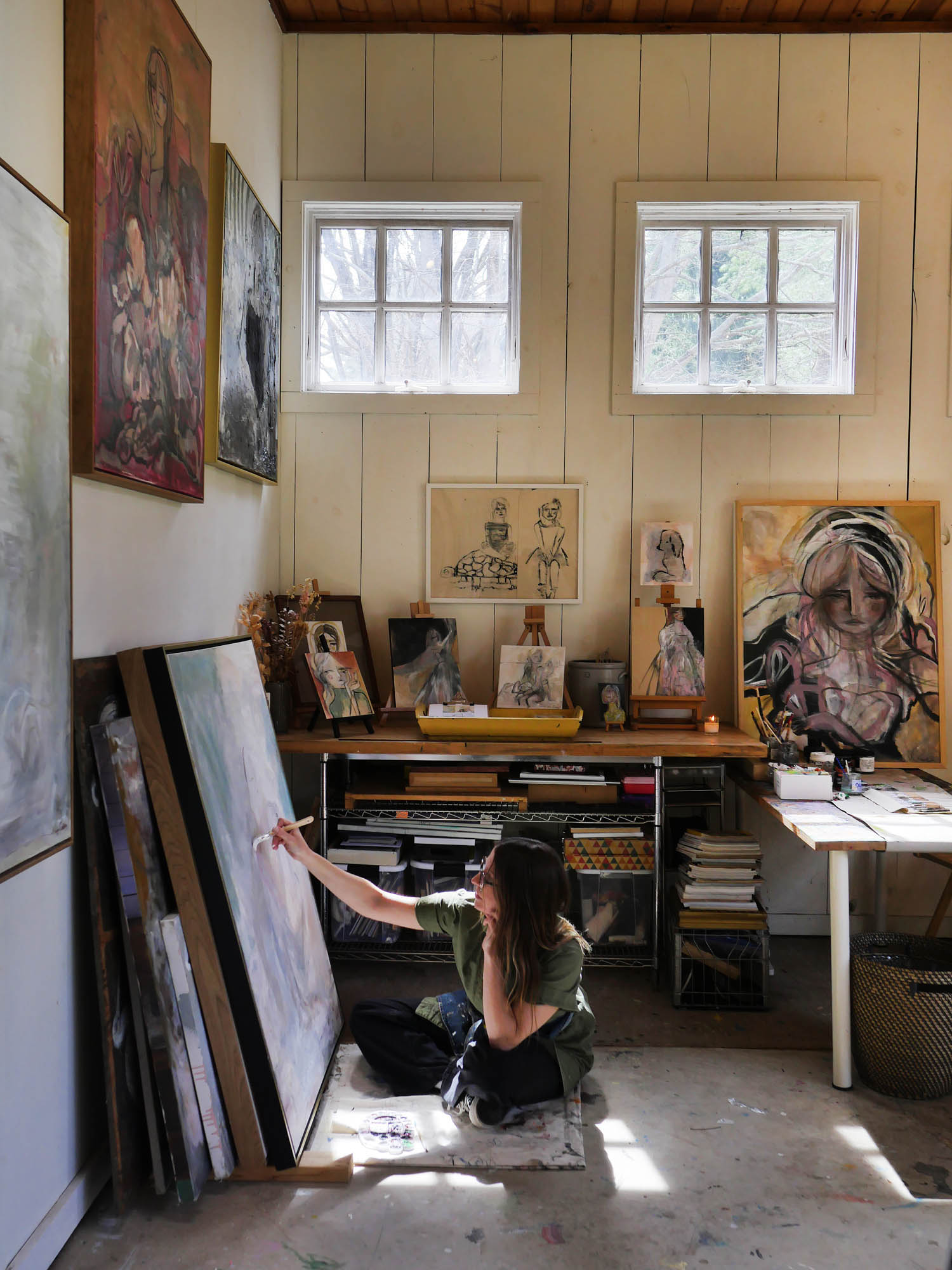
Cedro working from her home studio in Bedford.
Her village
When Cedro moved to Bedford in March 2017, she found a local support network at Yellow Studio in Cross River. This art gallery and community space for women has mounted two big shows for her. “It always feels so great to be around a big group of creative women. We’re so uplifting for one another.” Its founder, Tina Villaveces, as well as Chris Brescia, owner of CB Art Gallery, are two people “who really believed in me and pushed me,” she says.
Cedro also appreciates her mom friends. “They’re always looking out for me, collecting, and telling people about me.” One friend booked Cedro’s first Westchester show by going into the now-closed Nehapwa Design store in Pound Ridge and saying, “You should have some Megan Cedro paintings.” This type of promotion and word-of-mouth marketing is important for Cedro since, by admission, marketing is not her strong suit. “I’m not one to walk into places and promote myself. I would never. I’m just not like that.”
She is content with the move to Westchester, the life she has built here, and the expansion of her art business. “People out here have gorgeous, big homes, and they are buying art. They are collecting.”
However, it’s hard for Cedro to part with her paintings. She makes all of her favorites into postcards so she can remember them. “They’re all gone—my babies—out into the world,” she says. Cedro hopes they may eventually be reunited, although perhaps not in her lifetime. “I hope that maybe one day someone like my daughters or granddaughters will discover their love of my art and collect them. I would like them to be reunited.”
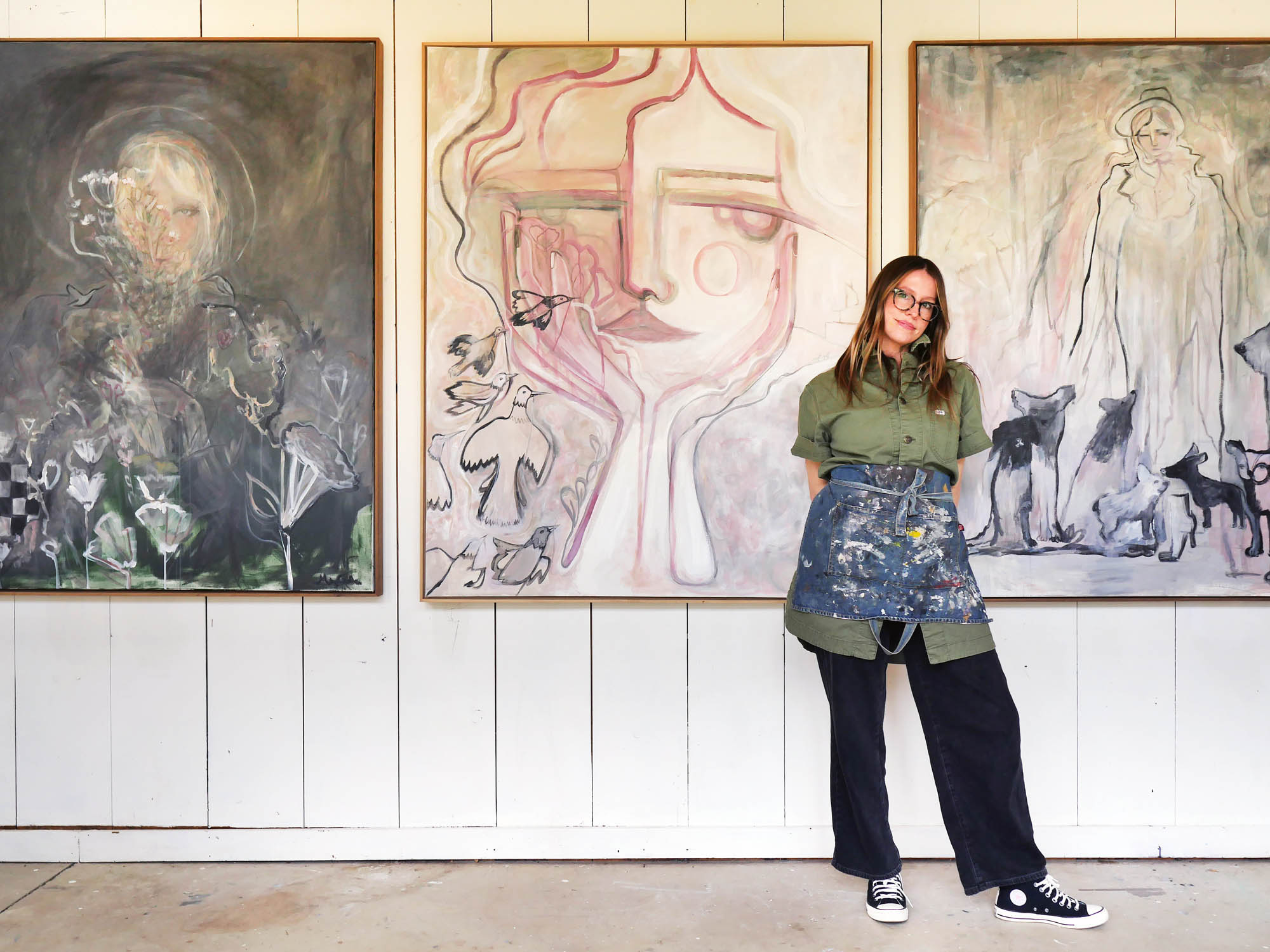
From left to right,“Saint Jane,” “Daze,” “Mother Canine,” acrylic, gouache and watercolors on canvas.
This article was edited by Julie Schwietert Collazo and Meryl Kaye. It was fact-checked by Gia Miller. The artwork is courtesy of The Metropolitan Museum of Art’s Open Access Initiative.
This article was published in the May/June 2026 edition of Connect to Northern Westchester.

Anastasia Mills Healy
A former editor at Condé Nast Traveler, Fodor’s, and Travel Agent, Anastasia Mills Healy is a Greenwich-based writer and editor who writes for Time Out, Lonely Planet and others, and is the author of “100 Things to Do in Connecticut Before You Die” and “Secret Connecticut.”

Justin is an award-winning designer and photographer. He was the owner and creative director at Future Boy Design, producing work for clients such as National Parks Service, Vintage Cinemas, The Tarrytown Music Hall, and others. His work has appeared in Bloomberg TV, South by Southwest (SXSW), Edible Magazine, Westchester Magazine, Refinery 29, the Art Directors Club, AIGA and more.
Justin is a two-time winner of the International Design Awards, American Photography and Latin America Fotografia. Vice News has called Justin Negard as “one of the best artists working today.”
He is the author of two books, On Design, which discusses principles and the business of design, and Bogotà which is a photographic journey through the Colombian capital.
Additionally, Justin has served as Creative Director at CityMouse Inc., an NYC-based design firm which provides accessible design for people with disabilities, and has been awarded by the City of New York, MIT Media Lab and South By Southwest.
He lives in Katonah with his wonderfully patient wife, son and daughter.