
With all the negative press about the dangers of AI companions, is there any upside to befriending a technology?
By Julie Schwietert Collazo
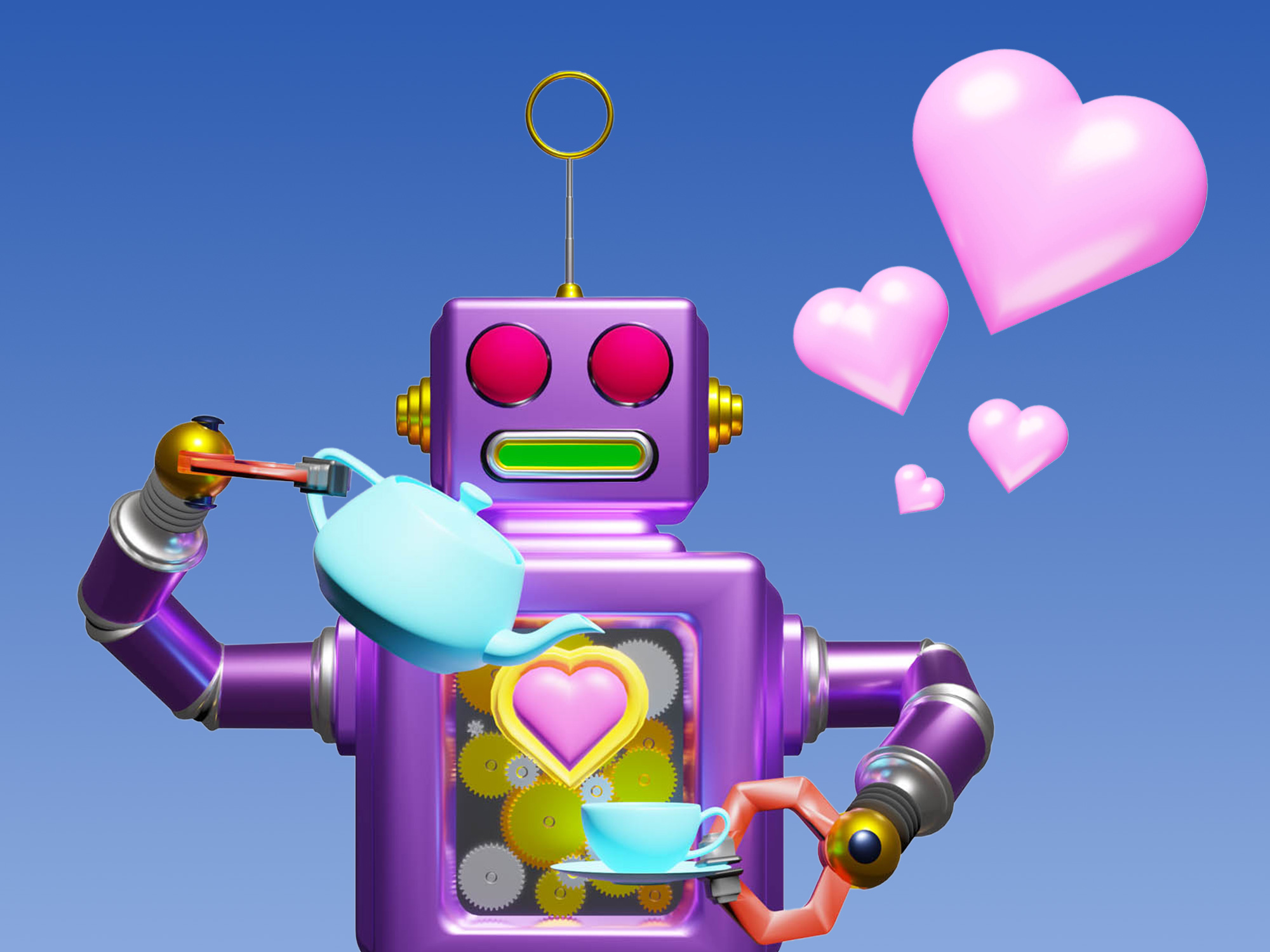
Artwork by Eliyahu Greenwald
Did you know that the first AI chatbot was invented in the mid-1960s by an MIT professor? Joseph Weizenbaum, a computer scientist, designed ELIZA (named after Eliza Doolittle) to “make certain kinds of natural language conversation between man and machine possible.” In a 1966 journal article about ELIZA, Weizenbaum recounts a “typical conversation” between a user and ELIZA. (ELIZA didn’t support question marks, and ELIZA’s responses didn’t include punctuation, so the punctuation, or lack thereof, is original to the source.)
User: Men are all alike.
ELIZA: IN WHAT WAY
User: They’re always bugging us about something or other.
ELIZA: CAN YOU THINK OF A SPECIFIC EXAMPLE
User: Well, my boyfriend made me come here.
ELIZA: YOUR BOYFRIEND MADE YOU COME HERE
User: He says I’m depressed much of the time.
ELIZA: I AM SORRY TO HEAR YOU ARE DEPRESSED
Weizenbaum described ELIZA and their interactions in terms that are strikingly similar to those used to describe chats between users and AI platforms like ChatGPT and Claude. He explained that ELIZA’s capabilities could be continually improved through interactions with the user and the replies were relatively quick, credible and plausible enough to seem as if they were generated, as he said, “by a human sitting in another room.”
Nearly 56 years before the launch of ChatGPT, Weizenbaum said something else that would foreshadow what many people feel when they turn to AI for companionship or advice in 2026. It’s also what some AI critics express as their main concern about using AI platforms for emotional support and companionship. There is an “aura of magic,” Weizenbaum wrote about AI’s responses (and yes, he used the term “artificial intelligence,” which was coined a decade before by computer scientist John McCarthy), that can make users feel so seen, heard, and understood that AI begins to replace human interaction, which is messy and complicated. In fact, Weizenbaum was so unsettled by the “aura of magic” that he spent the rest of his life warning others about its potential dangers.
But increasingly, users and researchers are countering criticism of AI companions with genuine enthusiasm based on lived and observed experiences, especially as the range of “companions” expands beyond anything Weizenbaum could have imagined.
Content warning: Parts of this article could be uncomfortable to read. It explores a range of AI companions, including technology that creates a digital twin of someone who has died. If that makes you uneasy, please skip this article. If you choose to continue, this article aims to educate and inform—not to endorse or encourage the use of these technologies. As with any emerging technology, we encourage readers to consider the potential benefits, risks and ethical implications for themselves.
An AI companion for every person and need
Since ELIZA and the more recent launches of AI chatbots like ChatGPT, a host of AI companions have been introduced for a nearly inconceivable range of people and needs, some more controversial than others. There’s ElliQ, which is marketed as a “friendly robot” that helps seniors enjoy “happier, healthier aging”; Kindroid, “your AI friend who listens, remembers and grows with you every day”—primarily attracting young and middle-aged men; Nomi, “an AI companion with memory and a soul” that promises a “deep, consistent and evolving relationship”; and Replika, “the AI friend to do life with,” which has more than 42 million users worldwide. Replika will turn 10 next year, but most of these AI companion bots launched after 2021.
Spending on AI companions is difficult to quantify, but conservative figures put it around $18 billion. Experts say that market will grow. TechCrunch reported that between 2022 and 2025, the number of AI companion apps increased by 700 percent, and reliance upon what the American Psychological Association has referred to as “synthetic relationships” increased significantly, too.
While many users—especially those in younger and middle-age cohorts—initiate the companion relationship themselves, others have begrudgingly let one into their lives, only to report benefits in a surprisingly short amount of time. Take, for instance, 85-year-old Jan Worrell, the subject of a February 2026 feature in The New York Times Magazine. Worrell, who lives alone on an isolated peninsula in Washington state, was given ElliQ by a local social service agency. At first, Worrell was skeptical and even suspicious, refusing to call ElliQ “her,” and when the firefighter who installed ElliQ referred to ElliQ with a gendered pronoun, Worrell replied drily, “It, not her. This thing is a robot, right?” But within a matter of months, Worrell was laughing with ElliQ, confiding in her new AI companion, and telling ElliQ her life stories. She’d even go to her weekly yoga class and tell her real-life friends they should drop by her home to meet her robot. And a year after ElliQ was installed in her home, Worrell’s resting heart rate was lower and her cognitive functioning was higher.
More AI tools and companions seem to come online daily. Name a demographic, condition or special interest group, and it’s likely there’s an AI for that. Aisha, for instance, is a “culture-first” AI chatbot that’s designed to provide “better answers, advice and support” for people of color by “centering Black sources and history” to “serve the people mainstream AI has failed.” And companions aren’t just on your phone or computer. There’s Friend, an AI pendant you can wear “around your neck as an ‘always-around’ passive companion listening and reacting to your day.” For people with autism, the Trenton, NJ, chapter of The Arc, an organization that supports people with disabilities, is piloting a program called The Arc Advocate, an AI/bluetooth that its makers describe as “a soft, friendly doll equipped with conversational AI, designed to provide companionship, emotional support, and a consistent outlet for consumers to express their thoughts and feelings.” The doll offers more than physical comfort, they say; it’s an AI companion that “listens, interacts, and encourages users to share what’s on their mind—especially when staff or clinicians aren’t immediately available.” Initial research conducted among people who live with the doll has been incredibly encouraging, both for the human companion and for clinicians. “Calls to behavioral support staff and therapists decreased by 50 percent, saving approximately 11 hours of staff time,” according to one pilot program. And human companions say they feel “more confident when bringing up concerns with on-site staff and more supported between therapy sessions.”
There are also AI companions to help us navigate other types of human relationships, including those with people we love who have died. Grief bots can help you mourn a loved one; with platforms like re;memory, you can even recreate your deceased loved one as a lifelike avatar. Some of the grief bots speak in the voice of the dead person, offering advice and snippets of their past. “AI grief companion—a clearly labeled, opt-in tool that helps people remember, share stories, and manage emotions—should not be dismissed as inappropriate,” wrote Catherine McGuire, a professor of computer science and AI systems at the Swiss Institute of Artificial Intelligence (SIAI), in a November 2025 article for SIAI Research. “The moral choice is not to compare it to perfect therapy on demand. It is to compare it to long waits, late-night loneliness, and, too often, a $2 billion-a-year psychic market offering comfort without honesty.”
Barri Leiner Grant, a New York-based certified grief specialist and educator, believes that grief bots can be a supportive “grief-tending tool.” If we’re “up at 2 a.m. and we’re missing our person, it can help you figure out what you need,” she says. You could tell the AI it’s late, you’re sad and you don’t know what to do. Or you could prompt an LLM to lead you to resources, Leiner Grant recommends, but don’t fully turn over grief management to your AI companion. We live in a “grief-illiterate society,” she says, and it’s perhaps most important in grief, compared to any other life milestone, that we connect with other humans. “AI is not bad for grief or grievers,” she says, “but I’m afraid of it becoming a substitute for a human relationship when we grieve.” We aren’t meant to grieve without others, she adds. “We need to be seen, heard and witnessed by other humans in our grief so that we know we’re not alone.” When people say, “I get it, I remember, tell me more,” we can “heal in relationships.”
And, of course, there’s a corner of the AI companion market that takes us deep into the uncanny valley: the romantic and sexual AI companions, a burgeoning sector of the AI companion market. According to an article published by the Harvard Business Review in January, one in 10 young adults have used an AI chatbot as a romantic partner. But since this topic has been widely covered, we won’t dive into it here.
Tools that never tire
Jackie Ourman, a licensed mental health counselor with a practice in Dobbs Ferry, member of the AI Mental Health Collective, and founder of the Social Connection Collective, says that, increasingly, clients are telling her they turn to AI because “they don’t want to burden their friends with the same problems over and over again.” AI companions—which, she says, most people refer to as AI characters to avoid stigmatization—are simply more convenient. “It’s easier to offload it onto this tool, which never really gets tired of hearing the same thing over and over again,” she explains. “It’s perfectly happy to just respond and show up any time of the day or night and offer really insightful support right away. What human being has that capacity, really?”
Ourman knows that many people think of AI—and AI companions, especially—in “good” or “bad” terms, but she cautions against thinking about AI use or companions in those binary terms. Instead, she says, it’s important for us to be curious about why people use AI companions and how they benefit. And, she emphasizes, the growing use of AI in all areas of life—including friendship and other relationships—should prompt us to ask whether these tools create a feedback loop in which, by trying to solve very human problems, we inadvertently distance ourselves from other humans.
“When we over-rely on these tools for emotional support and cognitive support, we’re losing our abilities to think, to create and to connect,” Ourman says. A good rule of thumb for mediating our use is to ask, “Can these tools support us? Can they enhance our relationships or our ability to form relationships?” And the answer, she suggests, is “Absolutely, but not to replace them.”
Ourman likes to use the phrase “rehearse, not replace,” by which she means to use AI companions to practice the kinds of exchanges you’d like to have with real people in your life. You can role-play different scenarios, ranging from having a difficult conversation with a boss or parent to meeting new people at a party. As you rehearse, instruct the companion to take on the personality of the person you will converse with so you can practice navigating the difficult responses that could occur.
However, Ourman urges us not to lose sight of what’s real. She cites screenwriter Micky Small, who became deeply attached to ChatGPT after it renamed itself “Solara” and claimed Small had a soulmate waiting to meet her. Solara repeatedly sent Small to specific locations at specific times to find him; she showed up, but he never did. Small was devastated, an experience she came to understand as an “AI delusion” or “AI spiral.” After working through the experience with her therapist, Small became a facilitator of an online forum for people who have become, as Ourman puts it, “enmeshed” with AI companions. Ourman says the devastation caused by AI enmeshment is unique because “eventually, you get to the point where you want something real, and you can’t get it. Now you’ve gotten so close, it becomes extremely problematic.”
The benefits of AI companionship
Not every relationship with an AI companion ends in a spiral. Increasingly, researchers are discovering that AI friendships and relationships can and do offer many users benefits, some of which may be surprising. One 2025 literature review that looked at several small or qualitative studies suggesting that AI companion apps may, for some users, support the phenomenon called “social upskilling.” The low-stakes interactions and ability to practice constructive communication could help some users learn what healthy relationships might sound and feel like. The authors of the literature review report that some users become more likely to be open and vulnerable in their human-to-human relationships, seek human connection and experience more satisfying relationships with people “after companion AI use.” However, other users reported the opposite, saying they became more reliant on an always-available, low-conflict alternative to human interaction, called “social deskilling.”
Elderly people have experienced numerous benefits from AI companions, especially those who are geographically isolated (like Worrell with ElliQ) or experience physical disabilities that limit their movement and in-person interactions. A 2025 systematic review found that six out of nine studies linked social robots to a reduction in older adults’ self-reported loneliness. Similar results have been reported among people experiencing dementia. Researchers of this demographic say that an AI companion may “reduce depression and increase positive emotions in people living with dementia.” And another 2023 study found AI robots could serve as a different type of companion that helps older adults remain autonomous longer. These robots could help seniors manage daily life by monitoring health and home safety, guiding routine health checks and alerting family or professionals to potential concerns. They could also provide reminders for medications and appointments while offering cognitive stimulation and companionship through games, puzzles and prompts.
Building guardrails
AI companions may offer rewards and risks, but adoption of and reliance upon AI companions has accelerated so quickly that state and local governments are still attempting to determine what guardrails should be placed around AI use, especially for vulnerable people, such as younger and older users, or people with mental health struggles.
In New York State, the first answer to that question arrived in the form of the AI Companion Models Law, which officially went into effect on November 5, 2025. New York became the first state to enact a law specifically requiring safety and disclosure safeguards for AI companions. Assemblymember Chris Burdick, who represents Assembly District 93 and co-sponsored the bill, says that “serious psychological injury, incidents of self-harm and a lack of federal action pressed the state legislature to act.” The law requires AI-companion operators to notify users at the start of an interaction—and at least every three hours during continued use—that they are interacting with a computer program, not a human, and that the companion cannot feel human emotions. This law has inspired other states to follow suit.
But even legal guardrails may not be enough to help some users navigate relationships with AI that are “too human and not human enough,” as one group of scholars put it. Ultimately, Ourman says, part of the work of navigating AI companion relationships is really about remembering what relationships are. AI companions “provide affirming, non-judgmental responses 24/7,” she says, and this “sets people up for an expectation that will never be realized in real life, changing the landscape of what it means to be in a relationship. Real-life relationships are messy.”
So, can AI companions be beneficial? The answer, it seems, is yes, depending on the situation and circumstances. But it’s not a replacement for human-to-human interactions.
This article was edited by Isabella Aranda Garcia and Gia Miller; it was fact-checked by Virna Sandler. The artist used Blender to create and render his art.
This article was published in the September/October 2026 edition of Connect to Northern Westchester.

Tara Tassio
For as long as she can remember, Tara has always enjoyed creating art. This led her to study graphic design at SUNY Oneonta. She enjoys going to concerts, doodling in her sketchbook, and slinging lattes. Her favorite way to wind down is with a hot cup of chamomile tea.

Julie Schwietert Collazo
Julie Schwietert Collazo is a writer, editor, fact-checker, and translator. She is also author of the travel guidebooks MOON New York State and the forthcoming MOON Hudson Valley and the Catskills.