
By Gia Miller
Photography by Justin Negard
“I find a sense of calm and peace from being in nature,” explains Waccabuc resident Sally Frank. As an artist who has dedicated over half a century to printmaking, for Frank, the natural world is not only her refuge, it’s her source of inspiration, her visual muse. And nature is also fundamental to her existence. “My work is all grounded in nature,” she says. “It is definitely my thing; nature has been pretty consistent in my work in one way or another for over fifty years.”
Whether she is taking her two rescue mutts, Lacey and Stella, for a walk through the woods or meticulously carving a massive woodblock in her studio, Frank is continuously attuned to the raw energy and quiet resilience of the earth. Its essence is a key component of her philosophy on life and what she strives to convey through her work. “I really believe that people are hardwired to connect with one another,” she notes. “And when people lose that connection, things go haywire. And the one thing that connects us all is our fundamental connection with the natural world.”
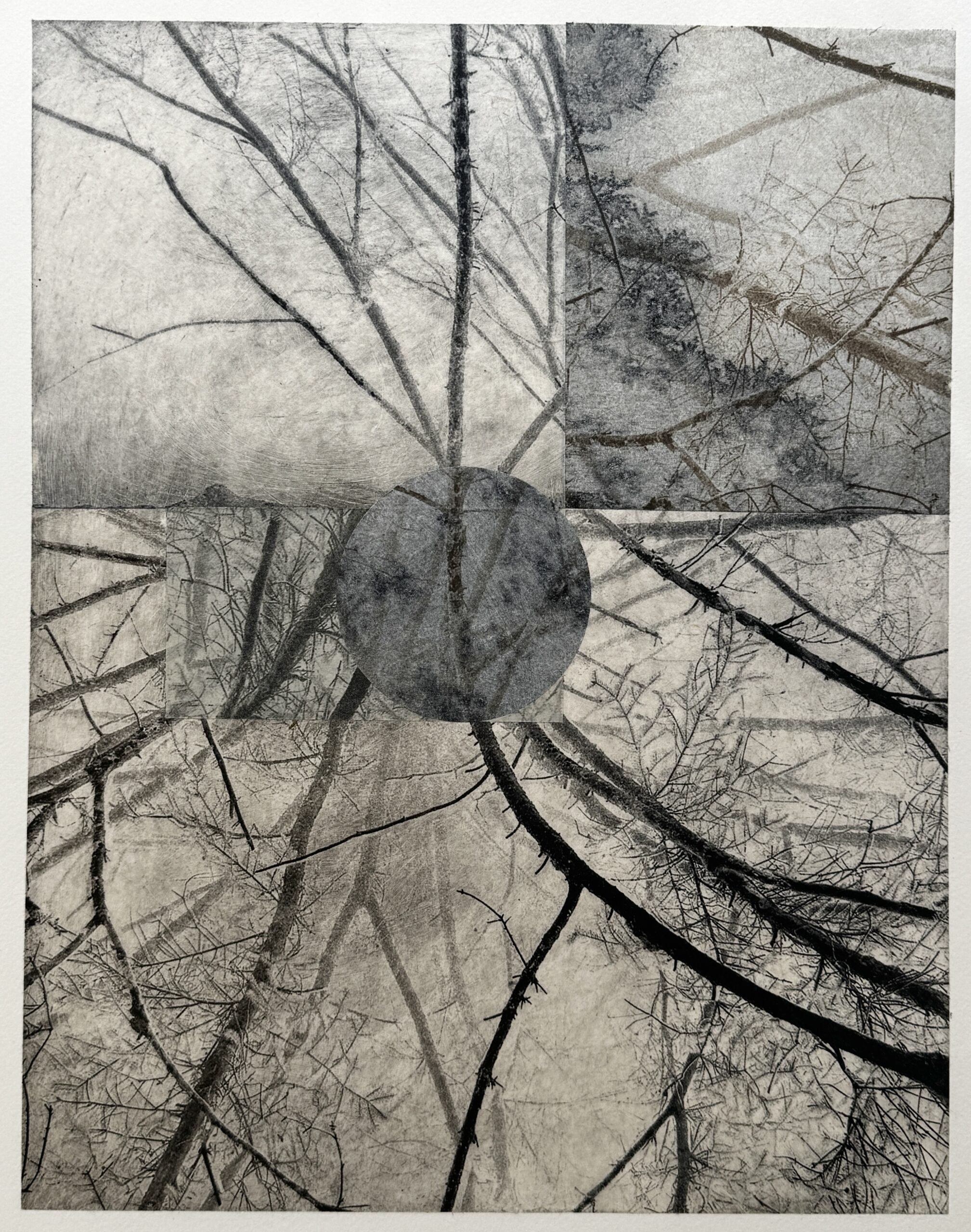
“Branches Out,” intaglio collage.
The freedom to explore
Frank’s profound, almost spiritual connection to the environment was cultivated during her childhood. She grew up on a former dairy farm 50 miles outside of Philadelphia in Chester County, PA. “My sister and I jokingly say we grew up feral because we would go off for hours and nobody knew where we were,” Frank remembers. “We lived in farm country out in the middle of nowhere, and we had this freedom that, unfortunately, many kids don’t ever get to experience these days. We’d climb on board one of the horses, and we’d just take off. We poked around, snooped in everybody’s backyard and whatnot.”
Their love of nature was punctuated by their parents who “were very into horticulture.” Frank’s paternal grandfather, Dr. James P. Burlingham, was a fairly famous horticulturist who had a rock garden in Syracuse in the 1920s and taught his son, Frank’s father, about plants. “When we walked in the woods with our parents, they would speak Latin,” Frank remembers. “They were literally identifying plants by their genus and species. I, unfortunately, didn’t pick up a lot of their knowledge, but they definitely instilled in me a love of nature and an appreciation for native plants and protecting nature.” That environment, the freedom to explore and “learn about critters and plants and trees,” created Frank’s lifelong appreciation for and connection to nature and native habitats.
Falling for an ancient art
Frank says she’s always been an artist, drawing regularly as a child, which she believes was a natural segue into the world of printmaking. Frank says people assumed she would become an artist, but she didn’t want to be one. “I resisted it for years,” she says. “I was a drama major at one point; I went into retail. I even spent a short time thinking I’d major in psychology.” But when she tried printmaking during her freshman year at Simon’s Rock, a small, liberal arts school located in the Berkshires at the time, she thought it was “the coolest thing in the world.”
“I liked it because I could use my drawing skills,” Frank explains. “The thing about printmaking that’s interesting is that even though you think you know how a print is going to come out, once you pull that print, depending on the colors you use and the paper, there’s always a surprise element. It’s not always necessarily a good surprise, but there’s always something you can’t totally control. And that can lead to some real fun.”
Frank majored in fine art (printmaking wasn’t an option) and then attended C.W. Post Long Island University to earn a master’s degree in printmaking. “It was totally impractical,” she laughs. “I did not think about what I was going to do with it. I definitely couldn’t afford my own press!” Frank paused her printmaking career and returned to watercolors and photography, choosing people and nature as her primary subjects.
After living in Brazil for three years, Frank and her family returned to the U.S., ultimately settling in New York, where she eventually discovered the Center for Contemporary Printmaking in Norwalk. “It was incredible,” she says. “I couldn’t believe I could actually use a press again and do printmaking.” There, she explored techniques like woodcuts, lithography and monotypes. Today, Frank has a press in her studio; she prefers working with oil-based inks for their colors and consistency and has replaced harsh chemicals with soy-based cleaners to protect her health and the environment.
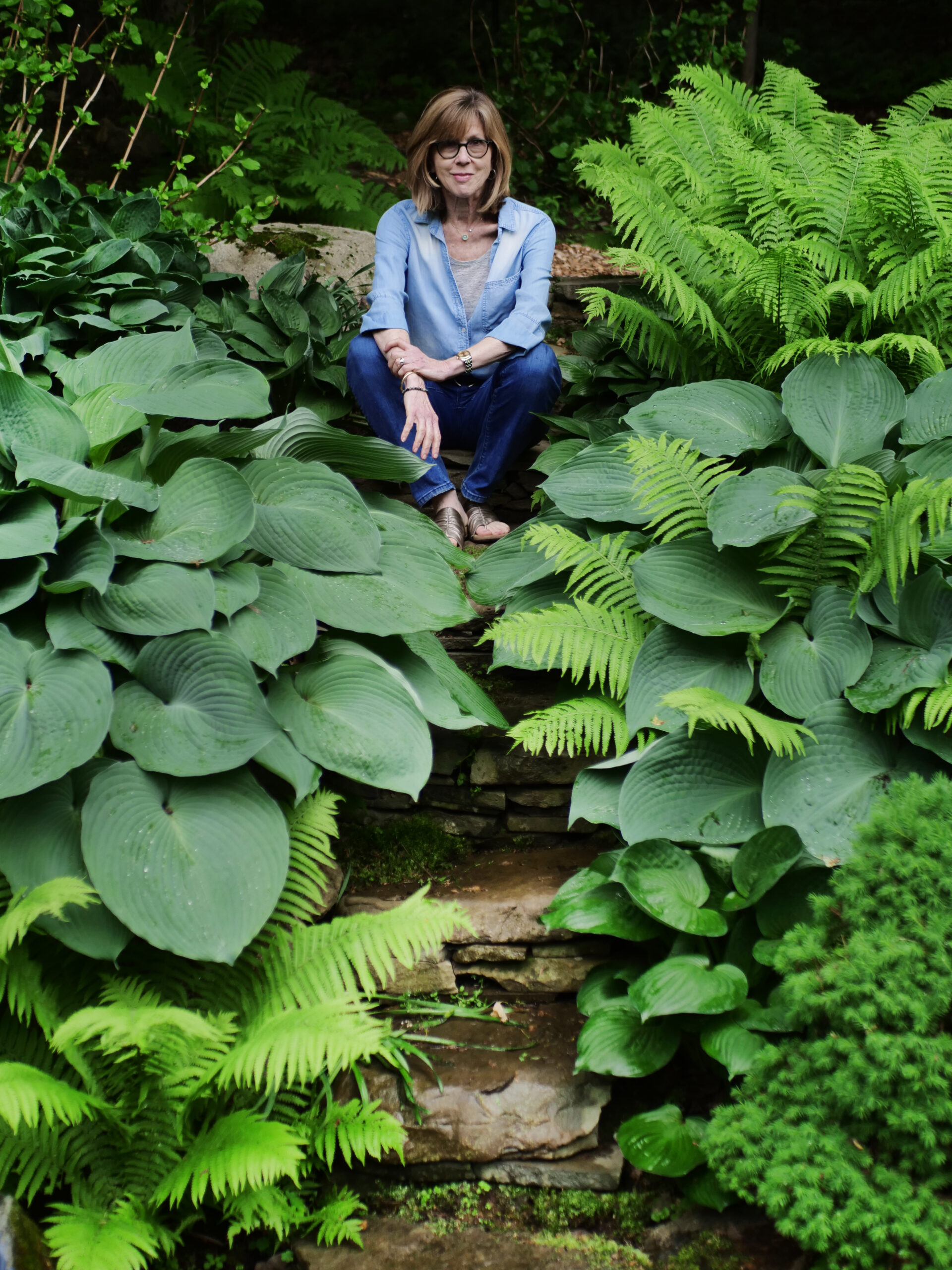
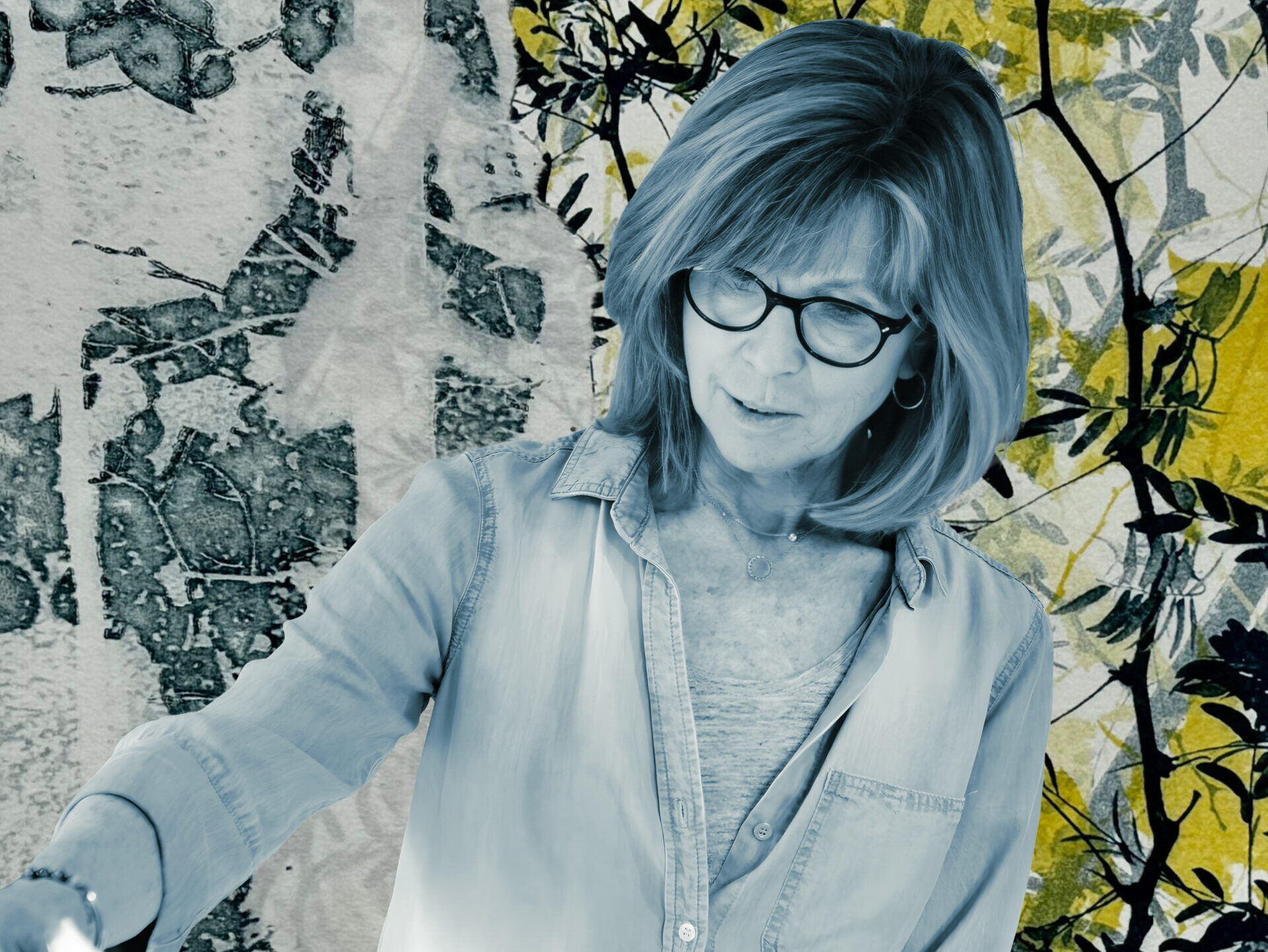
Frank at her home in Waccabuc.
Capturing nature
When Frank first began printmaking, she created literal botanical prints of plants and trees. Over the decades, however, her work has evolved into a more abstract interpretation of the earth’s structural elements. “I’ve always been fascinated by a tree’s root structure and branch structure,” she explains. “I like the winter landscapes. You can see there are a lot of naked branches in my work. I like those basic fundamentals, what nature is comprised of. I’m just fascinated by the variety of textures in nature. There’s an endless source of material; I’ll never ever run out of it. I’ll never get bored with creating images from nature, especially sort of juxtaposing different things, different pieces, through the collage work.”
Today, she deliberately avoids authentic representations. “My work is not a literal translation,” she states. “I am not taking images and recreating them.” Instead, her goal is to capture the underlying vitality of the landscape. “I feel the energy from images of nature, my impressions in nature, and I try to harness that.”
Frank gathers inspiration through mental “snapshots” collected during her meditative walks along wooded trails. A particular shadow cast across a tree branch, the way a leaf touches the bark, the texture of a shelf fungus—they all get filed away in her subconscious, eventually weaving their way into the fabric of her art. “I am not necessarily going to recreate them,” she clarifies, “but somehow they are going to enter into my language, my art language.”
She favors a thoughtful composition over the “wow factor” of images like roses. “I tend to go for things that are kind of moody and that make you contemplate,” she explains. “I’m creating things that are more settling, that make you pause and internalize.” Frank says she sticks to a color palette mainly dominated by earth tones and blue-grays, deliberately steering clear of overly vibrant aesthetic choices.
Creating a print is a meticulous, multi-step process that requires careful execution of each step. Frank begins by creating an image on a plate through acid etching, direct engraving with a sharp tool, or a photographic transfer process using a light-sensitive plate. Next she selects the appropriate paper, which can range from delicate, transparent Japanese paper to high-quality French or German papers. Then, she returns to the plate to ink it, a step she describes as “the tricky part.” Frank prefers oil-based inks, blending colors until she achieves the desired shade. She then works the ink across the plate, ensuring it settles into every impression.
After inking, the plate is meticulously wiped clean—a process that can take up to 45 minutes, depending on the complexity of the design and depth of the lines. Frank begins with a loose ball of tarlatan, followed by newsprint and then smooth tissue paper, gradually removing ink from the plate’s surface while preserving it in the etched lines and tones on the plate. If the plate isn’t completely clean,” Frank explains, “then your print will be kind of dull. You won’t get the light or the clean lines.”
The paper requires preparation as well. To improve ink absorption, Frank typically soaks it for 10 to 15 minutes before printing. Delicate Japanese papers are lightly misted and blotted instead, while monotypes are often printed on dry paper. Once everything is prepared, she places the plate on the press bed, positions the paper on top, and covers it with wool felt blankets to prevent the metal plates from bending and to distribute pressure evenly. For layered prints, she repeats the process on the same sheet. Frank often prints the same image in different colors and on different papers, exploring what she finds most “interesting or exciting.”
“Printmaking is a process art,” Frank explains. “There are many, many steps to it. And if you don’t like processes, then printmaking is not the thing for you. But there are a lot of artists who really enjoy the process.”
-
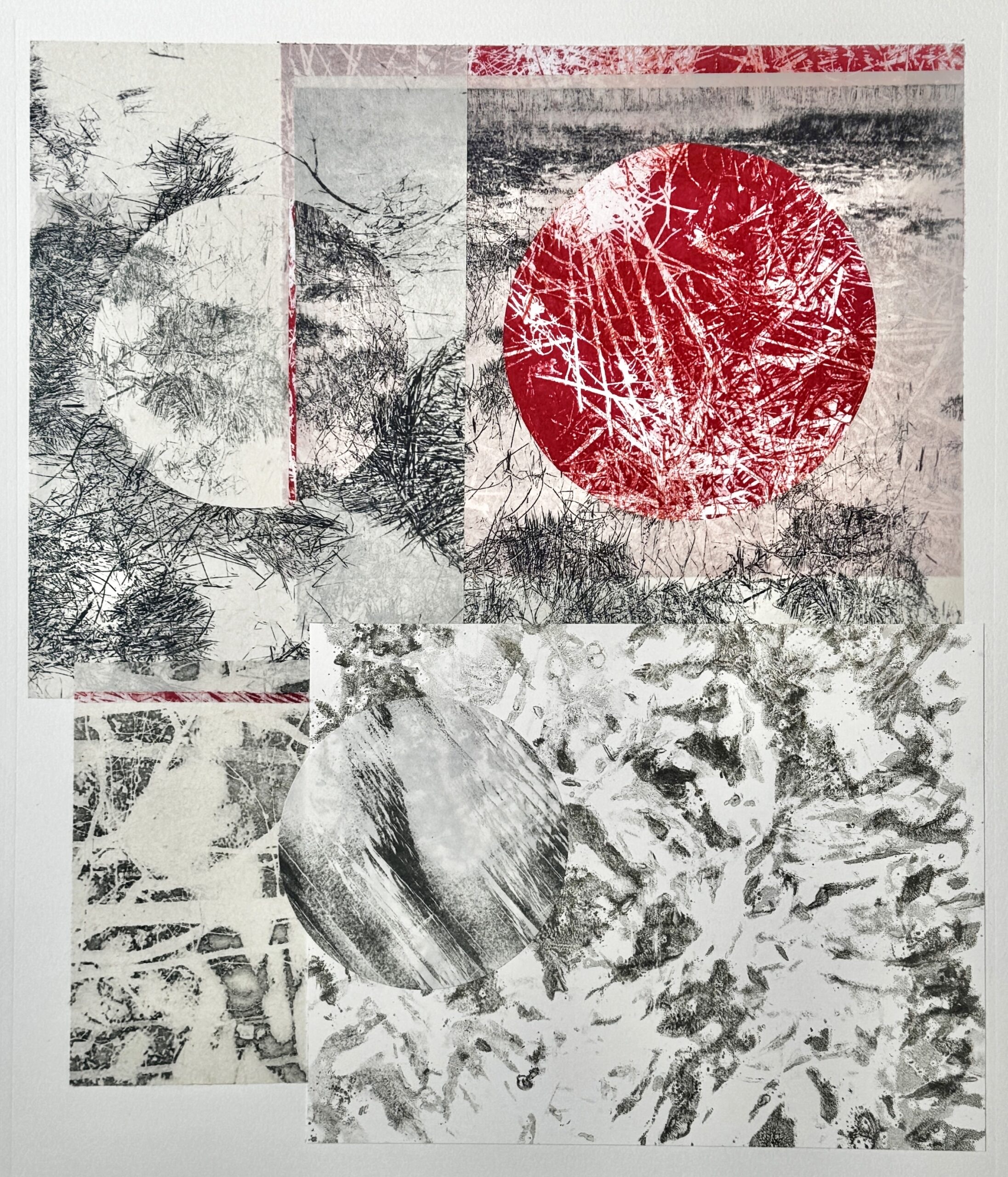
- “Reservation Bog,” intaglio collage.
-
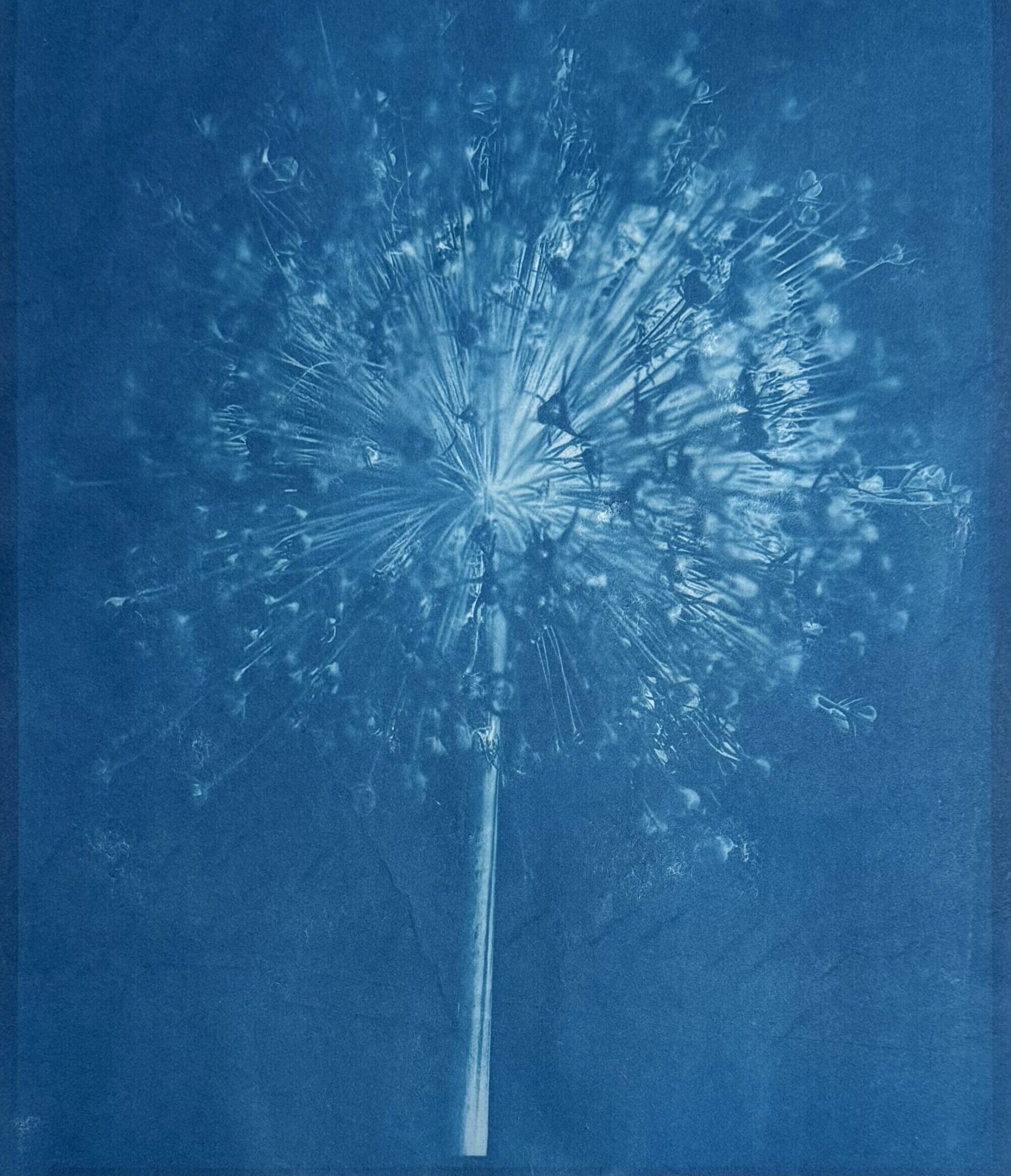
- “Allium,” cyanotype.
A new view
Recently, Frank began pushing the boundaries of traditional printmaking by creating complex, multi-layered collages and narrative books. It began after a conversation with her friend Monique Allain, who is also an artist. Allain encouraged Frank to try her hand at making a book and join a traveling book project Allain participates in called “Address: Earth—ArtistBooks in a Suitcase,” which features unique artist books addressing environmental and social challenges. “When you’re a printmaker, not every print is successful,” Frank explains. “You have all these scraps of different prints where there are parts that might be good and other parts are not so good.” Frank looked at her scraps, thought she could create something interesting and made her first book. She’s now made several, and her book “Untamed” is among the 50 included in the 2026 show. Frank created a custom box, tied with a leather cord to hold this one-of-a-kind artist book, and the entire package will be on display. The exhibition began in Poughkeepsie in June and will head to Cape Cod in July. It will be in Monticello, New York, on August 8 before traveling to Honolulu through December and then Buenos Aires at the beginning of 2027.
Frank’s own contribution features a narrative exploring the untamed forest, carrying the central message that while humans may cause destruction, nature itself is profoundly resilient and will survive. “Natural survival is non-linear,” she concluded in the author’s statement about her book. “As industrial elements batter and beat nature to its core, there is an untamable counter force that never rests. The winds and waters of time will find and nourish new life from organisms buried deep in the earth and nourish them into something new and miraculous that is the flow of life everlasting.”
These books were only the beginning. “I thought my art looked so cool this way that I decided to take it to the next level, and I started making bigger collages,” Frank says. But instead of using scraps of prints, she began deliberately printing pieces, mainly using Japanese rice paper. “When you collage it,” Frank explains, “it glues down so smoothly, and everything just sort of blends together very nicely. So now, I’ll start printing and then I will play around with the colors to figure out which ones go together.”
After selecting the color scheme, Frank begins cutting the papers, searching for an unusual and creative way to blend various colors, patterns and shapes together. Recently, she’s begun incorporating circle motifs into her collages, which she says represent the planets and the moon. “The idea came from looking out my bathroom window at night and seeing the moonlight,” Frank explains. “It really made me think about where we are in space.”
Frank says NASA’s recent Artemis II mission also served as inspiration. “I was totally enthralled, and I didn’t think I would be because I remember the last time they went to the moon,” she says. “But the way these astronauts expressed themselves was so moving. They talked about the distance, the singularity and how they recognize that we’re possibly alone in the universe. And they spoke about the uniqueness of the Earth; it was tied right into everything that I believe in. It really inspired me to use the motif of the moonlight and the planets.”
In May, one of Frank’s new collages, called “Marsh Moon,” was awarded the Greenwich Art Society Award by MoMA curator Caitlin Chaisson at the society’s 109th Annual Juried Exhibition.
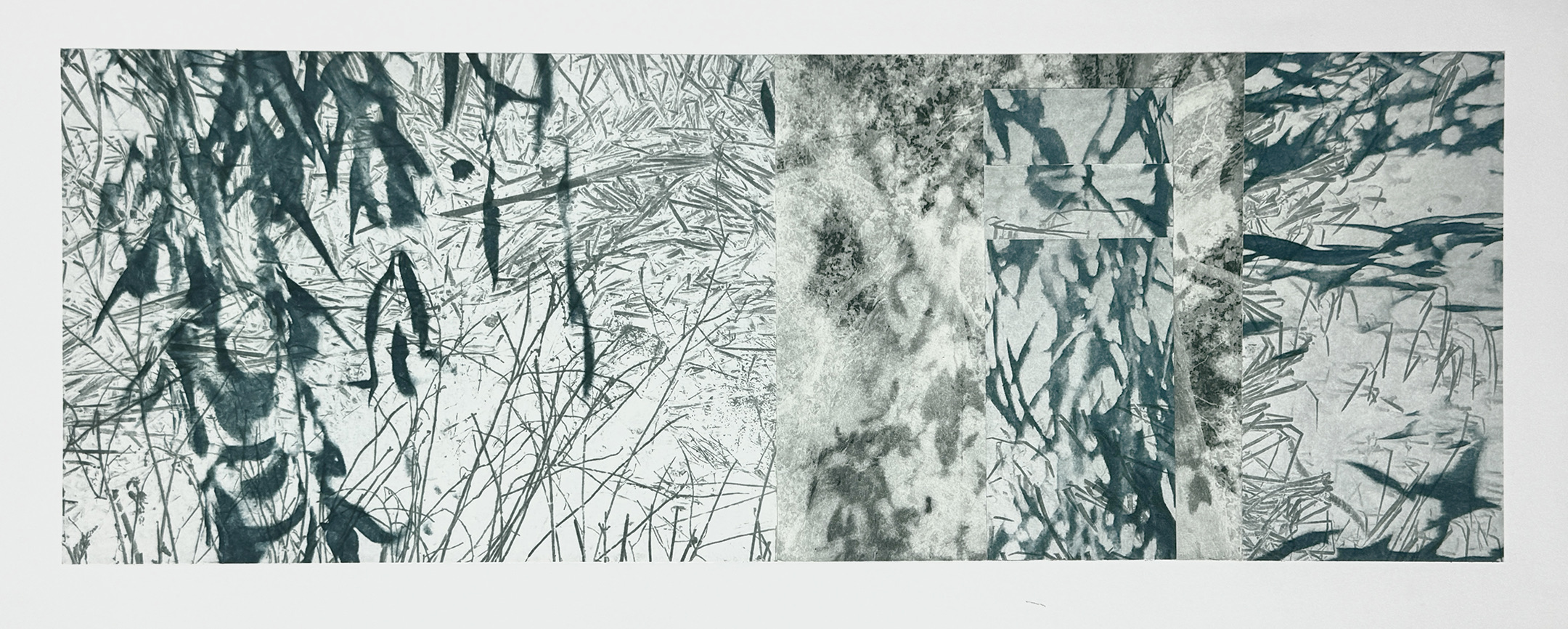
“Pondscape,” intaglio collage.
Protecting the world she loves
While Frank finds immense peace in nature, she is also acutely aware of the harsh realities threatening local ecosystems. Beyond her studio walls, she works to help protect the land she cherishes. Frank serves as a dedicated trail steward for the North Salem Open Land Foundation, regularly hiking a specific portion of the local trail to monitor for fallen trees and rampant invasive plant growth. “I report my findings to help ensure the trails are in sound condition for people who want to go out and hike and enjoy them,” she explains. “I love doing that. There’s also a trailhead right around the corner from me, and it’s like a magical world; it is just so absolutely beautiful.” Furthermore, as the co-chair of the Conservation Advisory Council for Lewisboro, she actively works to educate the public about the critical importance of preserving native habitats.
The looming specters of climate change and aggressive invasive species directly influence Frank’s artistic output. She created a series called “Bramble” specifically to highlight the subtle, insidious way non-native plants are choking out local ecosystems. “Little by little, they’re taking over our landscapes and changing the dimension of the forest,” Frank warns. “You need to have a clear understanding of what’s going on.”
She also vividly describes the devastation caused by beech leaf disease, which kills off native canopy trees (see more on “The Science of Conservation Is Changing“). “When they die off,” Frank explains, “all of a sudden you have sunlight hitting the forest floor where it didn’t hit before. And guess what loves that sunlight? Invasive species.” She fights this battle on her own property, spending countless hours cutting back barberry the moment it sprouts. “You just have to stay on top of it.”
Frank believes it’s impossible to eradicate invasive species. “Now it’s more about how do we cohabitate with the invasives,” she states. “And it’s basically by pushing back as much as you can in your domain. There is an initiative called Homegrown National Park, and it’s a fabulous program. The idea is that we can create a massive national park if everyone just does the right thing on their property.”
Even though she’s witnessing the destruction of the natural habitats she so freely roamed and fell in love with as a child, Frank’s worldview remains optimistic. She acknowledges that the natural world is constantly evolving through a harsh, raw competition for life, but she is continually inspired by the persistent will of the earth to survive.
“I think that when people take a moment to look and get out of whatever they’re caught up in—whether it’s getting to work on time, getting the kids new shoes or even the difficult struggle of figuring out how you’re going to afford putting food on your table—when they take some time to connect to nature and see nature, it can help,” she says. “Nature has a calming influence, and it also gives you a sense of being grounded, which I just think makes people kinder. And kindness is something we could all benefit from.”
Frank’s work will be on display at the “Putting it Together—Transforming Collage” exhibition, in conjunction with the Making Meaning Hudson Valley Symposium, through July 12 at 68 Prince Street Gallery, Kingston. Her work will also be part of the “Nature and Nurture” exhibition at South Shore Art Center, Bancroft Gallery, in Cohasset, MA, from September 10 to October 28.
This article was edited by Meryl Kaye and fact-checked by Julie Schwietert Collazo. The photographer used Adobe Creative Suite to edit his photos.
This article was published in the July/August 2026 edition of Connect to Northern Westchester.

Gia Miller is an award-winning journalist and the editor-in-chief/co-publisher of Connect to Northern Westchester. She has a magazine journalism degree (yes, that's a real thing) from the University of Georgia and has written for countless national publications, ranging from SELF to The Washington Post. Gia desperately wishes schools still taught grammar. Also, she wants everyone to know they can delete the word "that" from about 90% of their sentences, and there's no such thing as "first annual." When she's not running her media empire, Gia enjoys spending quality time with friends and family, laughing at her crazy dog and listening to a good podcast. She thanks multiple alarms, fermented grapes and her amazing husband for helping her get through each day. Her love languages are food and humor.
Justin is an award-winning designer and photographer. He was the owner and creative director at Future Boy Design, producing work for clients such as National Parks Service, Vintage Cinemas, The Tarrytown Music Hall, and others. His work has appeared in Bloomberg TV, South by Southwest (SXSW), Edible Magazine, Westchester Magazine, Refinery 29, the Art Directors Club, AIGA and more.
Justin is a two-time winner of the International Design Awards, American Photography and Latin America Fotografia. Vice News has called Justin Negard as “one of the best artists working today.”
He is the author of two books, On Design, which discusses principles and the business of design, and Bogotà which is a photographic journey through the Colombian capital.
Additionally, Justin has served as Creative Director at CityMouse Inc., an NYC-based design firm which provides accessible design for people with disabilities, and has been awarded by the City of New York, MIT Media Lab and South By Southwest.
He lives in Katonah with his wonderfully patient wife, son and daughter.