
The surprisingly beautiful benefits of creating a functional ecosystem in your yard
By Ruby Mendelson
Artwork by Eliyahu Greenwald
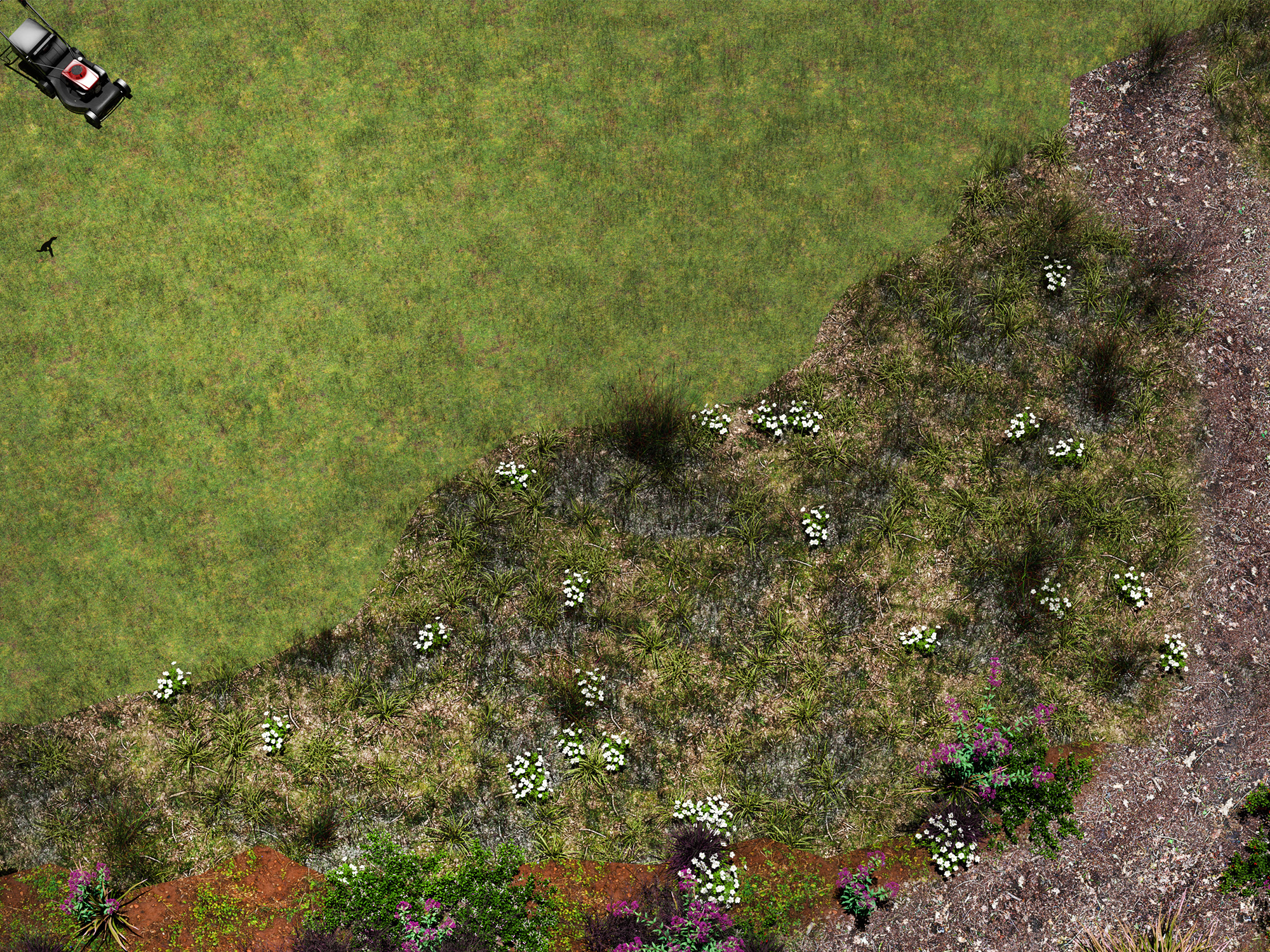
Bedford resident Murray Fisher used to have the perfect suburban lawn: it was immaculately maintained with neatly mowed grass for the kids to play and perfectly manicured plants and trees. But then Fisher had what he says was one of his “greatest revelations,” and what happened next was something he never could have expected. “I replaced about 50 percent of my lawn with wildflowers and native plants, creating an incredibly diverse preserve,” Fisher says. “It has provided endless joy for me, my family and some of my neighbors.”
Fisher’s garden transformed into a haven for over 2,000 mostly native species in just six years. “We still have a big lawn the kids play on,” Fisher explains, “but the rest of it, the other 50 percent, we’ve given it back to nature. Every day I find something new that I have not seen before—a new butterfly, a new moth, a new beetle. All I did was remove the lawn and sprinkle a bunch of native wildflower and grass seeds, and today I have about a 1,200-square-foot wildflower patch; I’ve literally done zero interventions. It’s been really thrilling to create a preserve in my backyard.”
This might all seem too good to be true. An easy-to-create, low-maintenance, beautiful, wildly diverse ecosystem right in your own backyard? But it is true, and the best part is, it’s really not that hard to do.
Start small, think wild
Jenn Cipriano, co-owner of Copia Home & Garden in South Salem, says that, like Fisher, anyone can do this. The goal is to create a functional ecosystem, which Cipriano defines as a garden where “each piece, whether it’s a plant or insect, is functioning all together to make the healthiest, most optimal landscape possible.” When done properly, a functional ecosystem requires much less hands-on care than a “traditional” mowed and/or landscaped lawn. “You don’t have to spray, you don’t have to do much fertilizing, you can do very minimal weeding,” Cipriano explains.
So what’s the first step? Surprisingly enough, the easiest way to start is by stopping. To maintain our picture-perfect suburban lawns, market research company Freedonia Group’s 2024 report says the “demand for home and garden pesticides is forecast to grow 2.8 percent per year to $3.2 billion in 2028.” But a more hands-off approach to gardening, like the one Fisher took, can actually cost you way less time and money while also improving the environment. Simply take a look at your yard. How much of that neatly cut grass do you actually use? Then think about how much time and effort you spend maintaining it. “We encourage people to take half of their mowed grass and turn it into a no-mow area,” Cipriano says. She explains that as soon as homeowners stop mowing and fertilizing these sections, nature knows what to do. “Your lawn will turn into these tall, beautiful, soft grasses. It’s very reminiscent of a meadow.”
Fisher, who spent his career in the environmental sector and currently works for Sycamore Partners, an ecologically focused real estate development firm, says after you stop mowing, you should reduce your other “machine hours” as well. “Don’t only reduce the amount of lawn you mow, but also reduce the leaf blower and the weed trimmer because those are all burning carbon, which kills plants,” he explains. “Then reduce the amount of inputs that you put on your entire property: fertilizer, pesticides, herbicides, fungicides—they are waging a chemical war against biological diversity. If you want your yard to be more functional, you have to use fewer chemicals.”
From there, the next step is to start buying local seeds and plants, which doesn’t have to be expensive. “You don’t have to run to the nursery and spend thousands of dollars on new plants,” Ciprian0 emphasizes. “You can go to seed exchanges at the local garden clubs; there is also a great seed library at the Pound Ridge Library, where people share the seeds they collected from native plants. It is going to take a little nurturing. But you can start very inexpensively by just using seeds to create a field of flowers that will reseed themselves.”
Friend or foe?
If you’re wondering what kinds of seeds to purchase and which plants will be the most self-sufficient, Fisher’s app, Wildr Places, is a great place to start. “It’s a one-stop shop for everything related to rewilding your property,” he explains. Fisher developed this app in partnership with Plan it Wild, an ecological landscape design and landscaping company that was finding it difficult to scale their business one yard at a time. “When I became a senior advisor for Plan it Wild, we decided to develop an app that could guide people on this journey,” Fisher explains. The app provides native plant recommendations for your area, helps you track the number of pollinators in your garden, and suggests eco-friendly yard management techniques.
Once you’ve learned what to (and not to) plant, make your plan, keeping in mind that experts say simplicity is key. “I’m not a big believer in ripping out every nonnative plant and substituting them for native plants; I don’t think that’s practical, and I don’t think that’s what gardening is about,” says Caroline Saxton, a Bedford 2030 Rooted Solutions Coach and ecological landscape consultant. “What I do encourage people to do is to try to eliminate invasive plants in their garden. The big ones, in my opinion, are barberry and burning bush. But if you have a huge expanse of burning bush, you don’t have to rip it all out. Our guidance is usually to have 70 to 80 percent native plants, but I always tell people that if it’s non-invasive and you like it, keep it and just add native plants.”
Native plants provide food and habitats for local animals and insects, while, according to Lower Hudson PRISM, an organization funded by the NYS Department of Environmental Conservation; invasive plants are “nonnative species that can cause harm to the environment, the economy or human health.” Not all nonnative plants are invasive, but the ones that are can cause or contribute to habitat degradation and loss, including the loss of native fish, wildlife and tree species. And they can also pose risks to public health and safety. The easiest (and most affordable) way to identify invasive species is to use an accurate online reference. (See “Need a hand? Start here.”)
The buzz about pollinators
To achieve a self-sustaining ecosystem, you are going to need help from some familiar faces: the native insects and animals in your area. And those aren’t only butterflies or bees; you’ll also need assistance from wasps, beetles, flies and bats. (Yes, all those creatures you spent so much time and money trying to exterminate can actually do the gardening for you.) These pollinators, according to the Hudson Valley Seed Co., “produce about three quarters of the world’s cultivated crops and about 80 percent of all flowering plants.”
Inviting these little gardeners into your ecosystem will require you to make a “trail” they can follow. “A pollinator pathway is an area where pollinators, meaning native bees and so forth, have a safe place to land and feed,” Saxton explains. “It’s not just about planting pretty flowers; it’s about providing host plants. For example, the monarch butterfly’s caterpillars can only eat milkweed leaves. If we eliminate all the milkweed from our gardens because it is a ‘weed,’ then we eliminate that food source for the monarch butterfly.”
“By planting a native plant, you are literally planting food for the rest of a pollinator’s life,” Fisher adds. And when you give your pollinators the resources they need, they’ll stick around and help out. They’ll carry pollen from flower to flower, allowing your native plants to produce seeds and bear fruit, and they’ll also control pests like mosquitos and aphids better than any repellent or insecticide ever could.
Fisher recommends using the app iNaturalist to upload photos of your new pollinator friends, plants and critters so you can easily identify everything that visits and grows in your garden. “The computer image recognition suggests the species,” Fisher explains. “I am now up to 2,000 species in my backyard! Anyone can do this. It’s cheaper and easier than mowing, leaf blowing, trimming, watering and applying chemicals. When you do less of all those things, suddenly, all the wildlife starts coming back.”
Speaking of pesticides, herbicides and the like, the experts agree they do more harm than good. Don’t welcome pollinators into your yard only to kill them with pesticides. Your lawn must be a combination of food sources for our local pollinators and chemical-free. “You’re providing a landing area for creatures who need it,” Saxton tells us. And in return, these creatures will pay you back by helping your ecosystem thrive.
But what about the ticks?
Ticks are one of the most common concerns our experts hear about when creating a functional ecosystem. But Cipriano says the situation isn’t as dramatic as we are often led to believe. “Nature does have a way of balancing itself out,” she notes. “The majority of our yard is a no-mow meadow, and my dogs get an occasional tick here and there, but by no means are we covered in them. I talk to people that have no-mow areas, and they all say the same thing.”
What you don’t want to do, she clarifies, is spray your garden. “Spraying for ticks is just spraying a lot of broad-spectrum insecticides. You’re killing the ticks, but you’re also killing all of the beneficial insects and other wildlife that will take care of the ticks.”
Instead, Saxton says your best bet is a combination of prevention and a thorough self-check after. “They crawl,” she says, “so tuck your pants into your socks to keep them from getting underneath your clothes.” Then check your body thoroughly when you go inside. “They usually end up in the areas that tend to sweat more, like the back of your knees, your groin area and under your armpits.”
Saxton also reminds us that ticks aren’t unique to no-mow meadows. “You can walk through a short grass area and still get a tick,” she says.
Nature’s floor plan
A thriving ecosystem should have plants of all different types and sizes to accommodate a variety of species. This is called vertical layering, and according to Saxton, it begins with your soil. “You want to have a healthy soil that is not contaminated and still has the necessary microbial components.” According to Cipriano, the best spot to look for healthy soil is at the edges of your property, away from the foundations of your house. “When people build houses,” she explains, “they excavate all the soil. What’s left after they’ve completed construction is this mix of something we can’t even call soil.” (Click here to learn about healthy soil.)
Once you’ve located (or created) healthy soil, it’s time to build your layers. “The herbaceous layer comes first; it provides a habitat for pollinators,” Saxton explains. “Then come the shrubs. When your herbaceous plants die back in the winter, your shrub layer becomes the next habitat for things like birds and small mammals, even foxes and other animals. Now you can add small trees and then larger trees. Some insects only have a tree as a host, so they are very important habitats as well.”
Even if a tree dies, you don’t need to pay to have it removed. “Dead trees are super important,” Fisher says. “Leave them standing ideally, but also leave them if they fall. A dead tree is home to nearly as many species as a live tree; they’re mostly beetles and other decomposers. Entire ecosystems exist on dead trees.”
Every drop counts
So you’ve stopped mowing your lawn. You’ve ripped out the invasives, attended seed swaps and planted natives. Pollinators and other helpful species are coming to your layered ecosystem. But there’s something critical your garden needs to survive: water. Does a self-sustaining ecosystem water itself? Yes and no. Depending on timing (yours and Mother Nature’s), you might have to intervene.
According to Ciprian0, some watering is definitely needed in the beginning. “You don’t need a whole irrigation system,” she says. “But I would recommend having a good hose to help newly planted species get started. You just have to get them through that initial hot summer. Then, once those plants are established, you won’t need to irrigate them anymore.” Saxton adds that it will take some time to wean new plants off their water dependence. “You have to train your plants to reach for the water that’s actually down in the ground rather than waiting for your weekly watering,” she explains.
The goal, when it comes to water, is for your ecosystem to recycle every last drop. “You almost want to treat water like it’s organic matter,” Fisher explains. “You’d like the water that lands on your property to stay there rather than run off. Heavy rain on a mowed lawn, as well as on a gravel or asphalt driveway, will run off. But if you have enough plants, that water should drain down into the soil.” The more rainwater your garden catches, the less you have to water it by hand.
Any water that doesn’t land in your garden can easily be collected from your gutters using a rain barrel. Simply place the barrel underneath the downspout of your gutter, and you will have a reservoir of fresh water to recycle back into your ecosystem whenever it looks thirsty. Most rain barrels come with a drain valve you can attach to your hose, but if not, use the barrel to fill up your watering can. However, a few words of caution: don’t use this water on anything you plan to eat. Runoff water from your roof can pick up bacteria, which you don’t want to pour over your prized fruits and vegetables. “And be careful about those barrels becoming collection spots for mosquitoes,” Cipriano adds, explaining that mosquitos often breed in pools of stagnant water. “That’s easily remedied with mosquito dunks.” The dunks use bacteria to kill mosquito larvae, and they are nontoxic to everything else.
Why wait for wild?
We know it might be difficult to make the switch from lawn to meadow, both mentally and physically. “It’s very different from what we’ve been taught about a conventional, traditional, super highly maintained yard,” Fisher says. But now is one of the best times to get started. “We have so many local groups and organizations that encourage people, give recommendations and provide consultations,” Cipriano says. “There are tons of resources and help. You don’t need to feel overwhelmed.”
Take this time to do a little planning. Figure out which section of your lawn you want to transform, research which natives are best for your area and go to seed swaps. “Hold off on planting in July,” Fisher advises. “Because of the heat, you would have to regularly water anything new. So the fall is a better time to plant—anytime up until the frost. But the rest of this stuff you can do immediately. You can mow less, you can remove invasive plants, and you can stop using pesticides and herbicides.”
Just remember to make it manageable. “Don’t try to do the whole yard at once,” Cipriano advises. “You want to be mindful and get off to a good start in a small area, then work your way out from there. Take your time; do it piece-by-piece.” Along the way, don’t forget to admire the beautiful, low-maintenance, wildly diverse and self-sustaining ecosystem you’re creating. And for those of you who are competitive, see if you can top Fisher’s 2,000 mostly native species. Just don’t be surprised if the birds, bees and butterflies end up claiming the victory.
This article was edited by Isabella Aranda Garcia and fact-checked by Julie Schwietert Collazo. The artist used Blender to create and render his art.
This article was published in the July/August 2026 edition of Connect to Northern Westchester.

Ruby Mendelson
Ruby Mendelson is a recent John Jay High School graduate who will attend Kenyon College in the fall to study creative writing. She loves creating characters and writing her own stories, sometimes working alongside her twin, Maggie. Ruby is also a huge FTC robotics nerd (Go Screwups!) and plays the clarinet. She has two cats, Olive and Goose, whom she’s considering smuggling into college.