
By Ella Brown and Isabella Aranda Garcia
Artwork by Nathaniel Aric Galka
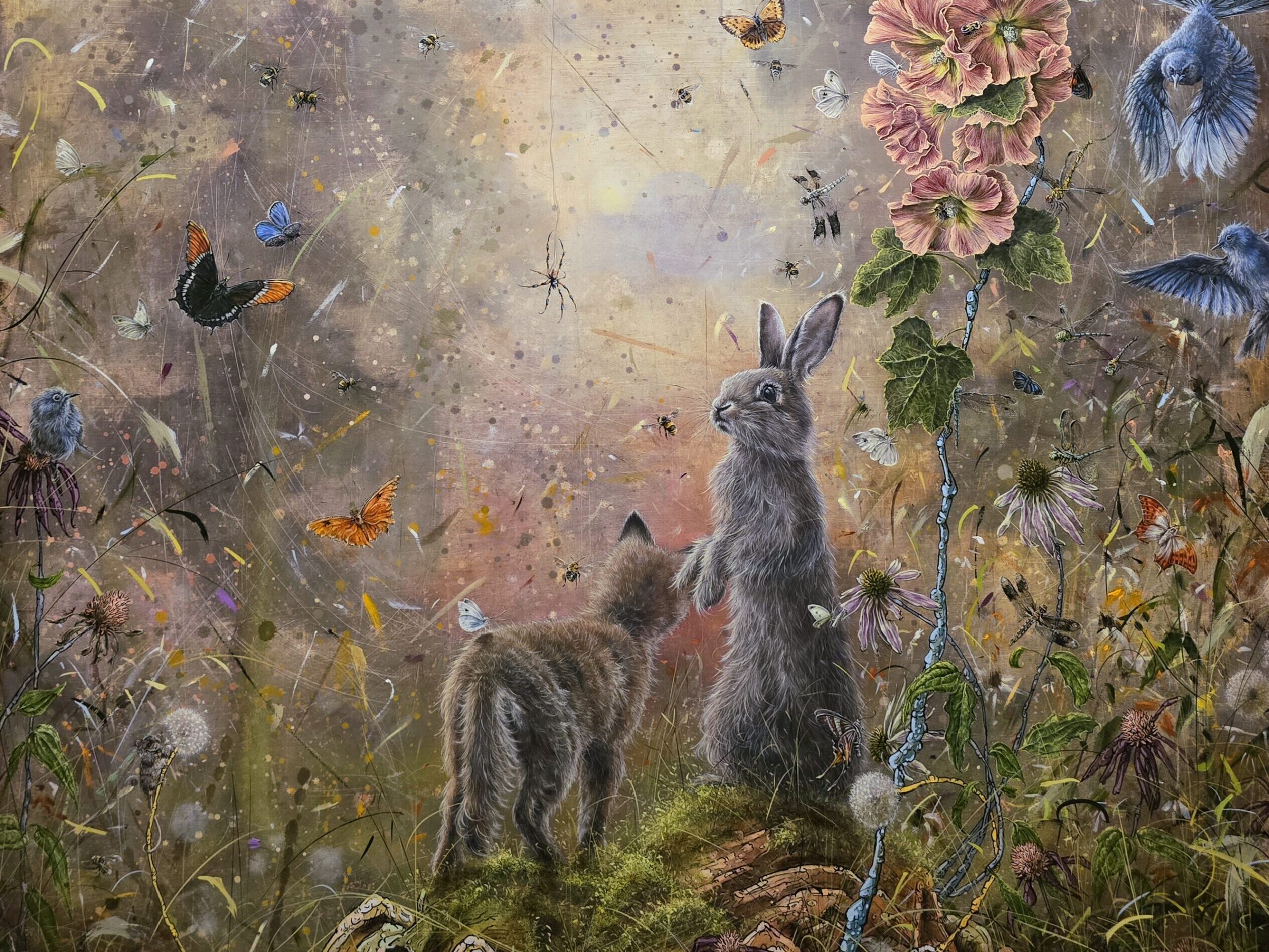
If you ask the artist about the scene above, he will tell you it was created to communicate moral lessons about how we treat our world. He will also tell you that the title of the piece, “You can feel happiness return…” is the introduction to a fable, and you, the viewer, should create your own story. So, let’s examine it. There’s a gray rabbit standing upright in a meadow bursting with hollyhocks, butterflies, bees and blue jays. And there’s a fox, its head slightly cocked, facing the other direction and looking toward something in the distance. It’s a world teeming with intricate, interdependent life. It’s beautiful, and it’s also fragile. Now if you look closely, the rabbit is not just posing. It’s watching. Alert. The fox sees something, too. It’s as if they understand what we are only beginning to: that a single barberry plant can alter the fate of a forest; that climate warming reshapes the migratory routes of billions of birds; and that microscopic nematodes are quietly killing trees that have stood for generations. One might wonder, is the title of the piece a nod to the people in our community who are working to make “happiness return?”
These days, the work of protecting land has become something far more complex than drawing a line around it and walking away. In the forests of Waccabuc, on the shores of the Long Island Sound, and deep in our local woods, scientists and land stewards are taking a new approach. They are not just saving land. They are trying to save everything on it, including us. As Amy Karpati, Ph.D., senior science advisor at Teatown Lake Reservation, puts it, “Nature conservation is human conservation.”
Draw a line around it and walk away. That era is over.
For most of the twentieth century, conservation in Westchester looked like a legal document. You acquired land, filed an easement and protected it from development. The assumption was that wildness, left alone, would sustain itself. That assumption no longer holds. Beech trees are not dying overnight. They’re dying the way most slow catastrophes do: gradually, then suddenly. Walk through almost any local forest preserve and you will see them, leaves crumpled and browning in the middle of July, bark stripped and blistered, entire stands going gray. Beech leaf disease, caused by a nematode believed to have arrived from Asia, has swept through the region.
At Teatown, Karpati has watched this unfold with measured urgency. “We’re assuming we’re going to lose these beech trees,” she says. The concern is not just the loss of a species. Beeches cast dense shade on the forest floor. When they die, the canopy opens and light floods in. And that light, Karpati explains, is not the benevolent kind. “That newly introduced sunlight stimulates invasive plants to grow. We’re worried that’s going to create a stepping-stone network of opportunity for these invasives to make their way into our interior forests.”
Janelle Robbins, Westchester Land Trust’s vice president of conservation, and Ben Kleist, preserve manager, are dealing with the same reckoning at the Frederick P. Rose Preserve in Waccabuc. Their answer was a 10-acre deer fence enclosing a dense beech stand to give the next generation of trees a fighting chance. “If we don’t do anything to protect this area,” Kleist says, “when the trees come down, there’s not going to be the next generation of trees ready to take their place. That area could fundamentally change from a forest to a shrubland or something else.”
It is a striking image: a fence as an act of hope. And it reflects a profound shift in how conservation science is practiced. The old model was passive; the new one is active. Scientists are not only protecting land from human interference. They are intervening, actively and continuously, to compensate for decades of damage.
The easements themselves tell the story. Some of the oldest conservation documents include prohibitions on the removal of any vegetation; it was written before anyone understood that problematic invasive species would eventually need to come out. “When you write an easement, it’s almost like you need to look into a crystal ball,” Robbins says. “The easements we’re writing today are different than the easements from even five years ago.”
When the data starts telling you something you don’t want to hear
At Bedford Audubon, executive director Medha Pandey runs one of roughly 300 active stations in a continent-wide monitoring effort called MAPS (Monitoring Avian Productivity and Survivorship), which began collecting standardized bird data in 1989. On banding days, she and her team are out before dawn, checking mist nets every 50 minutes, carefully extracting birds by hand, measuring fat deposits, checking brood patches and cloacal protuberance, recording molt, aging and sexing the birds, and more. It’s meticulous work.
This kind of long-term data collection was once considered the whole job. You monitored. You published. You reported. But you also collected, gathering climate and anthropogenic data so you could eventually study the long-term changes and their effects. What Pandey and her colleagues represent is a generation that has concluded that monitoring without responding is no longer enough.
Over the years, Pandey has noticed something she was hoping she wouldn’t. The wood thrush, one of the great singers of the North American forest, is disappearing from the local canopy. The wood thrush produces what ornithologists call biphonic songs, two different tones from two different sides of its vocal cords, simultaneously. The result, ringing across a forest at dawn, is something close to otherworldly.
The causes are the same forces reshaping every ecosystem in the county: beech leaf disease thinning the canopy and killing beech trees, emerald ash borers bringing down young and mature ash trees, and deer overpopulation stripping the understory’s native vegetation bare. A forest without an understory is not a forest. It is a collection of aging trees with too few plants underneath to provide shelter or resources to animals, and there’s nothing growing up to replace them.
Today, Bedford Audubon is taking action. “Specifically, we prioritize species under the greatest pressure from habitat loss and those we can meaningfully support through management of our sanctuaries,” Pandey explains. This fall, they will begin removing invasive species from about four acres of shrubland; these invasives currently cover about 55 percent of that land. The goal is to expand the availability of a high-quality habitat for birds such as the brown thrasher, American woodcock, prairie warbler and blue-winged warbler. They’re extremely rare in that sanctuary, and they’re struggling as their shrubland habitats continue to decline. These projects will serve as a helpful model to see how much Bedford Audubon can take on. “We’re a very small nonprofit,” Pandey notes. “We have only two full-time staff, including myself. And that is a massive undertaking. There’s so much room for growth. We’re already looking ahead to see what the next best plans might be.” In the future, they are hoping to create a forest management plan while maintaining the shrubland once it is (hopefully) rehabilitated.
The trees are moving, and the scientists are following
The old model of conservation assumed that species belonged where they had always been. Protect the habitat, and the habitat will protect what lives in it. Climate change has made that reasoning complicated.
The New Yorker recently published a piece titled “Our Warming Planet Is a Petri Dish for New and Deadly Microbes.” The article focuses on “flesh-eating” bacteria, infectious fungi and numerous other harmful microorganisms the author refers to as “climate-changed microbes.” She begins by sharing a story about a Maryland man who contracted a flesh-eating bacteria that, until recently, rarely appeared north of Georgia. But as the climate warms, species are shifting beyond their historical ranges—and the pathogens they carry are moving with them. Though thankfully less dramatic, climate-driven shifts in species ranges are already unfolding across Westchester, and local scientists are adapting their strategies accordingly.
“Historically, we would be at the southern end of the natural range for paper birch trees,” Kleist explains. “As things have continued to warm up, the amount of paper birch we find in our region has slowly decreased. Meanwhile, trees further to the south of us, like tulip trees, are starting to spread more and more into our area.” This is happening now, in measurable increments, so the Westchester Land Trust has begun planting trees from further south, selecting species whose historical ranges lie well below this latitude, betting that these plants will be better suited to a warming climate.
“This method strategically utilizes species that are adapted to climate trends similar to what our area is likely to experience,” Kleist explains. “Tree selections that are based on ‘what the climate conditions were like before’ are less likely to succeed. So far, we’re seeing really good results. They’re happy here, they’re growing well, and they support a wide range of different animals and insects. We’re still able to uphold the biodiversity that is critical in maintaining healthy areas, but we’re doing that in a more intelligent way than trying to hold on to these trees’ antiquated ranges.”
At Teatown, Karpati is thinking along the same lines with “assisted migration,” deliberately introducing species from the southern edge of our range, collecting seeds from more southerly populations, and helping plants move north faster than they could on their own.
And the climate implications extend all the way to the waterline. The Land Trust’s Otter Creek Preserve, their only nature preserve on Long Island Sound, is already contending with sea level rise. Robbins says they annually extend, repair and replace bog bridges as well as build new infrastructure to address the rise and flooding. Their strategies are changing. “We want to be thinking about the future and what that looks like.”
Reintroducing the apex predator
At the Wolf Conservation Center in South Salem, senior research scientist Joseph Hinton is grappling with a version of the same problem, except his subject is not a plant or a songbird; it’s the apex predator that once helped stabilize ecological communities in the northeastern landscape.
Hinton has spent nearly two decades studying red wolves and their relationship with the places and people around them. His Ph.D. focused on the wild red wolf population and its interactions and hybridization with coyotes. During this research, he discovered that most wolves died at the hands of people. “That seemed to be facilitating the hybridization problem,” Hinton explains. “From 2014 to 2020, thanks to political pushback and changes to US Forest & Wildlife Services management, along with the litigation that followed, we watched the red wolf population decline. It was a wake-up call that the human dimension side of the red wolf research was relevant here.”
That finding cuts against conventional wisdom: when it comes to support for wolf recovery, people—and their opinions—must be considered. “If you look at most large or medium-sized mammals, most of them are going to die at the hands of people,” Hinton notes. “Sometimes it’s legally allowed through hunting and trapping. Sometimes it’s poaching or vehicle collisions, and in the case of wolves, it’s all four.”
“Now,” he continues, “a lot of research is focused on how people impact carnivore populations, not just directly through killing them—whether deliberately or accidentally, like with roadkill—but also their willingness to just tolerate them.” Before, conservationists were just monitoring the wolves’ movement. “Now we are also measuring people’s attitudes towards wolves and figuring out how to get them on board to support carnivore restoration,” Hinton explains. “And if they’re not on board, we want to figure out why they might be unsupportive.”
Through this research, Hinton is discovering that urban and rural divides are much smaller than expected. Their recent data shows that regardless of political party or whether residents hunt, the level of support for reintroduction is remarkably consistent. “Today, it appears to be more cultural,” he says. “It’s not as tied to people’s income or education level. And having a better understanding of these cultures and how they value wildlife is important so institutions can modify their approach in those communities.”
The end goal for this group of conservationists is to restore red wolf populations so they can exist in their natural habitat alongside their human neighbors. “If there’s a very low tolerance, they’re going to support policies that remove those populations because they’re considered a threat,” says Hinton. “But if we can get people to understand that wolves are not a threat, then they can coexist.” To help mitigate this issue, conservationists are building outreach programs to educate people on wolves and why they are important.
Their next step is integrating all this research to develop a plan that includes when, and most importantly where, captive-born wolves can be reintroduced into the wild, along with improving how researchers work with the public to achieve their conservation objectives.
The science has changed. Now it’s our turn.
The easiest thing to do with all of this information is to despair. Barberry is everywhere. Beech trees are dying. Wood thrushes are disappearing. The climate is shifting. And yet, in every conversation with our local experts, something else kept surfacing: not denial, but a stubborn, practiced kind of hope.
Here is what the local conservationists want you to know: you do not need a thousand acres, a research grant or a biology degree. The shift happening in conservation science is also a shift in who conservation science is asking for help. “You could either be anxious and sad about this,” Kleist says, “or it could motivate you to get involved, which takes away some of the anxiety.”
That something does not have to be dramatic. Pandey suggests taking a few minutes to learn how to identify the difference between a native plant and an introduced one with apps like Seek and iNaturalist (see more in “Bringing Nature Back”). Or, as Kleist suggests, get involved. “We emphasize engaging the community and translating that engagement into conservation action through community science programs such as Project FeederWatch, the Christmas Bird Count and the Great Backyard Bird Count.” Robbins talks about the goats they hired to consume the invasive species at their Tom Burke preserve in Bedford Hills. When passersby stop to meet the animals, they ask what is happening. “There’s nothing better than a really cute goat to get people talking about habitat management,” she says. Land stewardship activities happen year-round; staff and volunteers can be found regularly removing invasives, planting native trees seasonally and cutting vines in the winter.
At Teatown, Karpati thinks about conservation in terms of triage: the most intact places need the lightest touch, and the most compromised places must shoulder the heaviest intervention. “You don’t have to have a thousand acres of land to be engaged in conservation,” she says. “You can do it if you have a backyard. You can do it even just by your voting choices, considering your consumption choices and choosing what you advocate for.”
What the old model of conservation never quite accounted for was the role of the ordinary person. It treated land protection as something done by institutions, for nature, on behalf of a public that was largely meant to stay out of the way. But today, with habitat fragmentation, a shifting climate, the loss of biodiversity, changing governmental policies and more, we’re losing species; scientists are asking for our help. “I feel like people too often think of the environment as something pretty in the background of our lives,” Karpati says, “without realizing that it is a functioning infrastructure that we are directly dependent upon.”
The wood thrush is still singing in our woods. The rabbit and fox in the painting are still watching, still alert in that meadow full of hollyhocks and bees and blue jays. The world is still here, and the scientists who have devoted their lives to it wake up every morning and choose to fight for it, planting trees and working to ensure species endure long after they are gone. That is not a small thing.
“Any time you invest in nature,” Kleist says, “it’s an investment in not just yourself but the people that you love and the people that you’ll meet—everybody. We are all a part of this interconnected system.”
This article was edited by Julie Schwietert Collazo and fact-checked by Virna Sandler. The artist used oil paints on canvas.
This article was published in the July/August 2026 edition of Connect to Northern Westchester.

Ella Brown

Isabella Aranda is a designer, writer and social media specialist with an M.A. in emerging media from the New Media Institute at the Grady College of Journalism & Mass Communication. Driven by curiosity and inspired by timeless modern design, she blends creativity and strategy to craft compelling narratives that engage diverse audiences.
Her expertise spans digital marketing, content creation and UX design, with notable achievements such as co-creating the Georgia On Your Mind podcast and leading digital campaigns that significantly boosted engagement. A Venezuelan immigrant, Isabella brings a multicultural perspective to her work, enhancing her ability to connect with and inspire others.

Nathaniel Aric Galka
Nathaniel Aric Galka is a fine artist residing in South Salem. His work is held by Forum Gallery, a blue-chip staple of the international art world. His works have been sold and shown all around the world from New York and Dubai to Abu Dhabi and Malaysia. He is also a principal partner of Sandra Rose Home, an interior design firm where he is the liaison for the art consultant division. In his spare time he is a student of horticulture.