

By Kayla Schmidt
Photography by Justin Negard
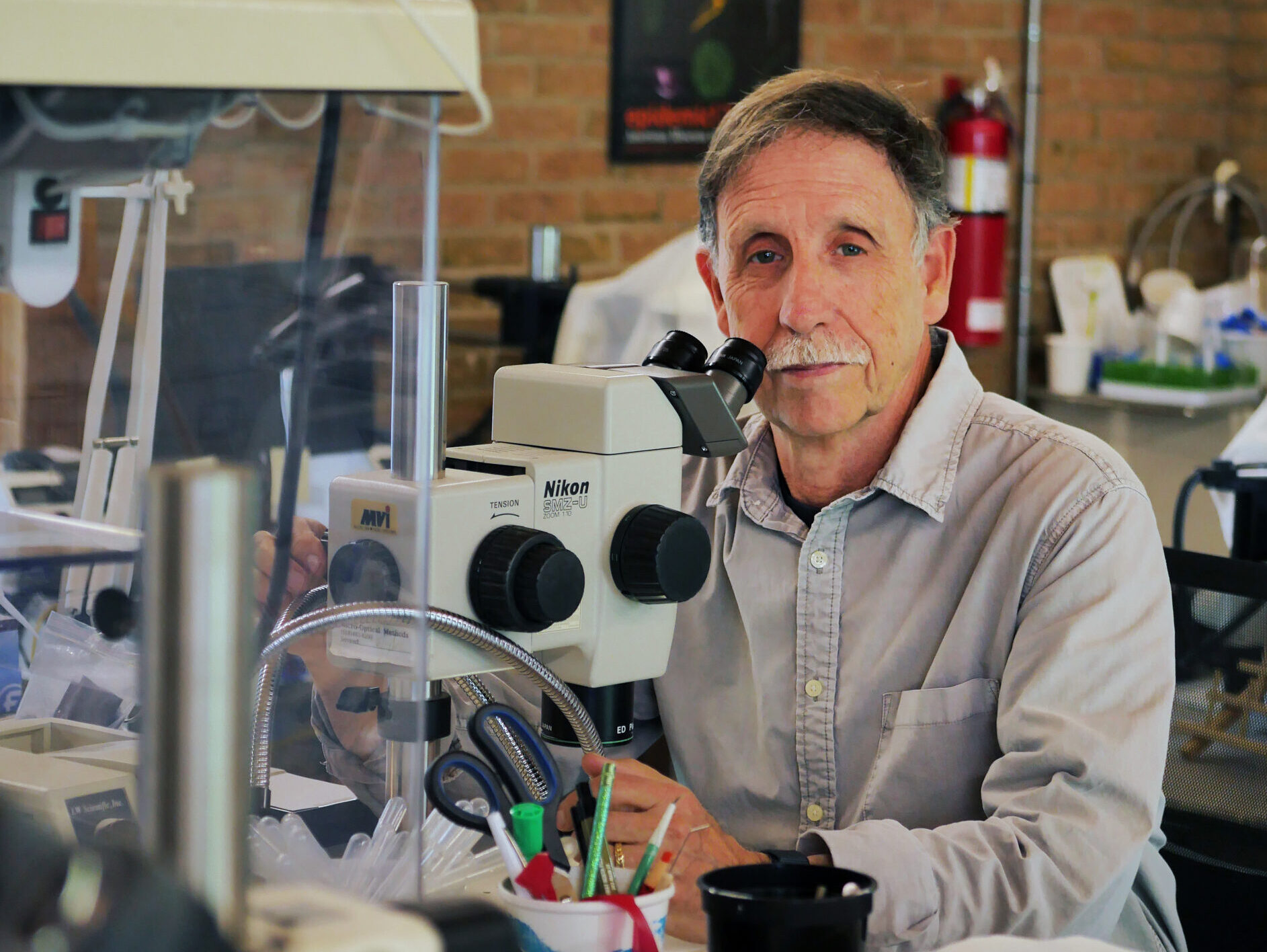
You probably don’t think much about ticks unless one has latched on to you. Tom Daniels thinks about them constantly. As a vector ecologist at Fordham University’s Louis Calder Center, he’s spent 40 years studying the tiny, much-loathed creatures, and he’ll be the first to tell you they deserve a little more respect. They’ve been around for 90 million years, after all.
What inspired you to study ticks?
I’ve always been interested in biology. I got my bachelor’s degree at Seton Hall, a master’s in zoology at Ohio State and a Ph.D. at the University of Colorado, where I studied free-ranging dogs on the Navajo reservation. I always looked at mammals, and one day I kind of just fell into the tick work. I was writing my dissertation for my Ph.D. and needed a job. Believe it or not, years ago, people found jobs by looking at newspaper ads. I saw one in The New York Times for mammal trapping, applied, and I’ve been working with ticks since 1985.
What qualifications do you need for this kind of job?
Priority number one: you can’t be afraid of ticks or the outdoors. You have to be able to identify ticks. Some of this work can be done by anyone with an interest in public health or entomology—we have a lot of undergrads—but if you want to lead a lab, it would help to get a Ph.D.
What is something people often misunderstand about your work?
They think anyone who’d want to work with ticks is a little off their rocker. But I have a lot of respect for ticks. They’ve been alive for 90 million years. They cause problems for us, but there are a lot of things we find repulsive. These ticks are just animals that are just trying to stay alive.
What does your role as a vector ecologist involve?
I was originally hired to research ticks, which were just becoming a problem in Westchester County. We’ve been monitoring the tick population at the Calder Center since 1985. In 1999, when the West Nile virus outbreak hit New York, the state and county didn’t have anyone to do the mosquito work, so we took that on too. A lot has changed in the past 40 years—the blacklegged tick, which is the agent of Lyme disease, and other tick species have moved into the area, so we’re studying what these ticks are and what they feed on.
What is your favorite part of your work?
I truly love my work. There are days I’m in the woods thinking this is the best place to be. You see a lot of wildlife—coyotes, mice, even the occasional bobcat crossing the road. It’s a blessing to do the kind of work we do, with the people we do it with.
What impact do you hope your work has on others?
Our job is to educate. When we train graduate students, we’re making new scientists. That’s really what the Calder Center is all about. I teach a biology course to nonmajors, and one of the things we try to relate to students is how important nature is. Think of Jenga: you never know what block you’re pulling. It’s the same in nature. If you take certain things out of an ecosystem, the whole thing can come down. People need to appreciate what’s around them. Even the ticks, even the mosquitoes.
This article was edited by Rinn Kress and fact-checked by Isabella Aranda Garcia. The photographer used Adobe Creative Suite to edit his photos.
This article was published in the July/August 2026 edition of Connect to Northern Westchester.

Kayla Schmidt
Kayla Schmidt is a sophomore at Horace Greeley High School. She is part of the newspaper and the SADD club, and she is also the co-manager of the track team. In her free time, Kayla enjoys spending time with her friends, family, and dogs, along with reading (preferably on the beach).