
By Liz Colombini
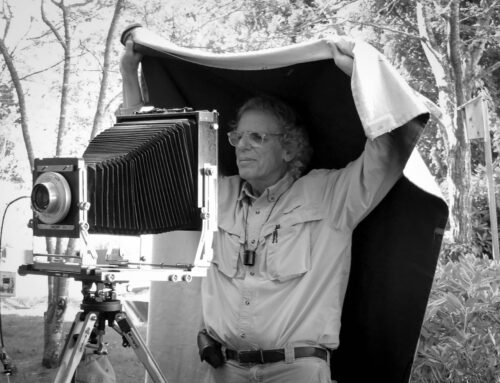
Photography by Gil Vaknin
There are animal tracks painted on the pavement at Green Chimneys. Follow them, and they’ll lead you past the gym, past the health center, past the dining hall and straight to the farm. It’s a fitting metaphor for how this extraordinary institution has always operated: if you want to reach a child who is struggling, sometimes you start by pointing them toward nature.
Green Chimneys’ main campus, nestled on 175 acres in Brewster, is far more than a weekend farm destination for families. At its core, it is a therapeutic day school and residential treatment center, one that has been quietly transforming the lives of children with social, emotional and behavioral challenges since 1947 by harnessing the singular power of the natural world.
Why animals? The philosophy behind the farm
Research on animal-assisted treatment has expanded considerably in recent decades, but Green Chimneys built its model on something simpler and more intuitive. The organization has long believed that nature offers what clinical settings often cannot. According to Green Chimneys, the concept is that nature gives you a chance to be in an accepting environment and to go at your own pace.
Science backs that instinct. “Animals help regulate the nervous system, serve as co-regulators and attachment figures that model safe, consistent relationships, and provide immediate, natural feedback about tone, energy and behavior,” says Kristin Licardi, the organization’s chief clinical officer. Research, she says, consistently shows animals can improve children’s attention and focus, executive functioning, motivation, empathy, self-awareness, emotional regulation and impulse control. “Since the bulk of our youth have deficits in many of these skills, animal-assisted interventions are well-matched to their treatment goals.”
Children who have spent much of their lives dysregulated, struggle to connect with adults and peers, and have rarely been in a position of competence or control often find that the non-judgmental quality of the natural world is exactly what they need. At Green Chimneys, the most fundamental struggle isn’t academic; it’s social and emotional. It’s designed to help kids make a connection because empathy and compassion are really hard for a kid who struggles to identify and manage their emotions.
Green Chimneys makes a careful distinction between animal-assisted treatment, which requires a licensed clinician certified in that specialty, and animal-assisted education, the broader category of activities its staff are trained to facilitate. Licardi says planned sessions might involve an obstacle course or structured activity, while a crisis intervention requires no setup. “Regardless of goal or intent,” she says, “there is always a big focus on observation skills, observing what is inside you: your thoughts, feelings, body sensations and urges, along with what is happening with the animal and in the environment.”
That therapeutic work is formally integrated with approaches like dialectical behavioral therapy (DBT), cognitive behavioral therapy (CBT) and narrative therapy, but it also happens organically. “We can move interventions into a natural outdoor space or walk a kid in crisis through the farm, which also has a positive impact,” Licardi says. “It’s a powerful resource.”
The farm is also, quite literally, a classroom. Farm classes, wildlife classes and staggered outdoor sessions are built into the school day. A student pulled from class for an occupational therapy session might find that session happening outside, among the animals. A student struggling with math might come down to measure feed. But the deepest lessons are not academic. They’re also learning other lessons about birth, death and caretaking for sick animals. Green Chimneys said goodbye to a beloved sheep, Bo Peep, with a memorial service. In an environment designed around emotional development, learning to grieve together matters.
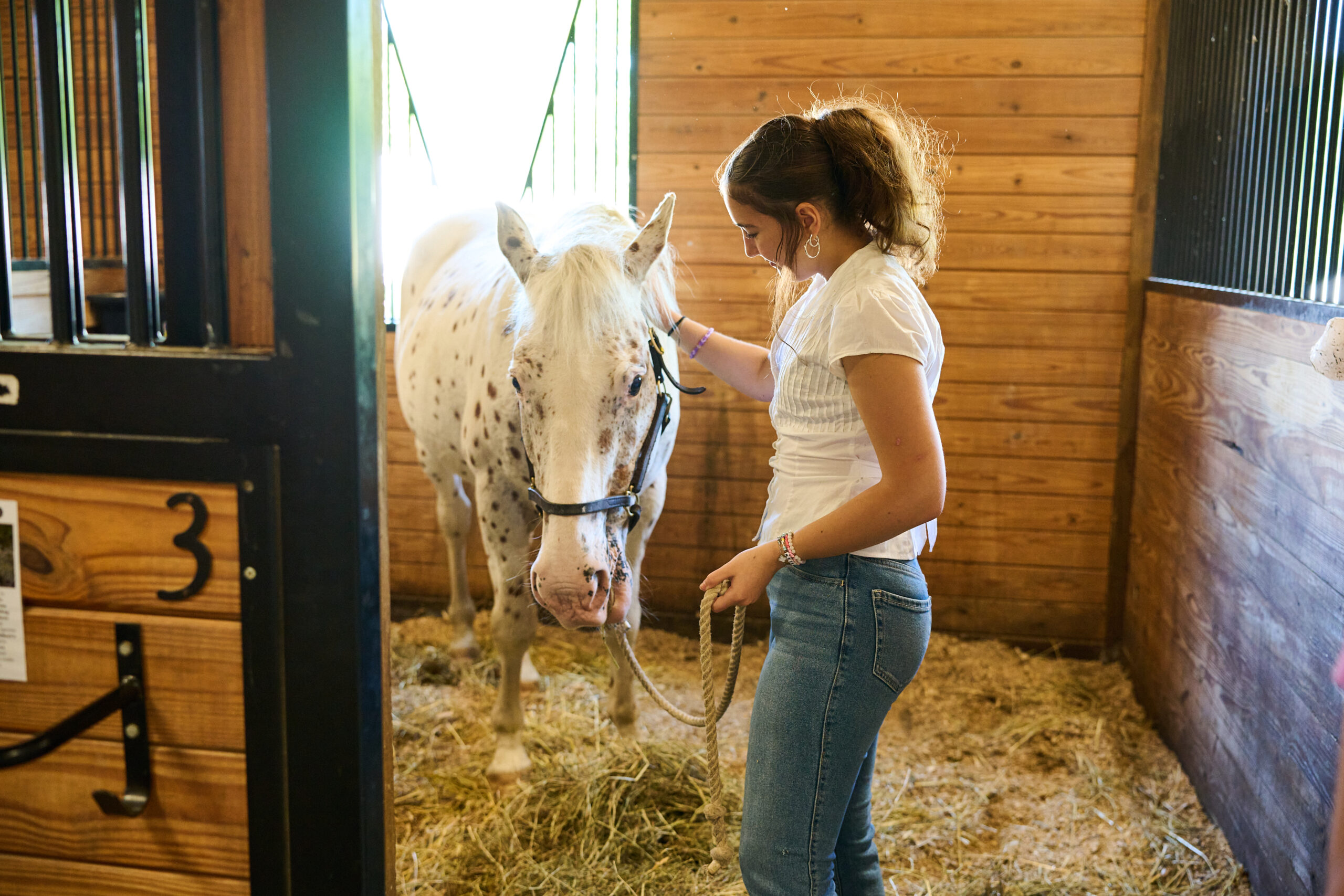
Gem leading Gandalf, a Appaloosa-draft cross horse, out of his stall for a walk.
A different kind of school
Green Chimneys School serves grades 2 through 12, and most students are placed there by their home school districts after determining the student’s needs require a higher level of support. Every student arrives with an Individualized Education Plan (IEP), a legal document that outlines the specialized support the child requires, and a history of mental health needs that a traditional classroom simply cannot meet. The school offers speech therapy, occupational therapy, social workers, psychologists and a psychiatrist. And the farm is woven through every aspect of that care.
Breakthroughs, when they come, tend to be quiet. Miyako Kinoshita, the assistant director of nature-based education, says her favorite example involves a student who, for months, had the job of feeding the horses each morning at 7:30. Every week, promptly at 8 a.m., he would stop mid-task, wash his hands and head to the dining hall. One morning, on his way out, he stopped and told staff that he had not yet fed the donkeys and asked who would do it. When he was told someone else would take care of it, he thought for a moment, turned around and said the donkeys had to be fed and that he had to do it before he left. After that day, he finished feeding every animal before heading to breakfast at 8:30 a.m., sitting with staff to eat before reporting to class. “Though he was half an hour late for breakfast,” Kinoshita says, “he felt accomplished and proud of himself for tending to the needs of another.”
Michael Kaufmann, vice president of nature-based programs, says this is exactly the point. The animals are a solid bridge between the staff and students, and often the human relationships with a therapist or teacher really grow in the presence of the animals. “Progress is not a single eureka moment,” he is careful to note. “It is about building healthy relationships with people and animals over time, which helps them learn how to interact with others, be socially aware, and gain skills, knowledge and confidence.”
Families are considered partners in that progress from the very beginning. “They are a critical part of our treatment team,” Licardi says. “They know their child best and are working hard to make sure they get what they need to thrive.” Green Chimneys supports the transfer of skills from campus to home through parent training, coaching and family counseling.
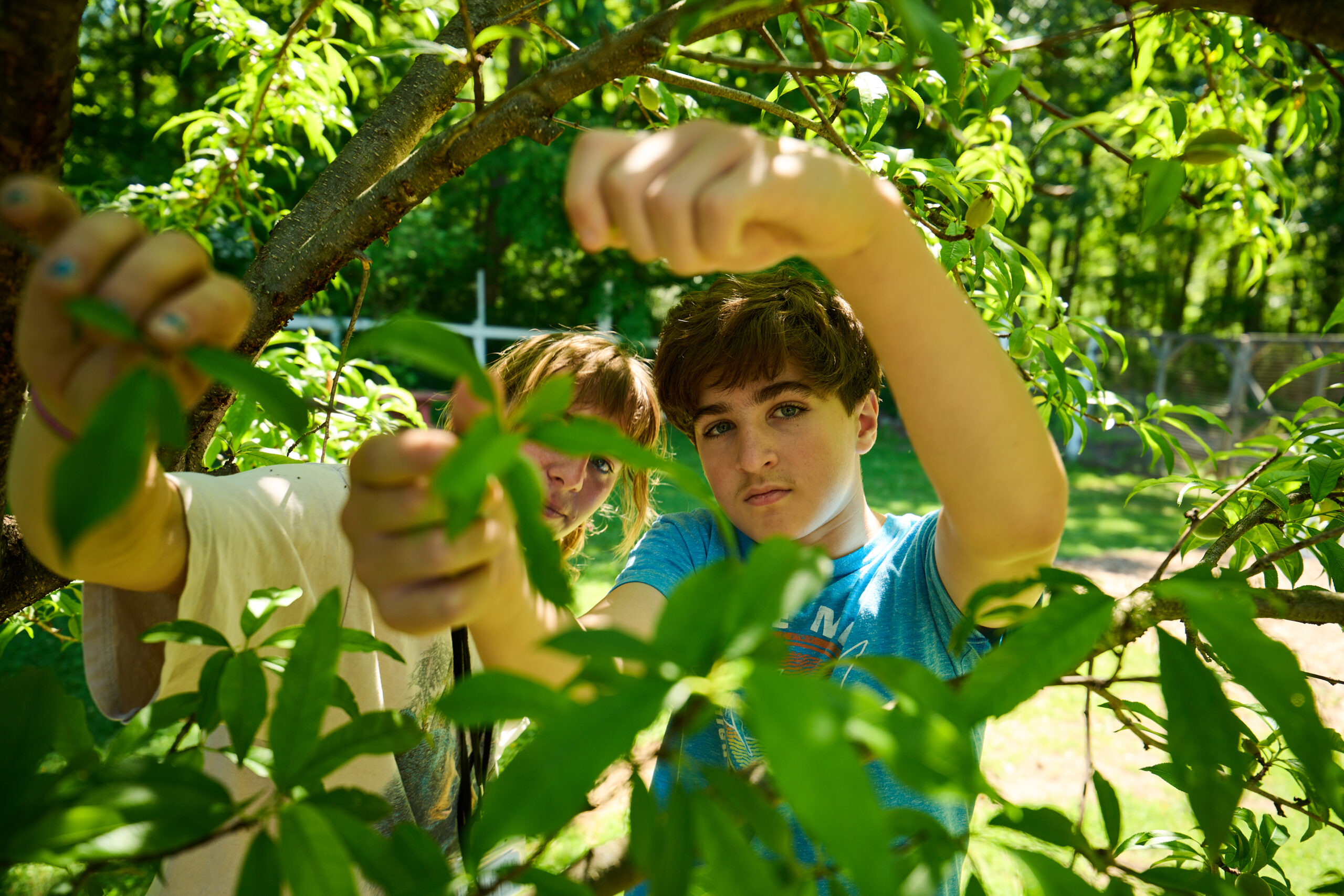
Matteo and Lauren Pudelka, the garden teacher, thinning a peach tree.
Meet the roster
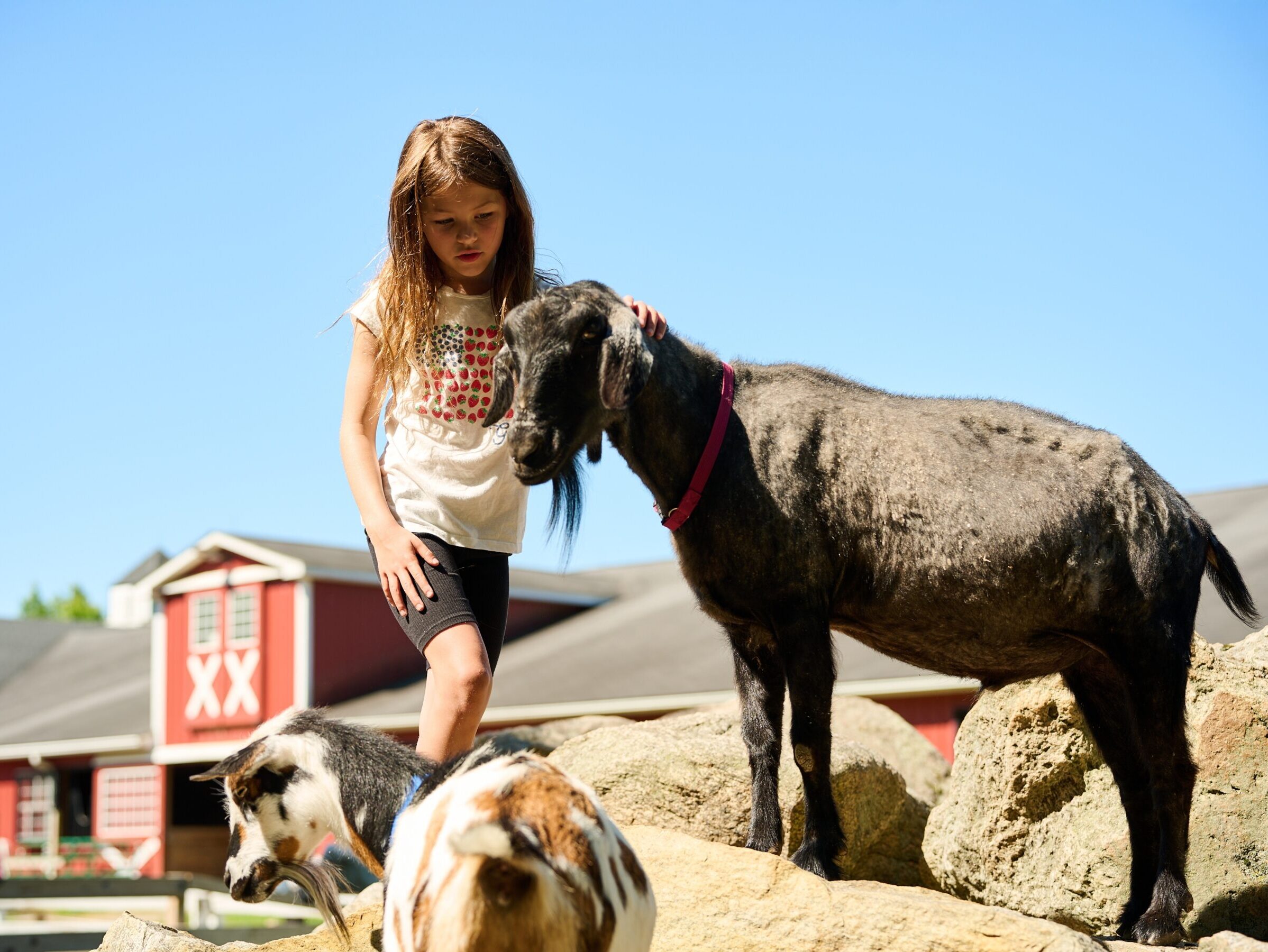
The farm at Green Chimneys is a serious operation. Cows, goats, pigs, sheep, llamas, alpacas, chickens of several breeds (including fluffy-feathered Silkie bantams), rabbits and pigs (who even have designer names: Prada, Batman and Dior) populate the grounds. Peacocks roam freely, five at last count, with white peacocks housed in the wildlife center and new females integrated slowly into the flock. There is also an impressively large Andean Condor, which was bred in captivity at the Washington, D.C. Zoo and couldn’t be released into the wild due to excessive imprinting on humans; Green Chimneys offered to care for it.
Every animal here has a backstory that mirrors the mission of the school itself. Sebastian the llama spent his early years as a companion animal in Connecticut, keeping elderly residents company at a nearby senior living facility before finding his way to Green Chimneys in 2022. Easygoing and patient by nature, he has become a favorite among students who groom him and take him for walks. He is also, by all accounts, a devoted mess-maker, known for rolling in the sandpit until staff need a leaf blower to make him presentable again.
The goat pen is home to Christopher, Annie and Hazel, a trio of Nigerian dwarf goats who arrived in 2024 after spending time at another therapeutic school. Despite their experience around children, settling into a new herd with unfamiliar faces took time. Students watched the three slowly find their footing and build new friendships, a process that mirrored their own in ways that did not go unnoticed.
Two miniature donkeys, Russell and Francisco, joined the farm in February 2025 after being donated by an equine rescue organization. The pair look nearly identical, both sporting white coats, but students quickly learned an important trick to distinguish them: Russell has a soft pink nose while Francisco’s is a deeper gray. Russell, the eldest at 20, is cheerfully social. Francisco, a decade younger, is more cautious but warms up to students who approach him with patience and calm energy. Learning to meet him on his terms has become a lesson in itself.
In the farm classroom, four guinea pigs named Honey, Calamity, Minerva and Freya live in a habitat with a tunnel that opens directly onto the classroom table. When they are ready to engage, they come out on their own. When they have had enough, they retreat. Students learn to read those cues and understand that the animals, like people, get to decide when they want to participate.
Then there are the horses. Maple, a gentle Clydesdale, first arrived in 2021 and quickly became a student favorite. When riding became uncomfortable for her, students were deeply involved in her care and recovery, which became a lesson in empathy. Eventually, she was rehomed, but when Green Chimneys transitioned their equine program to one that focused on non-riding activities this year, Maple returned along with Sprout, a miniature horse companion whose name was chosen by the students. Together, they are helping kids build confidence through therapeutic sessions, herd behavior and hands-on training.
Also in the barn is Mortimer (or Morty for short), a senior warmblood horse who arrived at Green Chimneys after being found abandoned, underweight and injured. He now suffers from several chronic health conditions that require daily attention, and his care is folded into the program. Students learn hands-on about veterinary treatments, including laser therapy and bandaging, while working with him on leading, grooming and reading equine body language. For young people who often feel defined by what they cannot do, caring for an animal who genuinely needs them is a meaningful experience.
For animals that Green Chimneys takes in, the intention is that it will be a forever home. Some arrive through rescue or rehabilitation; others simply come as strays.
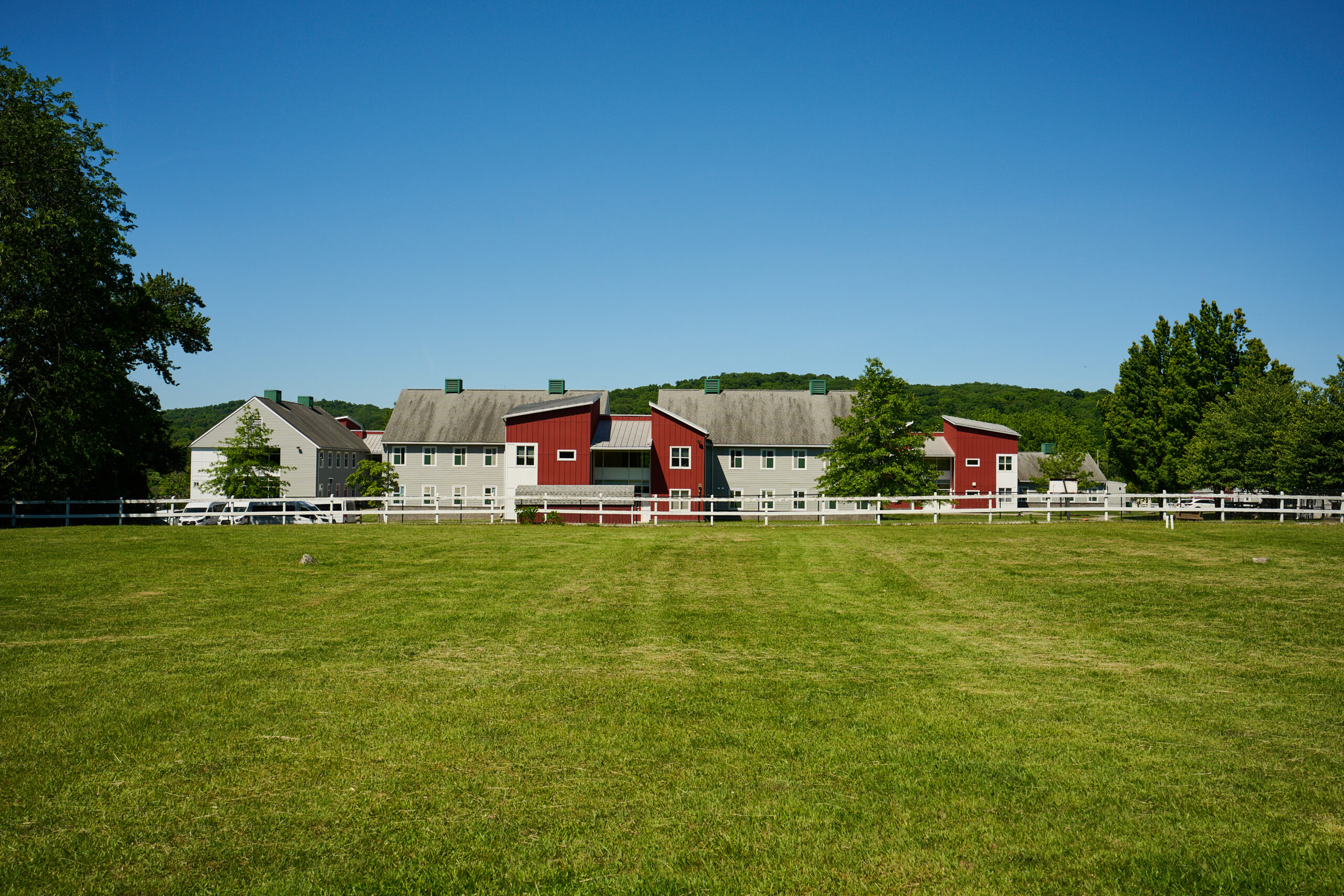
A view of the student residential complex, taken from the school garden.
What happens when a child is afraid
Not every student arrives eager to muck out a stall. Fear is a normal part of the process, and the staff handle it with care. “We use a combination of great patience, no force, and a gradual introduction to the setting,” says Kaufmann, who is also the director of the Sam and Myra Ross Institute, which serves as the education foundation of Green Chimneys and oversees research projects. “Fear is normal, as is sensory overload due to dirt, manure, sounds and smells, so we let interest emerge naturally and gradually.”
The numbers tell their own story. “Of our 200 students,” Kaufmann says, “160 volunteered for extra time with animals, and many of those students were afraid at the start.” Kinoshita explains that more experienced students play a key role in that transition. “Students who have been here longer often show new students how things are done,” she says. “Observing others enjoy safe and meaningful interactions allows a new student to gradually gain confidence.”
Come on the weekend
What makes Green Chimneys unusual, and unusually generous, is that its farm and wildlife center are open to the public, free of charge, every Saturday and Sunday from 10 a.m. to 3 p.m. Anyone, including children, can walk the grounds and get close to the animals, though visitors are asked not to touch them. The peacocks, who roam freely, will show off their plumage but walk away from humans if you get too close. Plan to spend at least an hour, and be sure to stop by the organization’s country store to buy some fresh eggs. There is more ground here than it first appears—the barns, outdoor paddocks, bird enclosures, ponds, etc. are worth a visit. The animal-track markers on the pavement will show you the way. Go at your own pace, and see what happens when you let nature meet you where you are.
This article was edited by Julie Schwietert Collazo and fact-checked by Isabella Aranda Garcia. The photographer used Adobe Creative Suite to edit his photos.
This article was published in the July/August 2026 edition of Connect to Northern Westchester.

Liz Colombini
Based in Yorktown Heights, Liz lives in the mountains with her partner, two kids, a few black cats and her dog Delta, who likes to herd their small flock of chickens. A self-proclaimed news junkie, she’s passionate about gardening, fitness and collecting tattoos, with each one telling its own story.

Gil Vaknin
With a camera in hand and a knack for making people feel comfortable, local photographer Gil Vaknin captures everything from corporate events and headshots to sports and lifestyle photography. His goal is simple: create images that tell a story and leave a lasting impression. The photo of Phoenix the camel at the top of this page is a testament to that vision, making such an impression on the editor-in-chief that she insisted it be featured in this issue.