
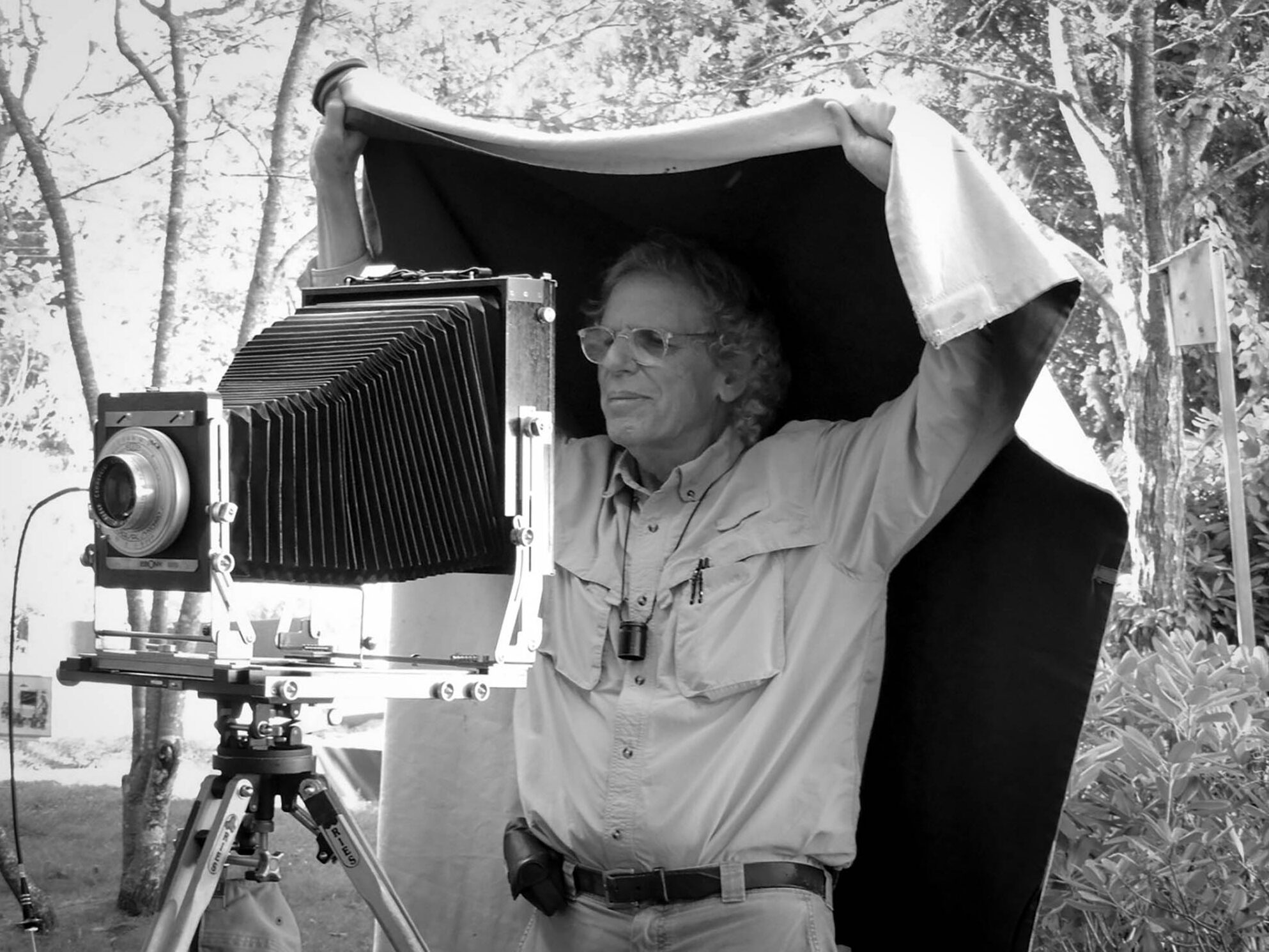
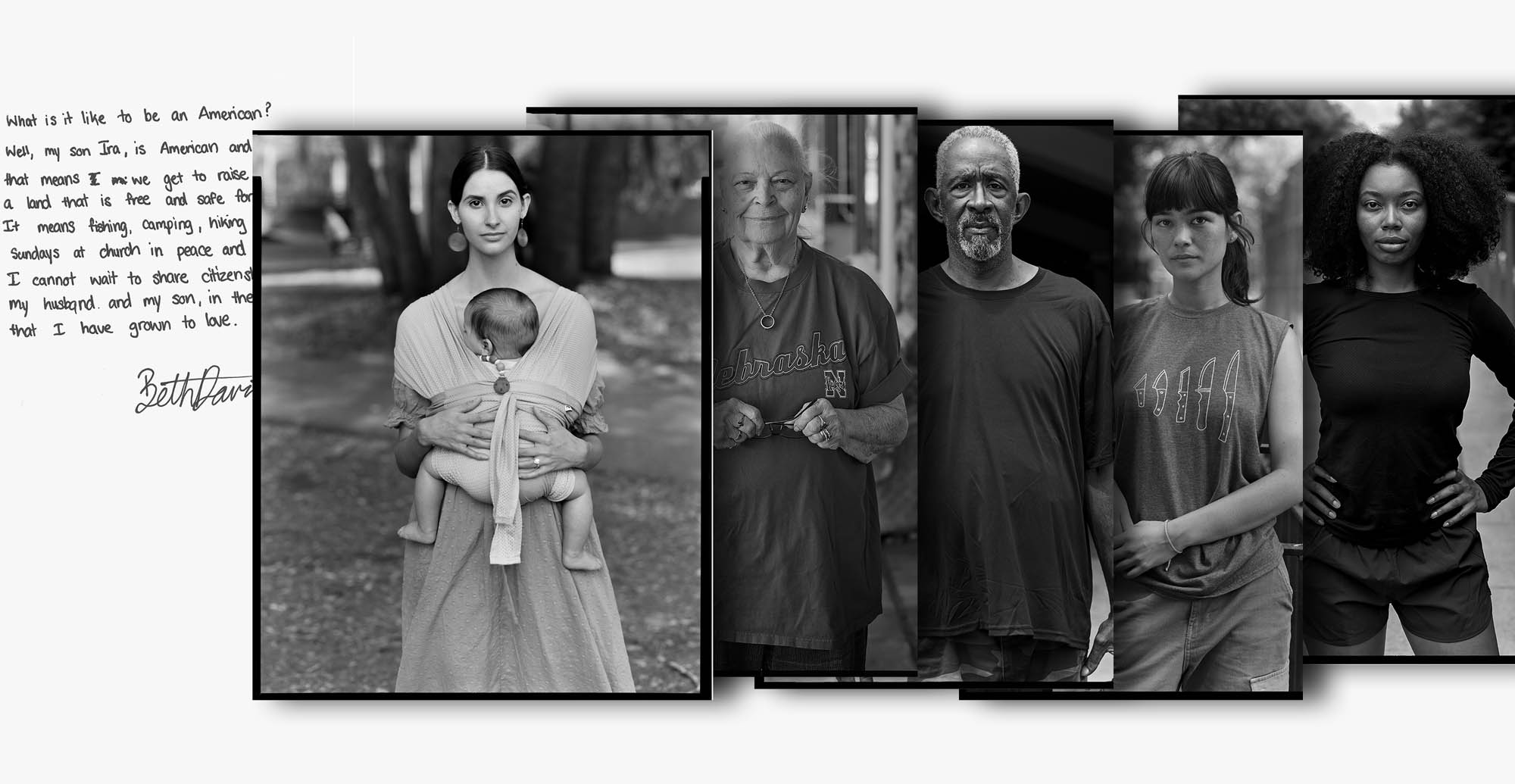
Between 2022 and 2024, Robert Kalman, a Brewster-based documentary portrait photographer, could often be found standing outside a “greasy spoon” somewhere in America. Armed with an 8×10 camera that equals him in height, Kalman would specifically instruct his subjects not to smile. He’d take their picture and then ask them a seemingly simple question: What does it mean to be an American? The person would answer aloud, and then Kalman would hand them his notebook so they could write it down. Over the course of the three years (the project began in New York in 2021), Kalman and his wife-slash-assistant Linda, met about 500 people throughout the country, and they received 500 different responses.
“I offered no observation or response,” says Kalman. “I accepted what they said, which was pretty challenging sometimes. The portraits are really good, but the heart of this project is the statements. They really reflect how diverse we are.”
Kalman wasn’t sure what to expect, but he went into the project with an open mind. “I learned that our national identity is defined by our differences,” he explains. “It occurred to me that if you go to Norway, Denmark or Nigeria, everyone’s DNA is fairly consistent across the country, but Americans are from a lot of different places. It’s e pluribus unum—out of many, one.”
The project’s concept was born while looking for something to do during Covid. Kalman, a longtime portrait photographer, saw masks as a barrier to his traditional work, so he began photographing something he found surprising: American flags “damaged and soiled and in disarray.” He and Linda traveled the Hudson Valley, and during a December 2020 trip, they came across a town where “the street was festooned with American flags, all of them nicely arrayed and nicely displayed,” Kalman remembers. “So I said to Linda, ‘Wow, looks like a lot of Americans live here.’ And then, as a throwaway line, I said, ‘I wonder what it’s like for them to be Americans?’ A few weeks later, January 6th happened, and now we had a project.”
They photographed and documented about 100 New Yorkers then Kalman shared his work with a group of photographers. One said, “These are brilliant photographs; they really deserve to be seen. But you’re not nearly done. New York isn’t the United States.”
So Kalman and his wife began setting up shop just outside “greasy spoons” across America because, Kalman says, “that’s where real Americans can be found.” The two serve as a team, with Linda being the first person to approach a potential subject. “I send Linda over first to break the ice,” Kalman says. “I’m standing there with a big camera, and I’m a big white guy from New York. But Linda’s this wonderful figure from the Midwest. She has a very high success rate.”
After putting them at ease, Kalman asks his subject to stand in front of the camera and not smile. During a trip to Hermiston, Oregon, Kalman noticed an older woman step out of her car wearing a bright red T-shirt that said “Nebraska” in what Kalman describes as “MAGA red.” Before she agreed to be photographed, Kalman says, “she looked me up and down and said, ‘You’re not a Democrat, are you?’ I paused, looked at her and said, ‘Ma’am, what I am is an American, just like you.’” Then she agreed.
While in Alabama, they met a “short little white guy with a little goatee” who was recently released from jail and told Kalman, “Jesus found me in jail.” They also met a 17-year-old girl who said her mother is a pharmacist and knows three languages, but she’s found it very hard to grow up in America because she’s different; she’s Muslim. And the last person in his book, which features 76 people, was perhaps the most memorable.
“We were in South Carolina, and I see this absolutely stunning woman across the street in a park, and she’s holding a baby,” Kalman remembers. “So I sent Linda over while I began schlepping my big camera across the street. Linda returned and said, ‘She’s not an American.’ So I walked over and asked her about her heritage. She responded, ‘I’m Trinidadian.’ And then she looked at me and said, ‘But my baby’s an American. I’m married to the Marine sitting over there.’ So the very last photo of the book, which is beyond everything, is of her holding the baby. It’s very subtle, but it’s there—this hopeful and optimistic American cradled in the arms of someone who wants to be an American by choice.”
Select images from Robert Kalman’s book, “What’s it like for you to be an American?” will be on display at Chroma Fine Art Gallery in Katonah from September 15 through October 11. The opening reception will be held on September 19, 4-8 p.m.
This article was published in the July/August 2026 edition of Connect to Northern Westchester.

The editorial staff at Connect To magazine.