

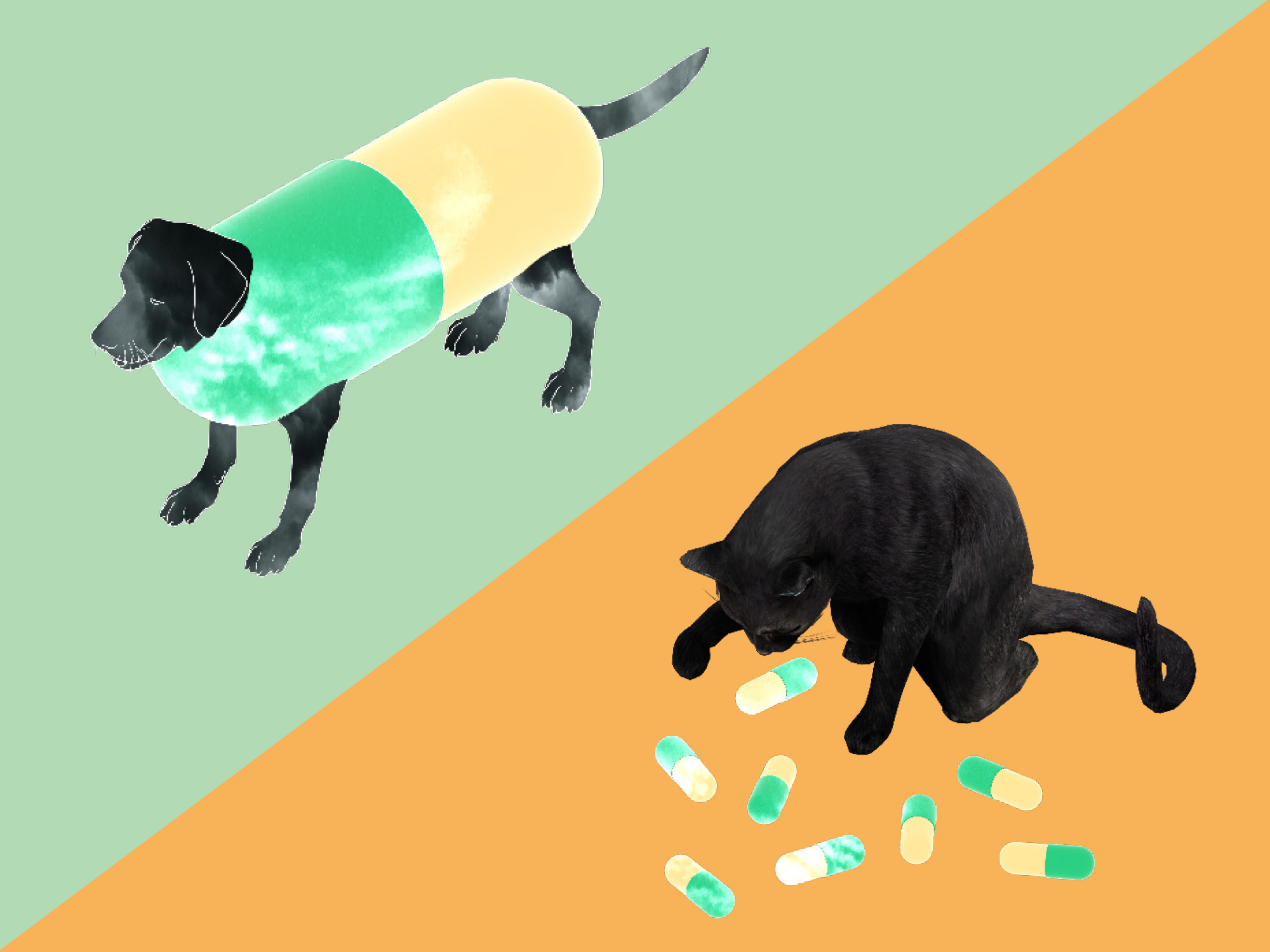
Better living through chemistry: it’s not just for humans
By Dr. Sarah J. Cutler
Artwork by Eliyahu Greenwald
In my role as a veterinarian and director of At Home Vet Care and The Behavior Clinic for Cats and Dogs, as well as president-elect of the American Veterinary Society of Animal Behavior, I have counseled thousands of families regarding their behavioral concerns about their dogs or cats.
While some behavioral issues can be solved by the owners learning how to meet their pet’s needs with a proper home setup as well as humane training and enrichment, there are pets with more serious issues. Some dogs or cats struggle with anxiety, phobias, sensory overload, aggression towards humans, aggression towards other animals and more. Managing these issues might require medication: specifically fluoxetine, commonly known as Prozac.
Let’s talk honestly about medication
Many people have concerns about negative side effects of behavioral medications for their pet. Some have experienced side effects themselves, while others may have witnessed or heard of a friend or family member reacting poorly to an antidepressant. Pet owners frequently worry their pet will become loopy or seem overly sedated, or they will no longer feel joy or be playful.
Bedford Judge Jodi Kimmel’s dog, Alastair, was great with commands like sit, give paw, etc., but he was still full of anxiety. When I first met the Kimmels and Alastair, they expressed concerns about medication. “I was nervous that he’d lose his personality since I’d never had a dog on meds like this,” Kimmel remembers. I prescribed Reconcile, which is made with fluoxetine and gabapentin. “He was a little out of it for a couple of weeks while he got used to the meds, but then he seemed to just exhale,” Kimmel explains. “He still loved to play but without the nervous/frenetic energy he had. We actually all exhaled, and we’ve all been so happy ever since.”
The goal of these medications is to make the pet feel better, so if there is a negative side effect, the medication can and should be stopped. However, a decrease in appetite may be resolved by adjusting dosage. Generally, most dogs and cats tolerate fluoxetine very well, especially when prescribed low doses that are then increased slowly as needed.
What to consider before medication
If you’ve learned to read your pet’s body language and are providing your pet with appropriate activities and assistance at home, have your pet’s overall health and physical wellness examined. There are many behavioral concerns that overlap with physical discomfort, such as orthopedic pain, gastrointestinal upset, itchy skin or urinary tract diseases. Then, work with a trainer who employs the Fear Free philosophy (see my article in the July/August 2025 issue) to see if training can help reduce or remove the negative behaviors.
However, in some cases, even with the best home management and behavior modifications, your pet’s quality of life could still be poor. For example, they could have a severe noise phobia, struggle with unrelenting anxiety or pain, suffer from trauma or have a disorder. In these cases, medication can significantly improve your pet’s life.
Severe noise phobias
When a pet dog or cat suffers from a severe noise phobia, they might react to noises from:
- cell phone beeps & rings
- fireworks
- garbage disposals
- garage doors
- gunshots
- slamming doors
- smoke detectors
- storms
- wind
Even less disruptive sounds such as loud footsteps, hair dryers, video games and booming voices can cause fear and anxiety in some pets.
Pets might scramble away, tremble and shake, vocalize, cry or run and hide. In some cases, sudden jarring noises can cause a cat or dog to be so startled that they become aggressive to the nearest person or animal. Dogs can struggle with the basic need to go outside because of the noise level, and cats might never come out of hiding in their own home.
You can help your pet with this issue by modifying the noises in the home, being a calm and reassuring presence, working on behavior modifications, using things like Thundershirts or Happy Hoodies, and providing a safe and quiet environment. However, there are times when the environmental sounds cannot be modified or the pet’s sensitivity is so profound that they continue to struggle.
This is when a veterinarian may consider trialing medications to reduce the sensory overload as well as the anxiety associated with that sensory overload. Fluoxetine helps the body utilize the serotonin it already produces and calms down the brain’s reactions to the noise issues. It can have anti-anxiety effects and help the brain slow down enough to improve learning and processing.
Aggression due to fear, anxiety or pain
Non-predatory aggression in dogs and cats is usually a result of fear, anxiety or pain. If you believe your pet to be struggling with this, your first step is to determine their triggers.
In many cases, consent-based handling is the best place to begin. You can learn how to do this through a professional who takes a compassionate and scientific approach. Further treatments for aggression involve avoiding the triggers, working with behavior modification, implementing relaxation protocols and using positive reinforcement techniques.
For example, if your dog is fearful of strangers and they growl, bark and lunge when a stranger approaches, they are trying to communicate they are uneasy; their behavior is an attempt to make the stranger move away. By putting distance between your dog and the stranger, you can diffuse the energy. Then, by pairing calm human reassurance, treats, or playing games in the presence of the stranger (at a distance), you can help change your dog’s negative feelings to neutral or positive.
But for some pets, it’s not just strangers. Their anxiety is so severe that they demonstrate these behaviors with their human family members. “Prior to medication, Alastair growled at my husband,” Kimmel explains. “We thought a lot of the other behaviors were puppy behaviors that he never outgrew. He wouldn’t let us sit at the table to eat dinner; he’d bark until I went outside to throw a toy for him. He wouldn’t let anyone sit quietly. It was exhausting and felt like another job for me.”
In cases like this, the pet’s anxiety is so profound that even with all the best care, adding medication can be a game changer. In some dogs, their fear reaction is so intense, or the environment won’t allow for distance, that learning is completely impaired, and the owners cannot progress with training alone. This is when a trial of fluoxetine is helpful. It could slow down the highly activated neurons enough for your dog to learn an alternative behavior.
“The medication has been life-changing,” Kimmel says. “Alastair’s anxiety eased in a way we never thought possible. While I’m still his favorite human, thanks to medication, there’s been major progress with his reactions to my husband. We are incredibly grateful to Dr. Cutler for recognizing what Alastair needed and giving him the chance to feel calm, confident and himself again.”
*Please note: Forceful training tools and techniques will cause anxiety to worsen.*
A pain-based feline syndrome
If your feline friend is constantly feisty, they might be suffering from a syndrome called Feline Hyperesthesia Syndrome, which causes an unpleasant muscle rippling sensation down the back. At rest, your cat’s eyes will dilate, their ears may twitch, then the sensation will progress down the back, and they may suddenly look at their hind end.
In some cats, it will cause them to attack their own feet or tails to the point of self-mutilation. Many of these cats don’t tolerate petting and may bite. In some cases, these sensations will trigger aggression towards another cat in the home, and other animals in the home may be triggered to aggress towards the twitchy cat. This syndrome is poorly understood, and it may have underlying physical causes such as skin or spinal disease. The use of pain medications and/or fluoxetine can be very helpful. This is an example of when physical and psychological conditions occur simultaneously.
 Lasting trauma
When a dog experiences neglect, trauma or abusive training, they may develop lifelong fears and anxieties. Giving them love, good food and medical care, while also removing any aversive-type training, are essential components of rehabilitation.
However, some dogs struggle to recover, remaining in a state of anxiety, despite all their human’s efforts. In these cases, offering a pharmaceutical boost may help them heal and learn to trust the world again.
Decisions about medications should be made with care, using meticulous attention to detail regarding the general health and appetite of your pet, the ease of administration, and your ability to monitor your pet closely. Thankfully, most medications for behavioral concerns are tolerated well and are safe.
It’s crucial to recognize that all the spheres of a pet’s life must be addressed for the best behavioral health outcomes. In other words, are they getting enough sleep, exercise, attention, proper nutrition and relaxation time? Can you reduce the noise levels and make sure all handling is gentle and respectful? Are their natural species-specific needs being met, and do they have enough opportunities to move freely and make choices in their daily life? In some cases, once all of the above has been sorted out, medications may not even be needed. But in other cases, the underlying anxiety or pain disorder is such that adding in appropriate medications can help your pet go from worry to wags and feisty to friendly.
This article was published in the January/February 2026 edition of Connect to Northern Westchester.
To view all 2026 Connect to the Best winners, click here.

Dr. Sarah J. Cutler
Dr. Sarah J. Cutler is a small animal veterinarian with more than 34 years of experience working with cats and dogs in the suburban and urban New York region. She graduated from the University of Pennsylvania’s School of Veterinary Medicine in 1997, where she began her studies in small animal behavior medicine with Dr. Karen Overall. For the past three decades Dr. Cutler has practiced medicine, surgery, and focused on the science of learning behavior and the human-animal bond. Dr. Cutler has worked in large/busy hospitals, consulted with multiple canine rescue groups, and founded At Home Vet Care (a house-call practice) in 2010 to provide high-quality medical and behavioral care in the comfort of pets’ homes. In 2021, Dr. Cutler opened the Behavior Clinic for Cats and Dogs in Bedford Hills with a team of certified Fear Free Professionals. Dr. Cutler is licensed to practice in both NY and CT and continues to study and learn through NAVC Institutes and yearly continuing education. Dr. Cutler is passionate about continuing her education while helping educate others, as well as using her voice to protect and advocate for the rights and needs of our beloved cats and dogs.