
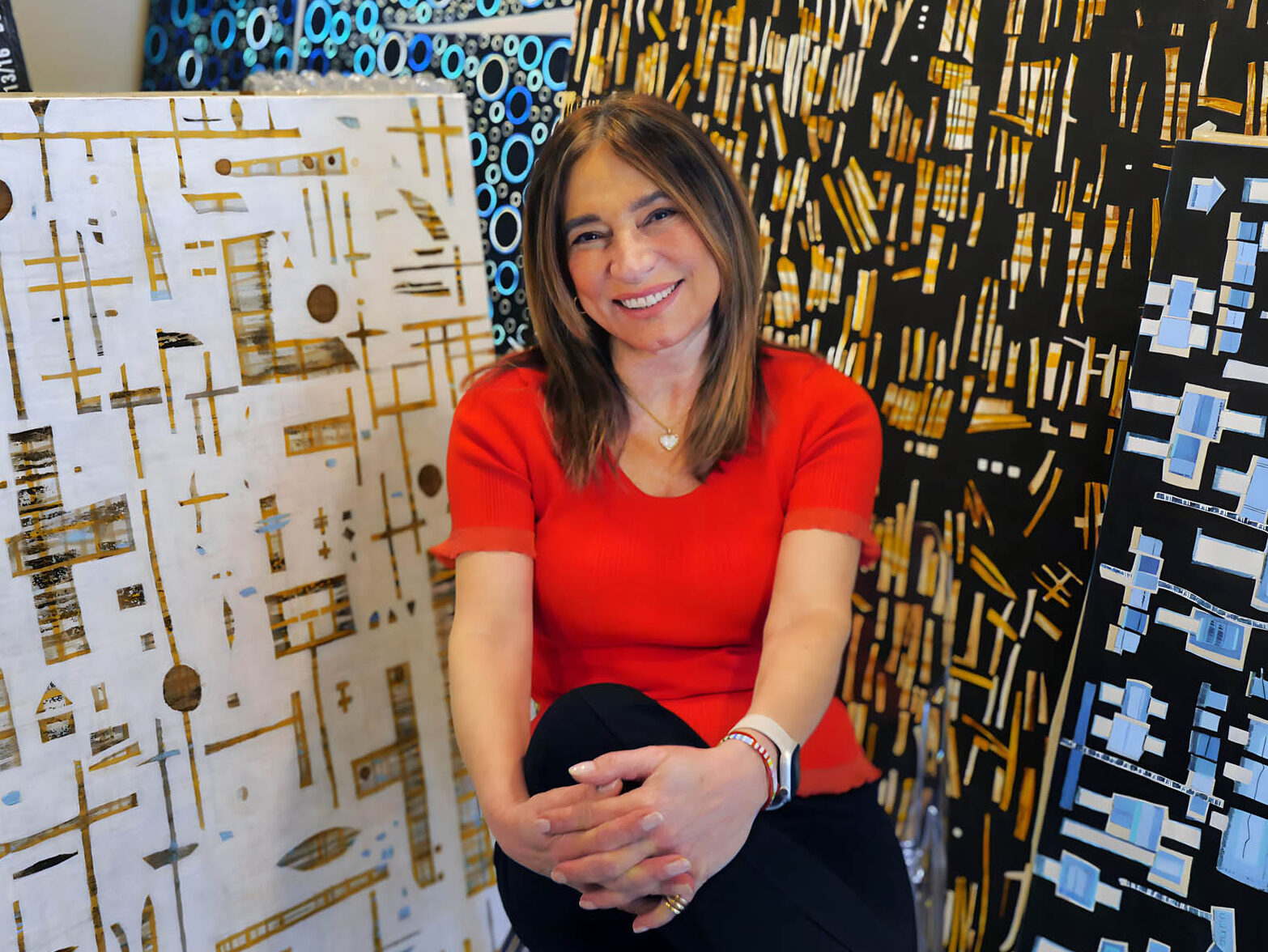
On a gray Saturday afternoon in March, artist Sofie Swann is in her light-filled basement studio standing in front of three large cardboard boxes. She gently lifts each one to reveal a small, brightly colored, shiny wood panel painted with brightly colored flowers. “These are my little resin pieces, and they’re curing right now,” she says, carefully placing each cardboard box back down to cover the painting underneath before she reveals the next one. “I applied the resin this morning, and they’ll remain covered for a good 24-48 hours until the resin is dry because if the slightest speck falls into the resin, it’ll stick and ruin the painting. Then, they sit for two to three weeks before I can ship them out.”
These wood panels are part of Swann’s Petits Swanns series. As the name suggests, Swann uses small wooden cubes and panels as her canvas, painting patterns of flowers, circles, dots, and other shapes that reflect the five other series of works she’s produced. Originally, they were for her—she wanted to decorate her coffee table and shelves with small pieces of art. But last year, when Rita Baunok, owner of Chroma Fine Art Gallery in Katonah, visited Swann’s studio to select pieces of work for an upcoming show, Swann learned they would also look beautiful hung on a wall. “After that show, I began hanging them on my own walls, and it inspired buyers to do the same,” Swann remembers.
“I love the end result of these pieces; they’re so beautiful,” Swann says. “But applying the resin is my least favorite part of the process; it’s incredibly stressful. I clean everything first, and as I’m applying it, I have to be so careful not to let anything, not even an eyelash, fall into it. It takes three to four hours of babysitting these pieces—running an artist’s torch over each piece every few minutes to bring the bubbles to the surface—before I can cover them with a box to cure. I’ve ruined several pieces because of the resin, but the end result is worth it, especially for these small, shiny pieces that work everywhere.”
Whether Swann is painting a small wooden box or a large canvas, her art is defined by patterns and repetition. “It can be circles, it can be flowers, but for me, it’s about finding the rhythm in repetition,” she explains. “I find it soothing and meditative. And while the patterns in my work look very similar, when you look at them closely, they’re all slightly different because everything I do is freehand.”
It’s a consistent theme throughout Swann’s collections visually and behind the scenes. Her extensive process to prepare a canvas is always similar, yet the paintings themselves are all slightly different because each one is inspired by a memory or emotion. And for Swann, whose childhood was abruptly upended as a young teen and who has mostly raised her children alone, her memories and the emotions tied to them are seemingly endless.
A single suitcase
Swann was born in Tehran, Iran, and as a young girl, she was always drawing patterns in her notebooks. But her parents couldn’t wrap their minds around their daughter earning a living as an artist. “My parents were very modern and forward-thinking, but their mindset was that you go to school, and you become a doctor, a lawyer, an engineer—artistic fields were not encouraged,” she explains.
In high school, Swann, who grew up speaking Farsi and English, was uprooted from the only life she knew. The political situation in Iran was deteriorating, and her parents believed it would get worse. “They did not have enough time to get out themselves, but they knew they could get my younger brother and I on a plane, so they did,” Swann remembers. “With hardly any warning, they told us to pack one suitcase each, and we were sent to California to live with our uncle (he moved to the U.S. years earlier), his American wife and their three children. We left everything, never to see it again. It was such a traumatic experience.” Swann and her brother weren’t able to speak to their parents for approximately a full year due to communication blackouts. Years later, her parents left Iran and settled in New Canaan.
Meanwhile, Swann continued on the path her parents laid out for her, attending Smith College, where she majored in French literature and government, and then law school at Suffolk University, a decision that serves her even today. “It’s really helped me throughout my life,” she notes. “I’m able to read and understand legal documents, like contracts, as well as legislation.”
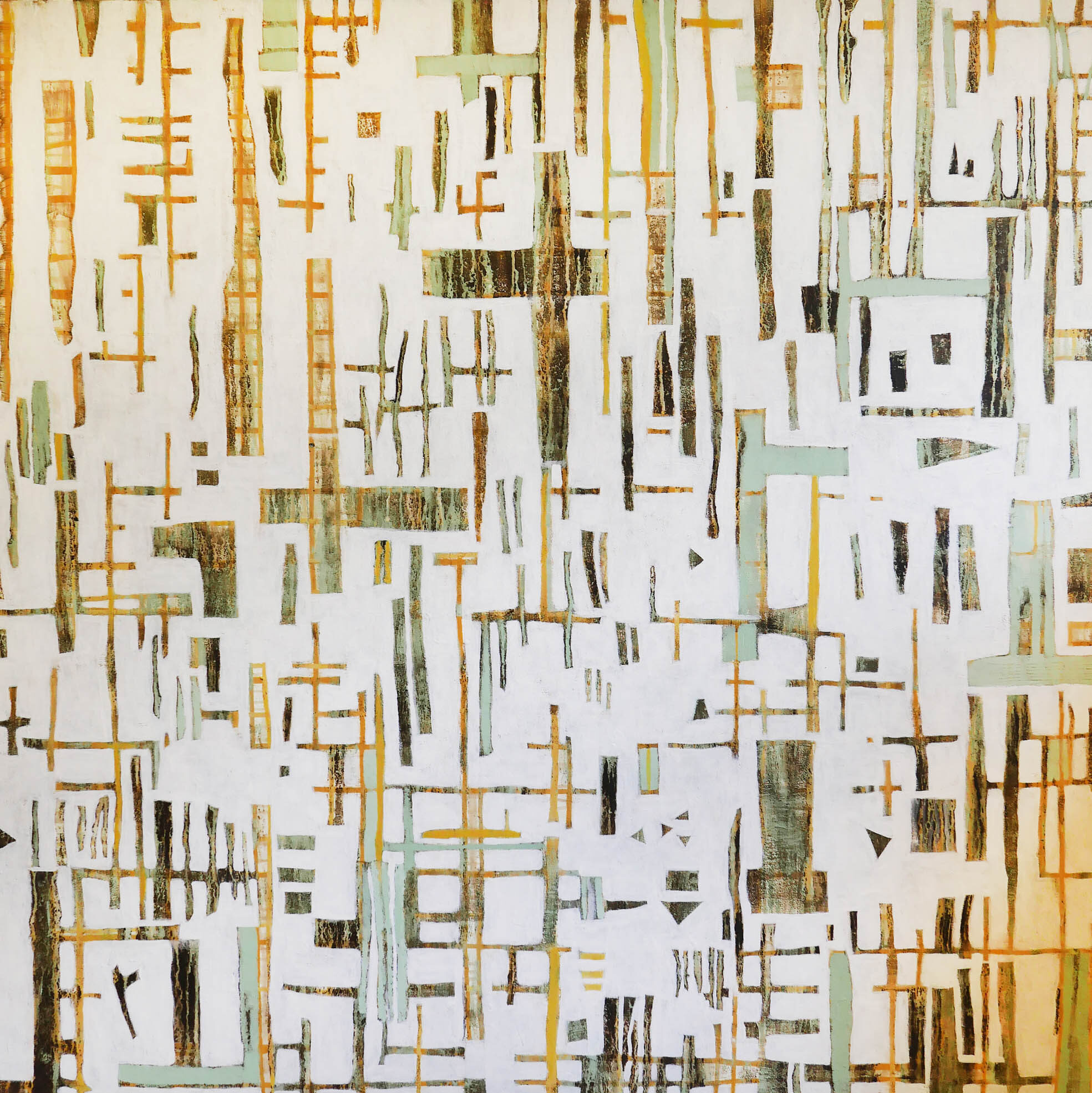
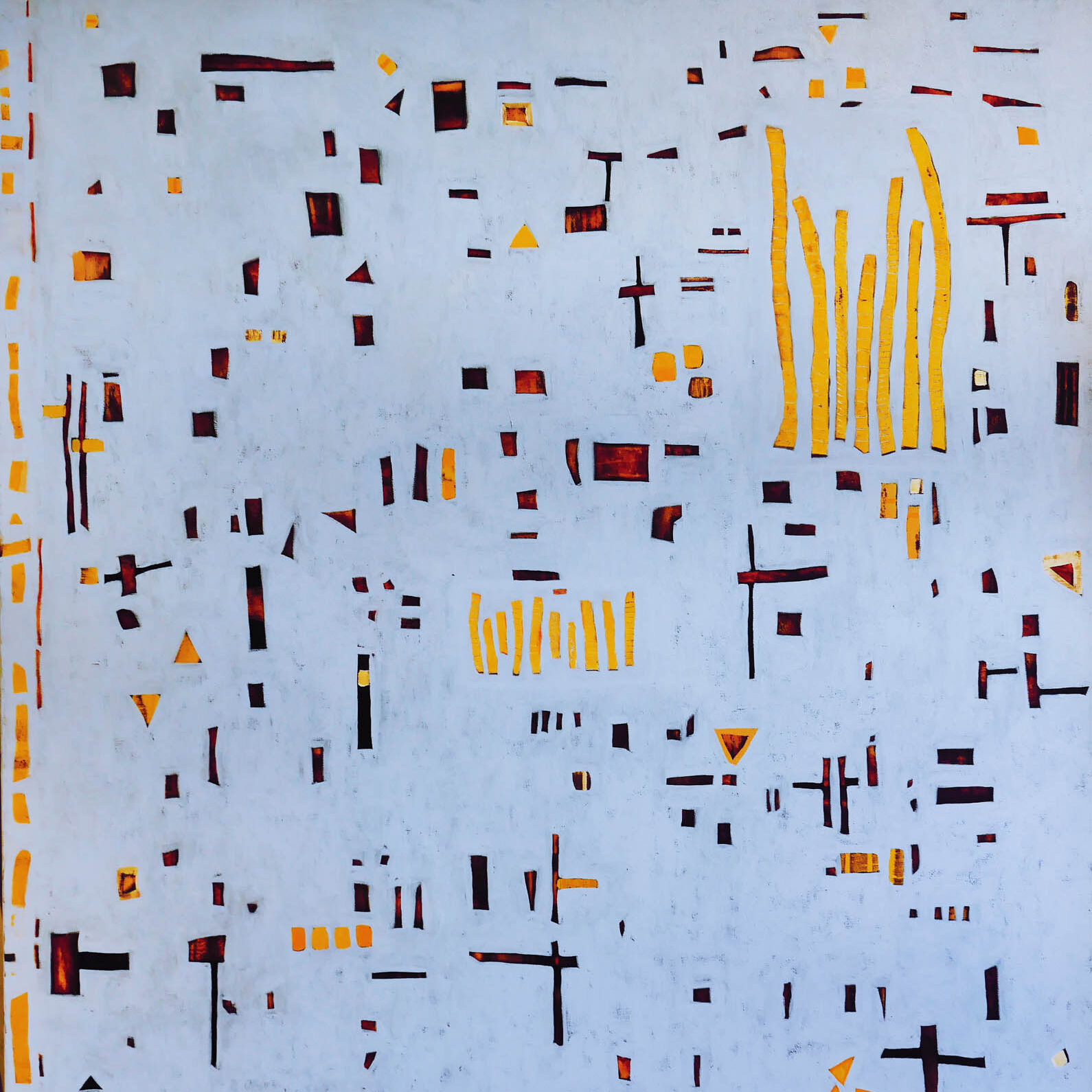
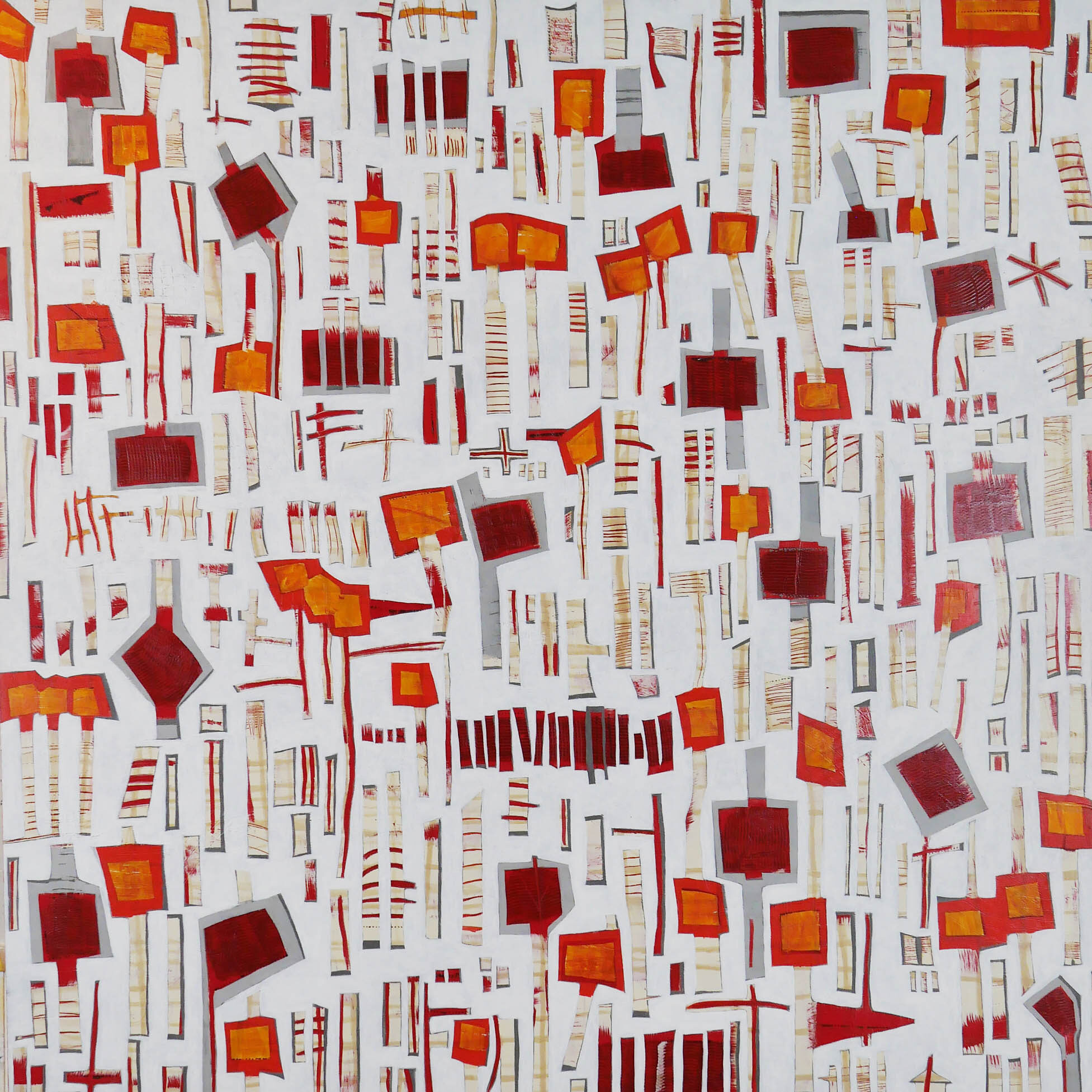
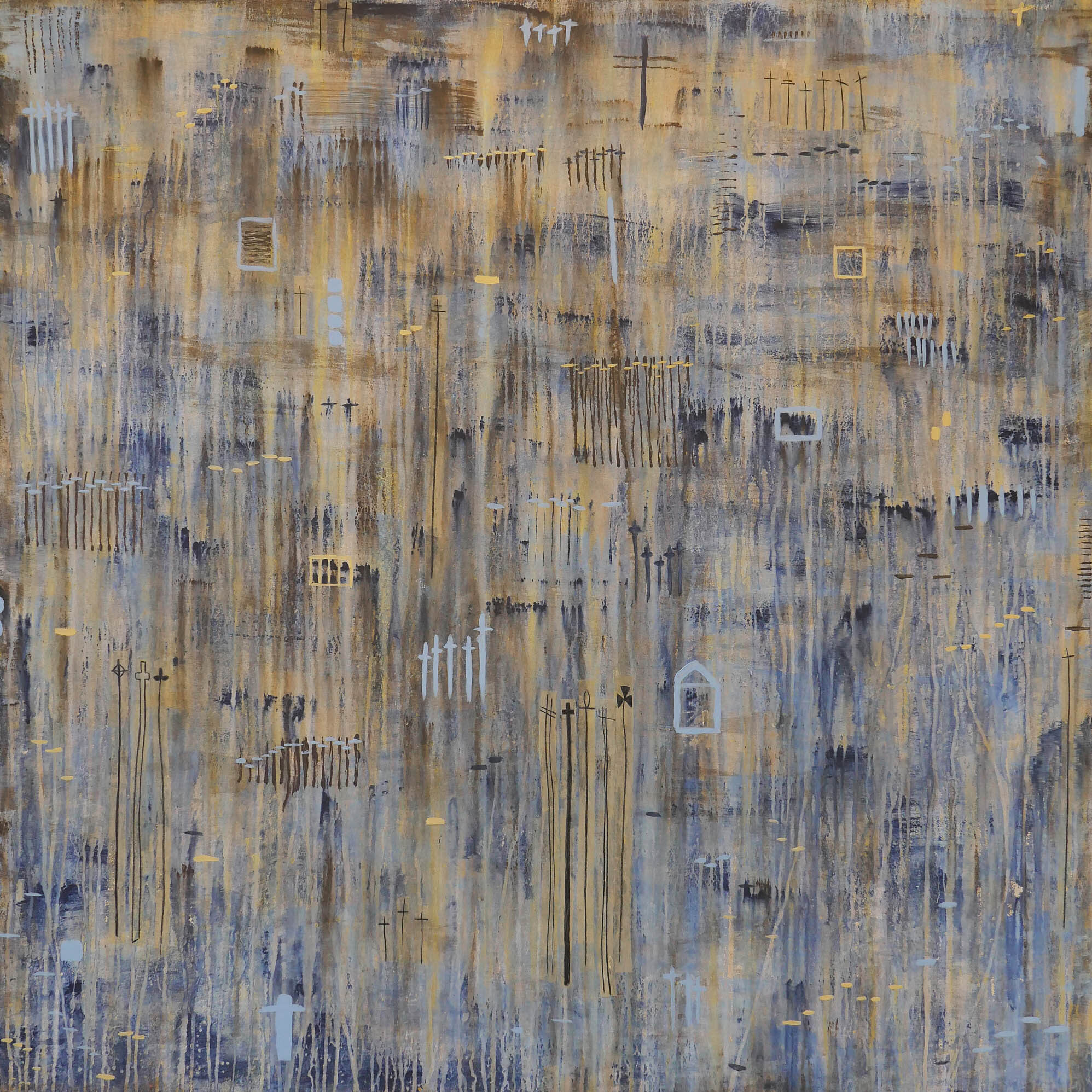
Clockwise from top left: “Exuvia,” acrylic and Persian tea on canvas; “Sail Away,” acrylic on canvas; “Gray in May,” acrylic on wood panel; “Lollipops #5,” acrylic and Persian tea on wood panel—all from the Present in the Past series.
A change of pace
Swann worked as a lawyer for five years before pursuing a more creative career. “I opened a home design store in Boston, called Repertoire, with a good friend of mine,” she explains. The store focused on mostly imported modern French and Italian home accessories and furniture. “That’s when the creative part of me wondered how I could have let this stay dormant for so long,” she remembers. “I was so happy.” During the years she co-owned Repertoire, Swann and her husband had two children. She also took several art classes at the School of the Museum of Fine Arts during that time. After approximately a decade of running Repertoire, Swann needed a change and made a bold decision: she moved her young family to Paris so her children could grow up bilingual.
Throughout the almost nine years they spent in Paris, Swann dedicated herself to raising her kids. When they returned to the U.S., Swann moved to Stamford to be near her mother. She used her legal background to secure a job at a financial firm.
Opening the box
One day, while unpacking boxes she had placed in a storage facility over a decade ago, Swann opened a box that changed everything. Inside were the old acrylic paints and brushes she had saved from her art classes in Boston. “As soon as I saw it,” she says, “I knew I had to paint again.”
Swann purchased several inexpensive canvases and began where she’d left off—painting people. But Swann couldn’t find her groove—no matter what style she tried, it didn’t resonate with her. Frustrated, she made a shift. “One day,” she remembers, “and I don’t even know how this happened, I realized it wasn’t working, and I just started doing my own thing. I stopped thinking about what I was doing and instead painted what I was feeling. It began with marks on the canvas, and I immediately felt relieved.” From that point on, painting became a central part of her life; she transformed her two-car garage into a studio. “Imagine me in the winter—I had the heater on, gloves, a hat,” she laughs. “I was obsessed. It was crazy.”
Swann spent almost all of her spare time blissfully painting. At first, she took the time to explore different styles, viewing the process as “a learning experience,” before she began to work on her initial series. And four or five years later, as she was preparing to move to her new home in Silvermine, CT (she chose her new home because of the finished basement filled with natural light and heat—perfect for a studio), she stepped back and realized she’d amassed quite a collection. “My children, who were now adults, and I were wrapping the paintings, and that’s when it hit me,” she explains. “I was like, ‘Wow! I’ve produced a lot of work.’”
Swann’s first big break came in 2018 when she won the prestigous Best in Show at the 68th Art of the Northeast juried exhibition at Silvermine Arts Center in CT. “That’s when I started to get some attention and began selling my work,” she says.
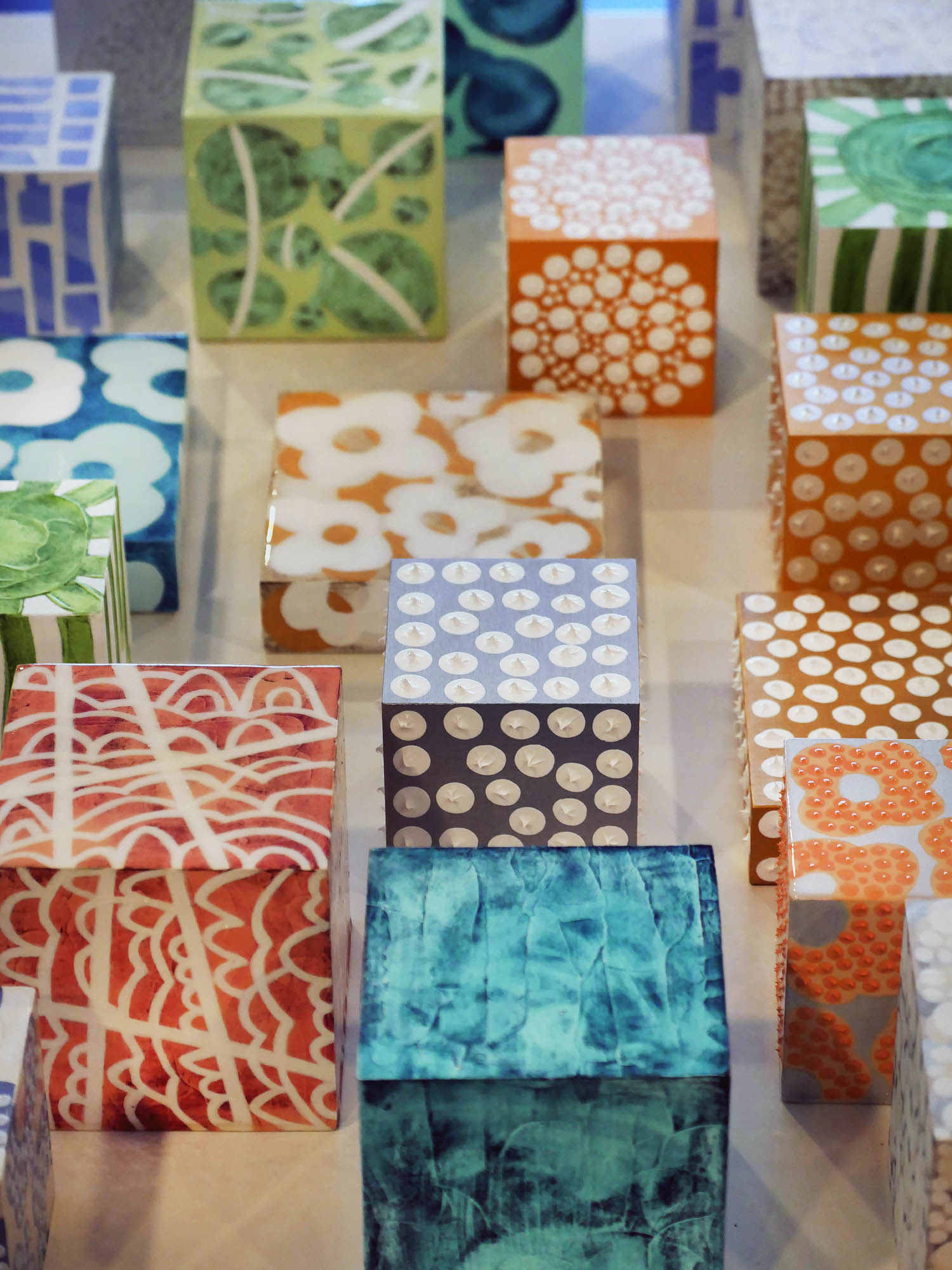
A collection of Petits Swanns.
The work before the work
Swann’s process is simultaneously detailed and spontaneous. For her larger pieces (which are often 48” x 48”, 60” x 48”, 72” x 48” or 60” x 60”) Swann spends between 30 and 80 hours creating a single painting, depending on the size. The substantial number hours are mainly due to the various “behind the scenes” layers. Swann begins by gessoing her canvas—a process that involves covering the wood or canvas in primer so it can be painted. She’ll often mark or scratch the canvas while gessoing (a process called “sgraffito”) because, she says, “I like to see imperfections when I look at a canvas. Some of it might show through in the final piece.” Once the gesso is dry (it takes at least 24 hours), the “underpainting” begins, and that process can vary.
Swann says she “doesn’t really think about” what she’s doing while she’s painting—she lets her emotions take over. She describes herself as a spontaneous painter and explains that she prefers acrylic paints because they dry quickly, allowing her to paint what she’s feeling as she feels it. Sometimes she’s expressing feelings from a memory, while other days it could be based on a song she heard or even the weather. A dreary day, for example, could result in a soft yellow-gold background or even a vase of flowers. “I don’t sketch—I’m just not a sketcher,” she continues. “Back in the day, I would sketch something first, but it didn’t feel as spontaneous as I wanted it to feel, so I put that aside. It just wasn’t my process. I just paint the image on the panel or canvas as I go along. And that, in my opinion, is when mistakes happen, but they usually tend to be good mistakes. Sometimes, I’ll work myself into a corner, and then I have to figure my way out. That’s when something new happens.”
But there is a general process to her work. The first step, after the gesso, is often a “wash,” which Swann describes as a layer of paint slightly mixed with water. After several layers of paint that she’s scratched and marked along the way, Swann will sometimes stain the canvas with steeped Persian tea. “I can’t pour the tea on a dark background, so I must bring the canvas to a light shade before I apply the tea so that it can be visible at the end,” Swann explains. “I usually use syringes or pour the tea directly on with a tiny carafe to make lines on the canvas. There are also times where I’ll mix a really transparent color with the tea to get a sort of dirty background. So basically, I create a mess, and then I clean it up and pull out the shapes and forms I want to see.” The tea must set for 24 hours before Swann can begin to apply color again.
When Swann has completed her painting, she steps back and examines her work. If she doesn’t like what she’s painted, Swann refuses to paint over it or throw it out. Instead, she finishes it, describing it as “penance.” And sometimes, those penance paintings surprise her. In 2025, when Baunok came to her studio to select pieces for an upcoming show, she fell in love with a painting Swann had very reluctantly completed.
“As I was doing it, I felt like something was off,” Swann remembers. “But I saw it through, even though I didn’t care for it, and I didn’t think anybody would buy it. But as soon as Rita saw it, she said, ‘What’s this? We should show this.’ I was surprised and told her I was planning to throw it out.’ But Rita put it in the show, and it was the first piece to sell.”
Swann only works on one canvas at a time, refusing to dilute her emotional focus. She will complete or prep a piece after work on a weekday, but when she paints, she prefers to do it all once on a weekend. “I’m really disciplined about that,” she says. “My kids don’t live at home anymore, and I’m single. So I get up at seven in the morning, and I paint until about six or seven in the evening.”
And as much as she tries not to, Swann does become attached to her paintings and feels a twinge of sadness each time one is sold. “But for each series I create, I always hold a few back to build my own collection,” she says.
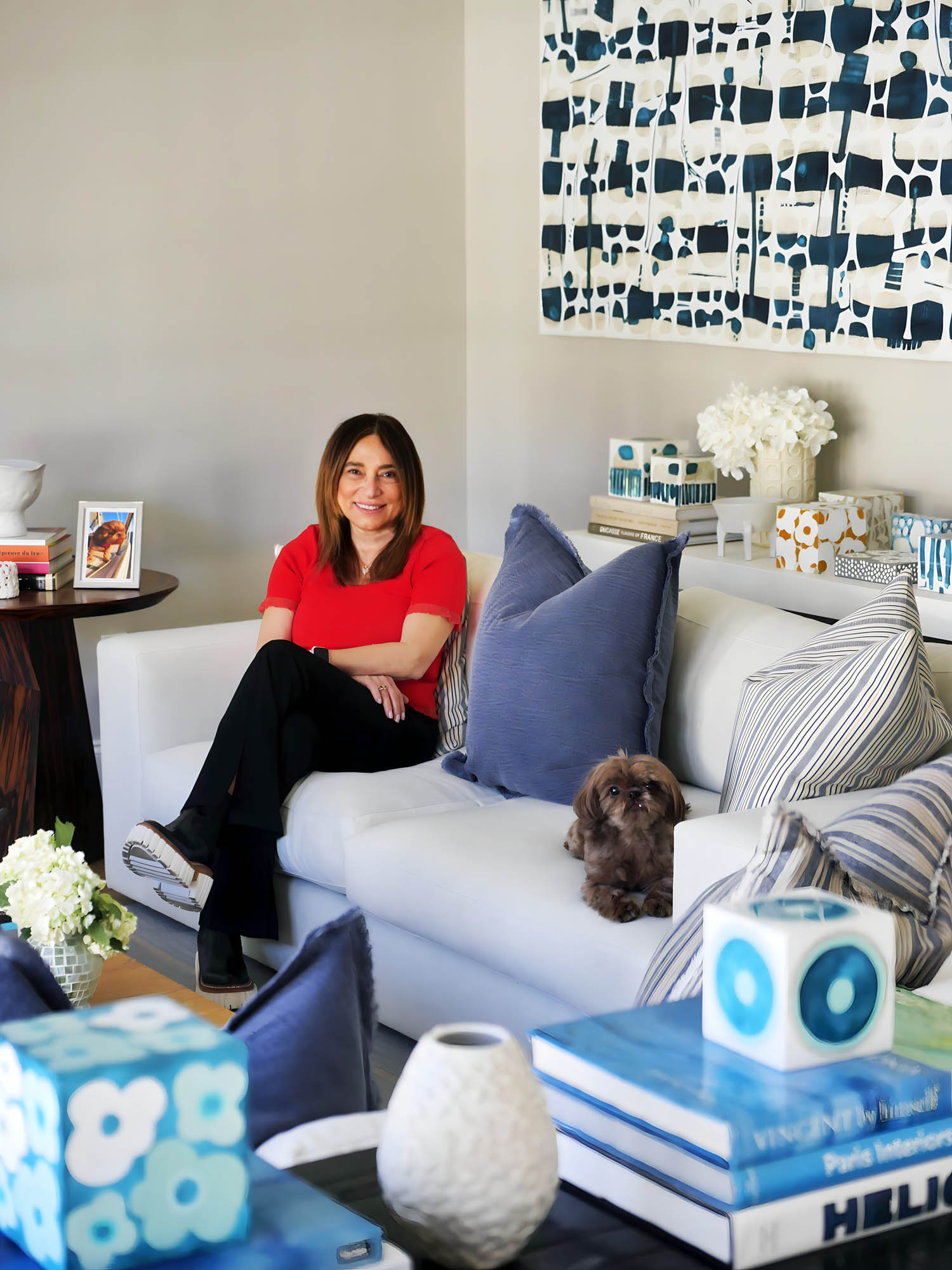
Swann and her Shih Tzu Eevee in her living room with several Petits Swanns in the foreground and “Sable et Mer,” an acrylic on canvas from the Sand & Sea series, behind her.
What’s old is new again
Swann tends to work on one series at a time, and it takes at least one year to feel as though a series is complete. “But that doesn’t mean it’s closed forever,” she explains. “Sometimes I may go back and paint something to add to a particular series because I am feeling that feeling in that moment.” And that’s true for her series “Present in the Past”—her very first, which she says “explores the fluid nature of memories, both real and imagined, through repetition and abstract forms.” It was a series she began in 2014 and worked on through 2018.
“For each painting in this particular series, I was thinking about either someone, a place, a memory or even a dream that occurred, mainly when I was in my 20s and 30s,” Swann explains. “I’d think about a particular person, what I did back then or even a specific day. Then, I would use the feelings related to those thoughts to select colors and put them on the canvas. The titles of these paintings won’t be apparent to anyone because they’ll just see patterns. But for me, each one was painted because I had something on my mind, and I was thinking about that thought and feeling it.”
“Sail Away,” for example, is about Swann’s summers in Nantucket, a town she began visiting with a group of friends each summer during college. When her children were young, they’d spend their entire summers in Nantucket, a tradition she continued during their years in France. “I have so many great memories of my summers there,” says Swann. “We would usually rent a house in Sconset, and we would sail, go to the beach and walk around the town. Everything about it was just magical. Back then, it was very quaint.”
Another painting in that series called “The Dance” is more reflective of an experience than a particular memory. This one, Swann says, was inspired by an upcoming wedding. “I was dreaming of weddings and people dancing,” she explains. “People who don’t normally dance will dance at weddings.”
And while most of the series is reflective of her first two decades as an adult, there are several paintings that refer to Swann’s childhood in Iran. One is a series-within-the-series called “Lollipops.”
“These take me back to my grandmother, who was a great cook,” Swann explains. “She would make the most delicious cupcakes, even though there were no cupcakes in Iran at that time. She was a great cook and baker, and she was a very important person and influence in my life.” Each “Lollipop” painting is similar in style but features different color combinations. “Lollipops #5,” for example, is filled with red and orange lollipops on a white background, while “Lollipops #7” contains blue and white lollipops on a black background.
And there are even some paintings in this series that are about a past Swann did not personally experience. “‘Leftovers’ is very caveman-ish, in a way,” says Swann. “I was thinking of old tools and skeletons of fish—relics you’d find in an archaeological dig. And as I thought about these relics from another era, I could feel excitement you get when you find something that’s unexpected.”
As she paints each piece, regardless of the collection, Swann is always focused on expressing her feelings and emotions rather than the shapes and forms she paints. “It’s very organic in a sense; it just comes out naturally without me having to force it,” she says. “I paint for myself more than anything else. And for me, that emotional connection works best.”
Swann’s Present in the Past collection will be on display at Chroma Fine Art Gallery in Katonah from May 12 through June 6 with an opening reception on May 16.
This partner content was published in the May/June 2026 edition of Connect to Northern Westchester.

The editorial staff at Connect To magazine.