

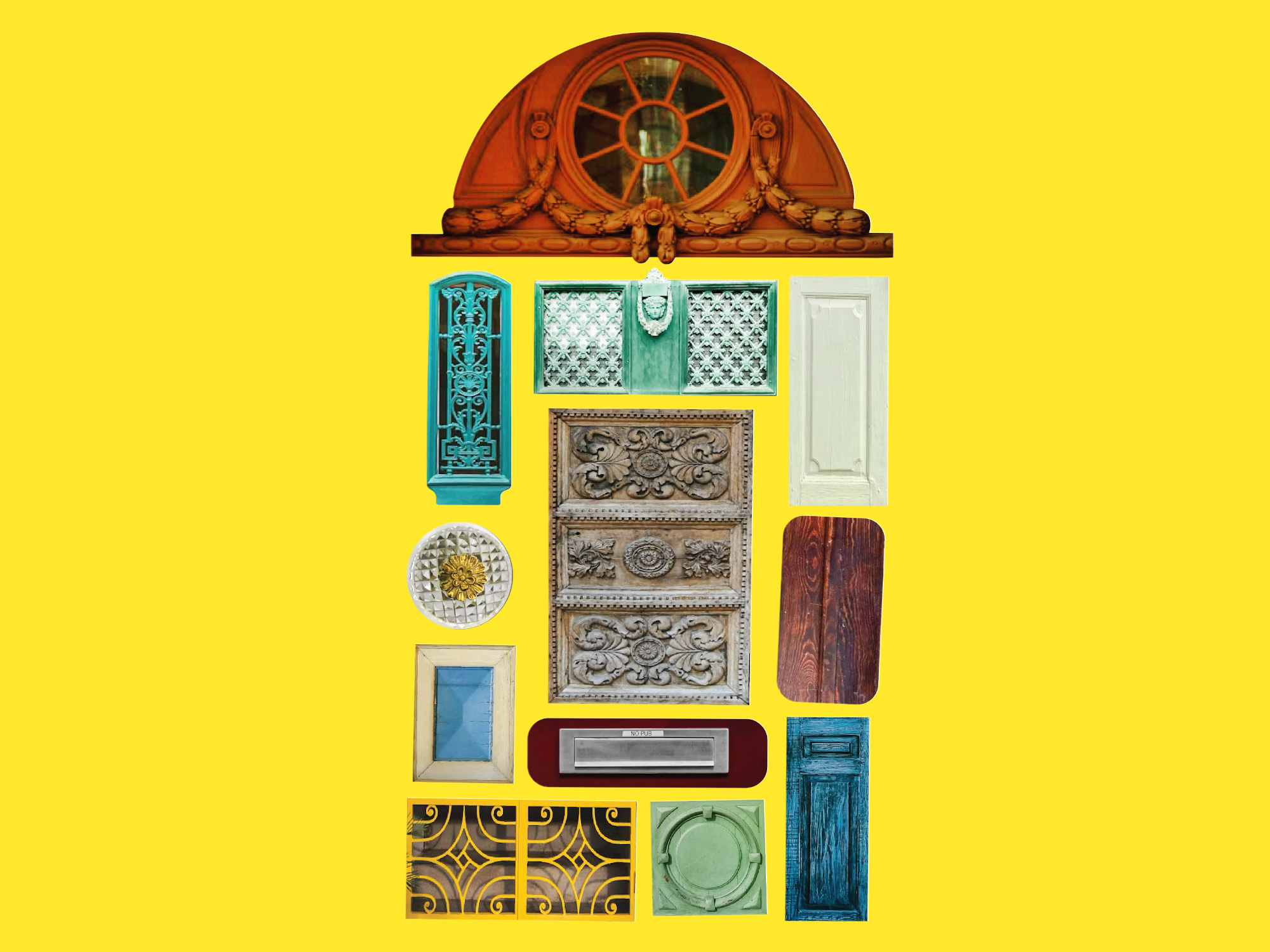
Writing & Design by Isabella Aranda Garcia
Like a piece of jewelry, the style, material and appearance of your front door convey who you are as a person and as a homeowner. In fact, it serves as the introduction to your life. “If you have an amazing necklace on or an amazing watch, it doesn’t matter if the shirt is from H&M and your pants are from Old Navy—a front door or its hardware is the equivalent for a home,” says Cate Hegarty, a licensed real estate agent with Compass. “It can really shine a lot more than people think.” So what does your house’s jewelry say about you? Is it the equivalent of a simple gold wedding band or bright and flashy like a shiny sapphire necklace? And what does it say about the person who lives inside?
Committed to curb appeal
Take a look at your door. Is it clean? Has it been repainted? Or does it have footprints from kicking the door open when your hands are full? Those minor details can leave a lasting impression. “You can get a feel for how well-maintained somebody’s house might be by looking at how they care for their front door,” says Hegarty. “It might sound a little silly, but if it’s cleaned up, there are nice flowers or landscaping right by the front door, there aren’t any cobwebs, and it’s nicely painted, that all provides insight into what the house is like inside. It doesn’t even need to be the most exquisite door you’ve ever seen.”
What does it say about you?
A high-maintenance perfectionist: If your door is pristine, freshly painted and free of cobwebs, it signals that the rest of your home (and your lifestyle) is likely well-maintained.
The down-to-earth or super-busy parent: If there are footprints from kicking the door open or perhaps a little bit of dust, it suggests a more casual, perhaps busier lifestyle where exterior aesthetics take a backseat to daily utility.
The weight of craftsmanship
Another subtle detail is the weight of your door. “My clients are always pretty surprised when I point that out,” says Hegarty. “Then, fifteen minutes into a tour, way past the front door, they’ll say, ‘Oh yeah, it does feel a lot more solid in here.’ They get this impression that the house is well built because nothing feels cheap or flimsy.”
Jack Mongiello, a sales representative at Jilco Window Corp., says choosing the right doorknob is just as important; it’s an integral component of creating the right impression. “Your front door is the first design statement your home makes, so the hardware shouldn’t be an afterthought,” he notes. “Think carefully about the hardware you choose because the right choice will elevate your entire entry and turn your front door into the focal point.”
What does it say about you?
The strong & resilient anchor: Choosing a heavy, solid door suggests you value stability, integrity and luxury. You want guests to feel the “weight” of your home’s quality the moment they touch the handle or open the door.
The economical pragmatist: A flimsy or hollow-feeling door may suggest a focus on budget over long-term craftsmanship.
Character vs. durability
Your front door reflects your priorities as a homeowner. If your door is solid wood, you likely value character and individuality over convenience. Mongiello says wood doors require upkeep, which indicates you’re willing to put in the work needed to care for your home. Fiberglass, however, demonstrates that you likely prioritize durability and practicality.
What does it say about you?
The traditionalist: An all-wood door is often shipped “bare,” allowing for complete personalization through custom stains and paints. Choosing wood suggests you value authentic character and are willing to perform the maintenance required to prevent warping or cracking.
The streamlined utilitarian: Fiberglass is maintenance-free and durable. Choosing this material suggests you value efficiency and longevity. Interestingly, fiberglass allows for more elaborate decorative glass options than wood, showing you can be “decorative” without the high-maintenance upkeep.
The privacy spectrum
Do you wave hi to the neighbors or prefer your privacy? Your choice in glass can be the most revealing indicator of whether you are an extrovert or an introvert. “Some people aren’t bothered by a glass panel that allows people to see in,” says Hegarty, “while others will say they need to get rid of that immediately because they need their privacy.”
What does it say about you?
The extrovert: If you choose clear or decorative glass panels that allow people to see in, you likely have an outspoken personality and a home that welcomes people in.
The introvert: If you prefer solid panels with no glass, you likely value privacy and boundaries. Hegarty notes that “panel people” often want to keep to themselves, but it’s sometimes driven by practical needs like preventing dogs from barking at delivery drivers.
The digital introvert/selective extrovert: Have a Ring camera? When someone is at your door, do you choose to control your social interactions from behind a digital barrier or check to see who it is and then open the door to engage with the person? If you’re the former, consider yourself a digital introvert; if the latter, a selective extrovert.
Color, risk and community
Color trends are shifting away from the “all-white” minimalist look toward bold risks. “If you want a fiberglass door in aqua blue, that basically means you want to be a standout person in your neighborhood,” Mongiello explains. Similarly, Hegarty has experienced some pretty unique doors that she says add to the charm of the home. “I sold a mid-century modern house last year that had a bright orange front door,” she remembers. “I think if I had told people the house had an orange front door, they might have looked at me a little sideways because it’s hard to imagine that would be a strong focal point. But within the context of the home’s overall design, it worked beautifully. And when potential buyers saw it in person, they would say, ‘Oh my God, of course this house has an orange door. How could it not have an orange door?’”
What does it say about you?
The standout individual: Choosing a radiant orange, aqua blue or any bright color for your door signals a person who is not afraid to take risks and wants to be seen as an individual.
The chameleon: Mongiello observes that some “standout” personalities like to change the color of their door once, twice and maybe three times every few years, continually reimagining how the front door can express their evolving style.
The assimilator: If you go for a classic, subdued color because you’re following the neighborhood trends or need to conform to HOA requirements, you prefer to fit in.
A quick note about rhe “rear door”
While we’ve spent this article breaking down the front door’s message, Mongiello points out a funny irony: many homeowners actually prioritize their rear or side doors because that is where they and their guests truly enter (usually via the driveway). If your front door is a “default” but your mudroom entrance is stunning, you are likely a pragmatic entertainer who knows the grand front entry may get the glory, but the real red carpet is rolled out in the mudroom.
This article was edited and fact-checked by Gia Miller. The artist began with images from Unsplash and edited them using Adobe Creative Suite.
This article was published in the March/April 2026 edition of Connect to Northern Westchester.

Isabella Aranda is a designer, writer and social media specialist with an M.A. in emerging media from the New Media Institute at the Grady College of Journalism & Mass Communication. Driven by curiosity and inspired by timeless modern design, she blends creativity and strategy to craft compelling narratives that engage diverse audiences.
Her expertise spans digital marketing, content creation and UX design, with notable achievements such as co-creating the Georgia On Your Mind podcast and leading digital campaigns that significantly boosted engagement. A Venezuelan immigrant, Isabella brings a multicultural perspective to her work, enhancing her ability to connect with and inspire others.