
How to find, vet and style secondhand pieces to create spaces full of personality and soul.
By Gia Miller
Photography by Justin Negard
One morning, when she was in her 20s, Stacey Winnick, now a vintage stylist and thrifting coach on Instagram and Facebook who lives in Briarcliff Manor, was living on 87th Street and Third Avenue in Manhattan when she saw it: a vintage rolltop dresser on the curb in front of her apartment. It was fate, and she knew just what to do. “I asked the doorman if he could watch it for me while I found someone to help me take it up to my apartment,” she remembers. “I should have paid him off, but I didn’t know; I was just a kid. When I came back down for it, I saw a guy on a bike putting my dresser into a cab. I yelled, ‘That’s my dresser!’ But he didn’t stop. Looking back, I should have taken out all the drawers and brought them inside while I went to find someone to help me. Nobody is going to take a piece without all the drawers. That dresser is probably about $6,000 today, and I still think about it. It’s the one that got away.”
Winnick learned her lesson, and she hasn’t made that mistake again. But, she says, the perfect item doesn’t always present itself right outside your front door. Often, it takes weeks, months or even years (it took Winnick four years to find the perfect sofa for the right price and six years for her dining table) to find beautiful and meaningful furniture and accessories that blend seamlessly and fashion a space that’s distinctively yours.
So if you’re dedicated to the search—whether driven by cost, passion or both—and can practice the art of patience, decorating or redecorating a room or home on a budget can result in a stunning space that eschews the dreaded “belongs in a Pottery Barn catalog” look. Ready to embrace the hunt? Perfect. Let’s dive in.
Raid your house before you even open your wallet
Before budgeting or shopping, take stock of what you have and what you need. “If you want to redo a room in your home, the first thing you should do is take a careful look at that room and ask yourself, ‘Is there anything I want to keep?’” recommends Mary R. Zipkin, owner of Knack of All Trades, a service that helps homeowners clear out their homes and sell unwanted items through her estate sales. “Be honest with yourself,” she advises. “Do you really want something that’s 20 years old? If it no longer serves you, then it’s time to get rid of it.”
“Next,” Zipkin continues, “carefully look through the other rooms in your home for anything that would look better in the room you want to redesign. Often, people have good things in their home, but they aren’t put together in the best way.” At this stage, Zipkin recommends asking a third party, like a friend with excellent taste, for their opinion on where furniture and decorative items should be placed. They might see something you don’t.
Then take photos and videos of the room you want to redesign, along with every other room, prior to removing furniture. “We have these phones with 8,000 pictures on them; everyone should have a folder with pictures of their house at all times—just in case they see something they like,” says Zipkin, who is also the owner of The KnaCk Shoppe in Pound Ridge where she sells previously loved furniture, home decor and clothing. “Even if you’ve decided that everything goes but the rug, take pictures and videos of the current setup so you can get help when you’re shopping. Whenever someone comes into The KnaCk Shoppe or one of my estate sales, I can usually tell if something will fit even if they don’t have the exact dimensions. And for most people, when they hold up a picture next to the item, they’ll know if the item will work in that room.”
After you’ve rearranged rooms and filled your new “My House” folder on your phone with pictures and videos, you can create your budget. But instead of establishing separate budgets for expensive items (think: sofas, dining tables, beds) and decorative pieces, consider creating a single general budget because who knows? You might discover a stunning, pristine sofa for $100 and fall in love with a side table priced at $400.
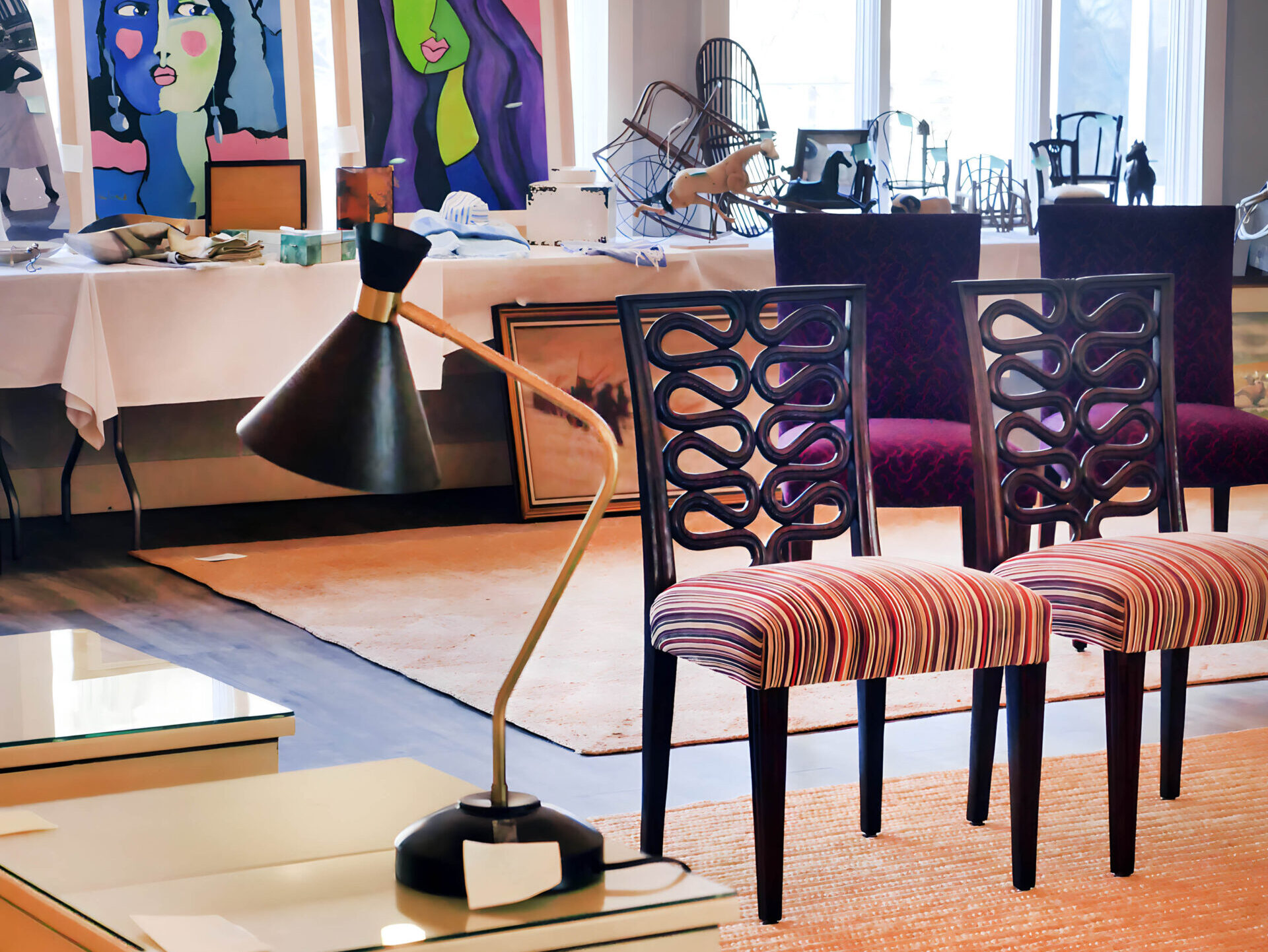
An apartment Winnick fully furunished with previously loved items. (Photo courtesy of Frii Branding LLC.)
Scroll, stroll and side-eye the curb
Now, it’s finally time to shop. The bad news is that finding the right pieces will take some time, and the search could take you all over the map. Determine how far you’re willing to drive, and stick to your boundaries. The good news is that there are numerous places to look and plenty of deals to be had, both online and in person.
Online, one of your best options is Facebook. Winnick’s page, Chappaqua Moms Sales, has more than 11,000 members throughout Westchester offering heavily discounted “like new” pieces. There are many similar Facebook pages throughout the region, among them, Greenwich Tag Sales and Stamford/Norwalk Tag Sale Items. Don’t overlook Facebook Marketplace, where you choose your geographic area to join, and local Buy Nothing groups, where all items are given away.
Online auction sites are another great option. “Auctions usually run for one or two days, but photos of all the items are usually on the website a week in advance,” says Winnick. “I recommend starting with LiveAuctioneers.com or EstateSales.net. You can just write “couch” in the search bar, filter by zip code and how far you’ll travel, and see all the couches for sale in your area. But be aware: if you can’t pick it up yourself and they have to ship it, the couch will cost a lot more.”
In person, Zipkin’s Pound Ridge store is one of several in the region that sell previously loved items. Others include:
- Bedford House (Katonah)
- Fantastic Finds (Mount Kisco)
- Katonah Thrift Shop (Katonah)
- Old New House (Katonah)
- The Cottage (Pound Ridge)
- TWIGS Thriftee Thrift Shop (Mount Kisco)
- Yorktown Love In Action (Yorktown)
There are also Take It Or Leave It (TIOLI) sheds in the Bedford Hills and Chappaqua train station parking lots as well as at the Briarcliff Manor Youth Center. A TIOLI is just what it sounds like: you can drop off what you don’t want and pick up what you do—all for free. And there are many other shops just outside northern Westchester; Winnick says her favorites are the Auction Barn in New Milford, CT and the TIOLIs at Andrus on Hudson in Hastings-on-Hudson and the Tarrytown Community Opportunity Center (it only happens twice a year). Additionally, there are estate sales, such as Zipkin’s (which she holds regularly), rummage sales (Katonah Presbyterian Church’s annual spring sale is among the region’s biggest), yard sales and even some great finds left on the street.
“Every town has a large bulk pickup day, and people place things they no longer want on the side of the road,” says Winnick. “If you go out very early that morning, around 6 a.m., you’ll be amazed by what people throw out, especially in towns like Scarsdale and Chappaqua. Once, when I was coming back from dropping my son off at an early morning hockey practice, I saw a beautiful mid-century modern leather office chair on the side of the road.”
Winnick says the best way to learn about these bulk pickup days is to visit a town’s Department of Public Works web page, which typically lists dates.

Winnick in a vintage leather chair. (Photo courtesy of Frii Branding LLC.)
Every piece deserves a full interrogation
When you know, you know. It’s as simple as that, experts say. “When people come into my shop and they see something they like, they’ll turn to me and say, ‘I want that,’ and they’ll buy it right away,” says Zipkin. “When you’re shopping, trust yourself and your gut. If you love it, and it makes you happy, then get it.”
But, of course, do your due diligence. First, and perhaps most importantly, Winnick and Zipkin say you shouldn’t buy an item without seeing it in person. If you plan to reupholster and/or stain a piece a darker color, you still need to make sure it’s in good shape (or is easily fixable) and comfortable. And if you’re buying from an individual (instead of a professional estate seller or auctioneer), Winnick says it’s important to purchase upholstered items and rugs from pet-free homes because “even the homeowner might not know what the pet did to it.”
For the inspection, let’s start with sofas, stools and chairs. You must sit (and lie if it’s a sofa) on each one the way you would at home. Spend a bit of time there, and ask yourself:
- Am I comfortable?
- Wiggle around a bit. Is the piece sturdy or wobbly?
- Have the legs been scratched or nibbled at?
- Does it sink in the middle?
- Flip the cushions—are there any tears, fading or stains? Do you see any dark spots near the seams?
- How does it smell? Is there a smoke or mildew smell? If so, those will never come out, and they could make you sick (see our article on “Is Your Home Making You Sick?)—walk away.
- For other furniture—such as tables, dressers, cabinets, bookcases and desks—inspect the craftsmanship closely. Look at the front, back, bottom and top for the following:
- Any scratches, bites, holes, chips or splitting, including the legs. If there are scratches or chips, look closely to determine if they’re from normal wear and tear or something else.
- Water rings, warping or rust on metal parts.
- Sturdiness.
- How the doors and/or drawers open and close. If they’re “tricky,” is it an easy repair, or would you need to remove/replace them to make the piece usable?
For accessories, it’s a bit simpler. There are a few things to do/consider:
- Always plug in a lamp or any electronics before you buy them to make sure they work.
- If you love the art but hate the frame, is it a simple-to-replace standard size, or will the custom frame cost more than the art itself? (If yes, is that project within your budget?)
- For any decorative objects, look for chips, cracks and discoloration.
- Ignore the lampshade; new ones are inexpensive.
For all furniture and accessories with scratches, chips or other flaws, carefully consider if they give the piece “character” or if the damage will taunt you, causing you to hate it and regret your purchase. Oh, and please don’t buy things that are “projects” unless you’re truly one of those people who enjoys fixing or painting things and has the time to do so.
Give Rooms a soul, not just stuff
Let’s be honest, all these great tips are useless if you don’t know how to put a room together. It’s not easy to create a room or home with soul where every hand-picked piece blends perfectly and is balanced. But, according to our experts, it’s not that difficult either.
Even though a sofa or dining table anchors a room, designing a space is more about the smaller pieces, especially art. “Don’t buy the art because it looked cute on the wall, but it has no soul,” Zipkin pleads. “Don’t buy it just for decoration. Buy it because it’s something that moved you and you can’t stop looking at it. Find the art you love and buy that.”
And while we are big fans of buying art from any of the numerous talented artists in our area, not every piece needs to be an investment. You can find beautiful art that speaks to you anywhere, even at Goodwill or a rummage sale. When you do, Winnick advises you to hold on tight. “Your top priority in those situations is to never let it go,” she cautions. “Don’t ask anyone to hold it for you—they could go on their break and forget to tell someone it’s on hold, or they could forget themselves. That’s the worst way to lose it. If your hands or cart are full, buy what you have, put it in your car, and return to your shopping.”
The same, she says, is true online. While it could take years to find the right items, when you do, message the seller immediately and be prepared to rearrange your schedule to view and purchase the item as early as that same day, especially if it’s an “I’m moving and everything must go today” type of sale. Those sellers really mean it.
Zipkin’s next priority is lamps. Her house is full of them. “Your house is so much warmer without overhead lighting,” she says. “While necessary in some rooms, if you want to have a cozy environment, low light is always the way to go. There are so many great lamps out there, and they don’t have to match, even in the same room.”
After that, pillows, books, picture frames and decorative items complete the story. Build that collection over time as things catch your eye. And unless you’re a professional or have a really great eye, don’t overdo it. You want a cozy space, not a cluttered one. Leave some breathing room on tables and walls.
If you fall in love with something and bring it home only to realize it doesn’t match the room’s decor, find a new place for it. Or, move what clashes into a different room. There’s no harm in rearranging.
“It’s more about finding the pieces that mean something to you and that you’re drawn to,” Zipkin explains. “Then, it’s about figuring out how to make it work. Because it will work when you have those pieces.”
And, most importantly, enjoy the experience; decorating shouldn’t be stressful. It should be an exciting opportunity to express yourself in a way that makes you smile and relax each time you walk into that space.
This article was edited by Julie Schwietert Collazo and fact-checked by Isabella Aranda Garcia. The photo was taken with Panasonic Lumix optics and edited in Adobe Creative Suite.
This article was published in the March/April 2026 edition of Connect to Northern Westchester.

Gia Miller is an award-winning journalist and the editor-in-chief/co-publisher of Connect to Northern Westchester. She has a magazine journalism degree (yes, that's a real thing) from the University of Georgia and has written for countless national publications, ranging from SELF to The Washington Post. Gia desperately wishes schools still taught grammar. Also, she wants everyone to know they can delete the word "that" from about 90% of their sentences, and there's no such thing as "first annual." When she's not running her media empire, Gia enjoys spending quality time with friends and family, laughing at her crazy dog and listening to a good podcast. She thanks multiple alarms, fermented grapes and her amazing husband for helping her get through each day. Her love languages are food and humor.

Justin is an award-winning designer and photographer. He was the owner and creative director at Future Boy Design, producing work for clients such as National Parks Service, Vintage Cinemas, The Tarrytown Music Hall, and others. His work has appeared in Bloomberg TV, South by Southwest (SXSW), Edible Magazine, Westchester Magazine, Refinery 29, the Art Directors Club, AIGA and more.
Justin is a two-time winner of the International Design Awards, American Photography and Latin America Fotografia. Vice News has called Justin Negard as “one of the best artists working today.”
He is the author of two books, On Design, which discusses principles and the business of design, and Bogotà which is a photographic journey through the Colombian capital.
Additionally, Justin has served as Creative Director at CityMouse Inc., an NYC-based design firm which provides accessible design for people with disabilities, and has been awarded by the City of New York, MIT Media Lab and South By Southwest.
He lives in Katonah with his wonderfully patient wife, son and daughter.