
By Ilyssa Panitz
Photography by Jonathan Baskin
The year was 1988. It was a sunny fall afternoon in New York City when Audrey Zinman, who was 27 years old and working as a marketing manager for a family business, entered a flea market on West 26th Street, not far from where she lived. As Zinman strolled up and down the aisles checking out the thousands of items for sale, she suddenly stopped dead in her tracks. Right in front of her was a 24” x 8” vase for $25—but the piece was far from ordinary. “I had never seen anything like it,” says Zinman. “It was decoupaged with birds and flowers on a white background. It was the most exquisite vase I had ever seen, and I was immediately drawn to how luminous the images looked in the glass.” This discovery sparked something in Zinman. “Not only did I have to have it, but I kept saying I must learn how to do this.”
After paying in cash, Zinman excitedly carried the vase home and picked out a prime spot to display her new treasure. “I would stare at it for hours,” she recalls, “and over time I became more fascinated by the art of decoupage.” This practice, which dates back to the 12th century, involves decorating objects by gluing colored-paper cutouts onto the item and then sealing them with a varnish to create a smooth, finished look.
-
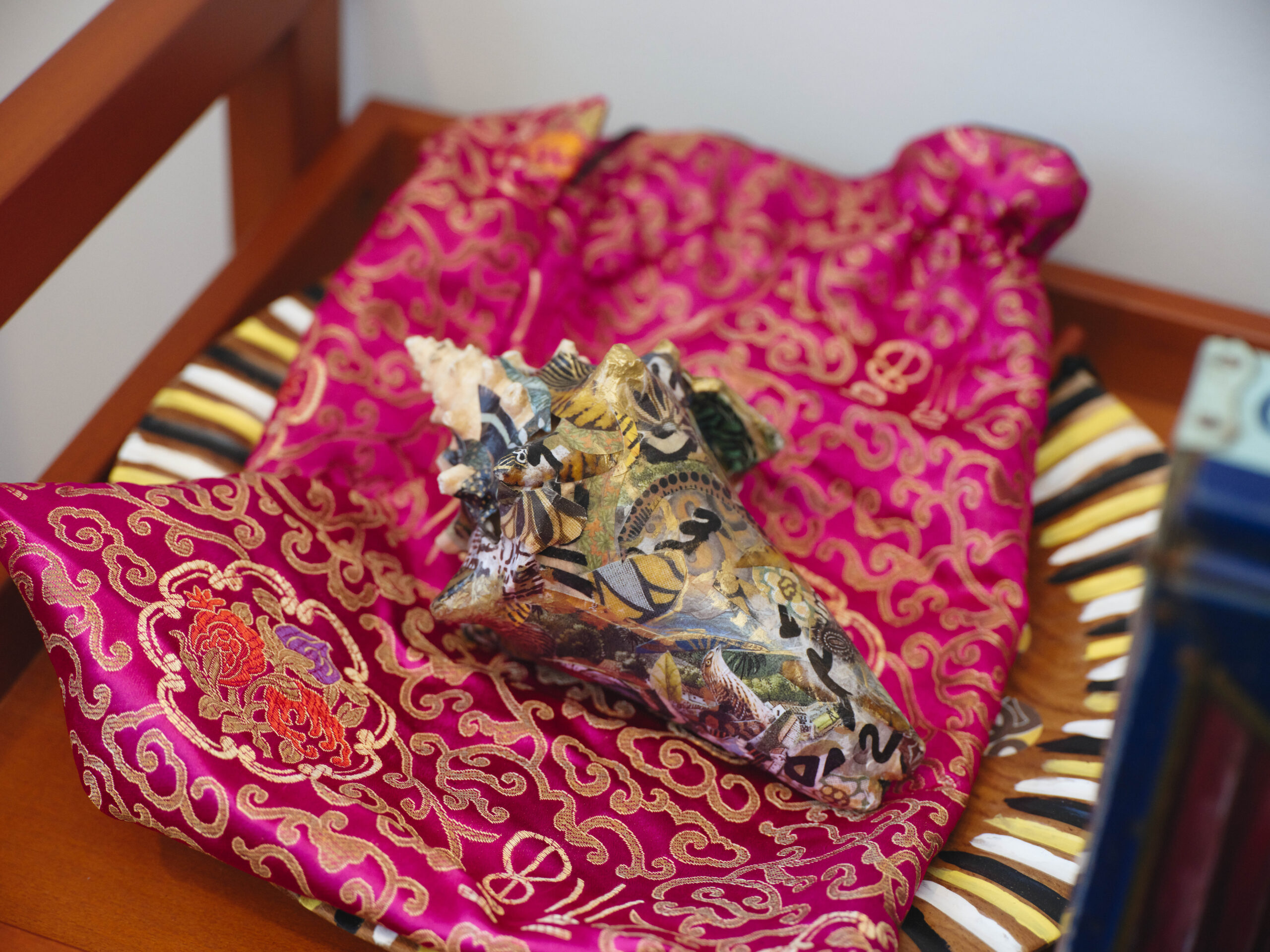
- Decoupaged shell.
-

- Mulberry papers in Zinman’s studio.
Making a paper trail
Like most of us who write a wish or bucket list, sometimes life gets in the way, and for Zinman, she put her dream of learning decoupage on hold when she discovered she was pregnant with twins. “At one point, I had no free time because I was busy raising kids, volunteering, driving carpools and making dinners,” she explains. “But when my children got older, I enrolled in a decoupage workshop in New York City with Durwin Rice, a famous decoupage artist.”
The vase she had loved for 30 years unfortunately broke during a move from one home to another, but Zinman was determined to recreate its beauty. “I always knew I wanted to be an artist,” Zinman says. “But my parents were focused on everyone having a solid education and a stable career, so sadly, taking up art was off the table for me.” Instead, Zinman attended Duke University and graduated with a bachelor’s degree in English. “When I became an adult, I made it my mission to pursue my passion for art.”
Zinman describes her decoupage journey as a long and slow road. “I started taking classes and workshops 25 years ago at a local YMCA, online and with Rice,” she explains. ”But finding instructors was no easy task because decoupage is a bit of a lost art form.” Given that few people taught decoupage, when Zinman found Rice’s workshop, she became excited to learn from a true expert. But that was just the beginning. Decoupage isn’t as simple as it might seem. Artists struggle with challenges—like bubbling glass and paper tears—and it can take years to master.
After completing the workshop with Rice, Zinman enrolled in any decoupage class she could find. It wasn’t until one of her teachers retired that she found decoupage artist Lucy Solinsky, who became a friend of Zinman’s. “Lucy taught me how to take my art to another level by looking at each piece as if I am painting with paper,” Zinman says. “I came into this art form feeling like this was a ‘less than’ craft, and quite frankly, there’s a lot of very tacky decoupage out there. Lucy made me feel that I was using paper and images to paint, and that took the art to a different level for me because color, texture (on some surfaces) and the relationships of images to each other gained more meaning. So, the scissor became my paintbrush, and I felt freer to experiment and push boundaries in the art form.”
-
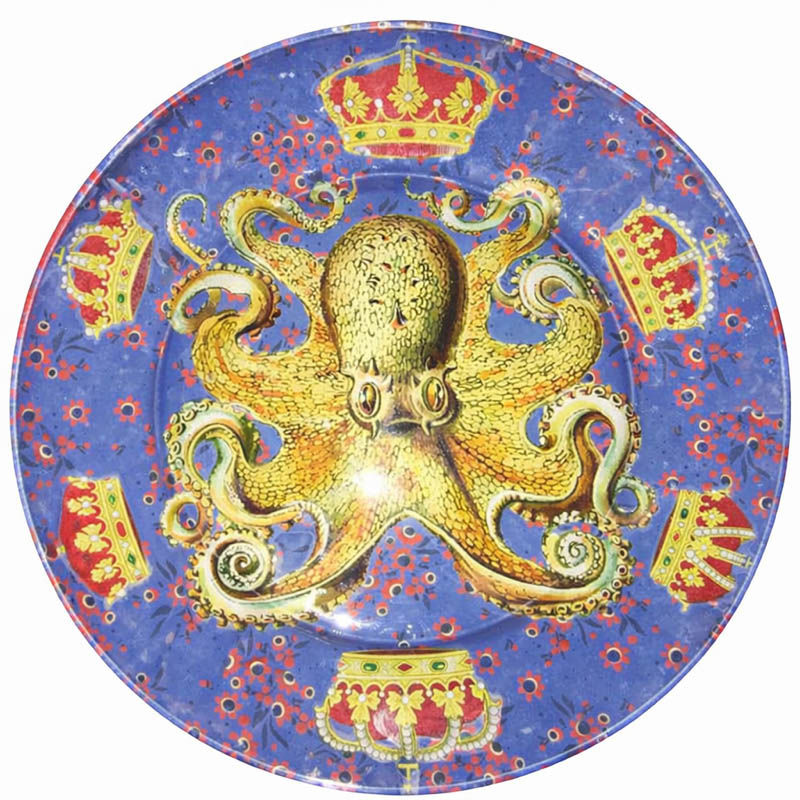
- Decoupaged plates.
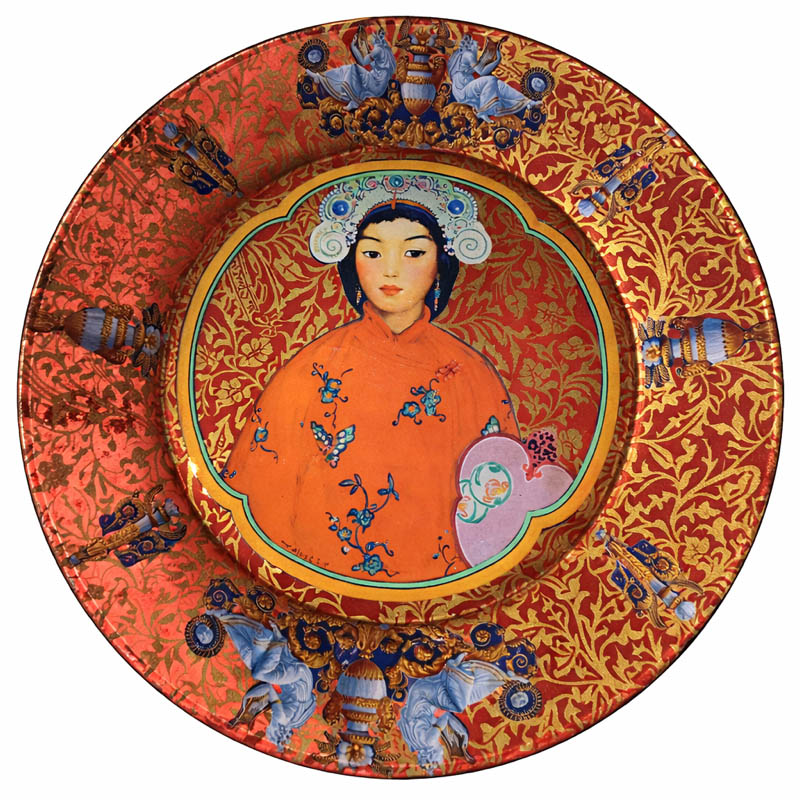

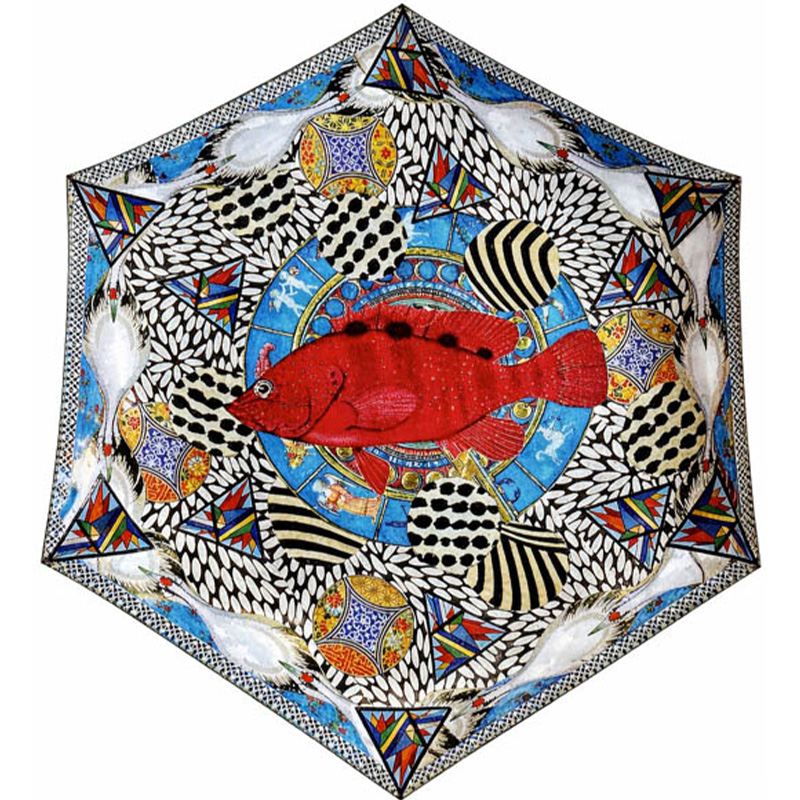
Layer by layer
Solinsky inspired Zinman to push the boundary of decoupage beyond glass, and she began decoupaging other objects, such as shells, mirrors, old telephones, biscuit tins, pendants, pocket watches and Lucite bags. “I think it’s important to learn on glass,” Zinman says, “as the precision it requires really allows one to perfect their technique. The reason I decided to move on from glass was because old objects began to catch my eye. I love old things that have been discarded; I imagine what interesting journeys they have taken.” Zinman says the idea of repurposing forgotten items ignites her creative process. Her first non-glass item was a cheese board that she decoupaged with images of printed cows. It was the first step towards venturing outside her comfort zone.
When it’s time to decoupage a new object, Zinman says she looks through the collection of things she has gathered and reaches for the piece that inspires her at that moment. Presently, Zinman has a fascination with vintage biscuit tins. “I like creating little fantasy worlds inside them,” Zinman says. “And I will add free-standing decoupage objects inside to create a cabinet of curiosity.”
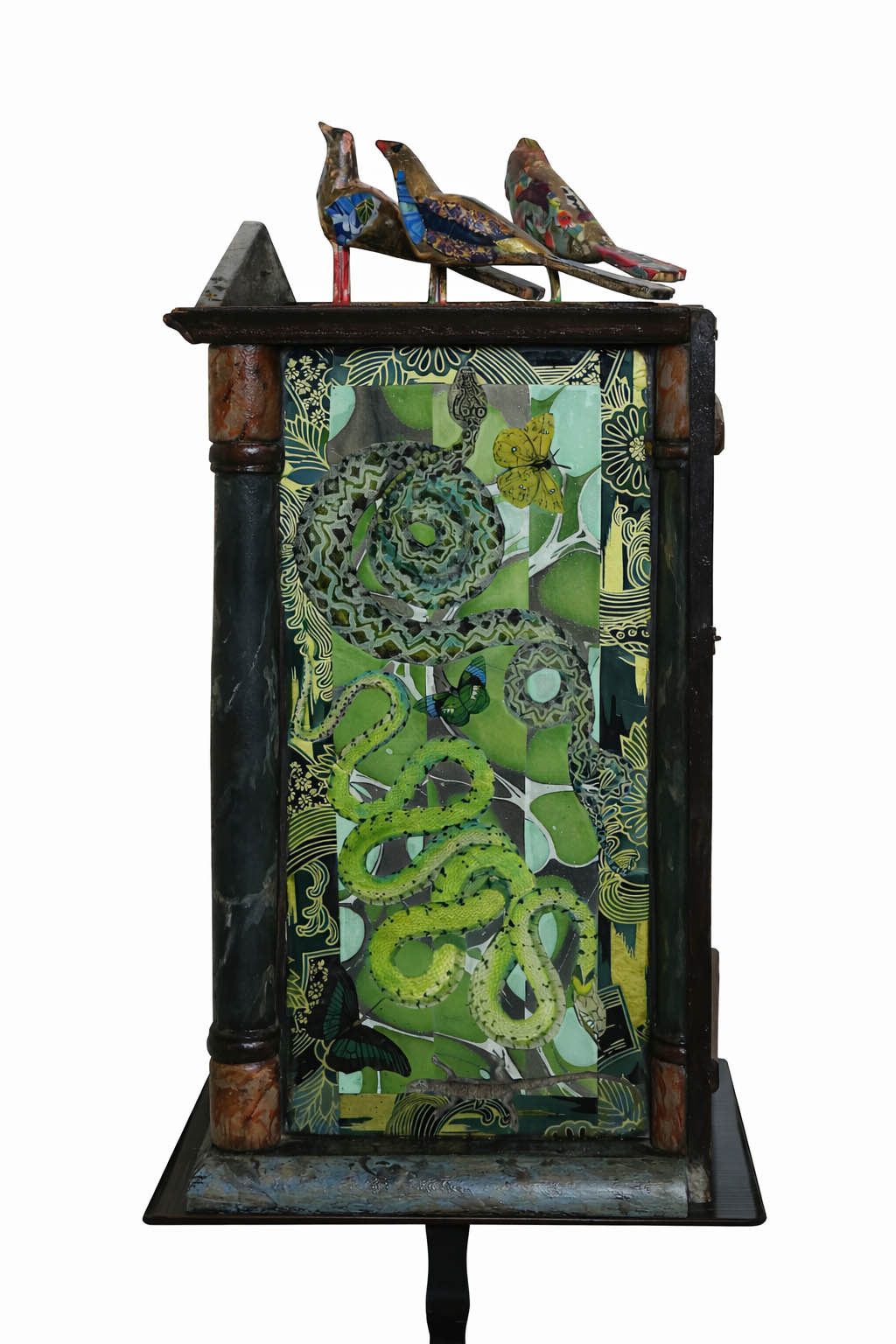
Decoupaged lamp.
Zinman now works in a 10’ x 12’ spare room located in her Bedford home, usually at night when it’s quiet and there are fewer email and phone interruptions. She plays opera, soft jazz and hits from the 1970s on a low volume and methodically goes through her “system.” First, she selects an object she wants to beautify. “I never have a goal when I am on the hunt for objects,” Zinman says, “because I am always looking for the next piece. Most of the places are local —Mary Zipkin’s Knack of All Trades is a great resource. When I find things, I put them on a shelf and wait until I am ready to create. Currently, I have telephones, 1960s box bags, lampshades, biscuit tins and pocket watches in the queue.” Then she begins searching for the image or images that speak to her at that moment, serving as inspiration for the shape of the paper cutouts. To locate the perfect picture, Zinman goes to flea markets, tag sales and beaches; she also photographs graffiti walls and organizes them into one of 15 boxes she has labeled by category. “When I travel, I am always searching for images or objects,” she explains. “When I am looking for papers, I am more focused on color and sometimes texture.”
Once the object and images are selected, Zinman heads to her three shelves filled with decoupage paper, mostly from a company called Mulberry Papers, which makes hand-crafted, colorful papers featuring portraits, florals, sea life, architecture, zodiac signs and more. Then, Zinman begins to cut, using a combination of cuticle scissors, small Fiskars scissors and knives with small blades. This process, she says, is very intense and requires precision. “I sometimes have a lot of trouble focusing,” Zinman says. “But when I am cutting, I go into a meditative and relaxing state, where my brain is in a Zen mode.” Finally, it’s time to glue the images, a step that Zinman says cannot be rushed. This phase must be done flawlessly, and the glue can take anywhere from 24 to 36 hours to dry properly before a protective treatment can be applied. As she’s creating these pieces, Zinman keeps herself organized using three different trollies: one for works in progress, another for finished pieces and a third for the final cleanup stage.
Unlike some artists who devote their attention to a single piece, Zinman prefers to work on multiple objects at a time. “I have collections of images grouped for specific objects,” Zinman says. “I begin by cutting more images than I will use. Then I lay them out and start gluing. While the glue is drying, I move onto another piece. When complete, I finish it with a sealer and sanding.” Zinman describes her method as a fluid process and dreams of the day she will have a studio with a long table, where she can move from piece to piece during their varying stages of completion.
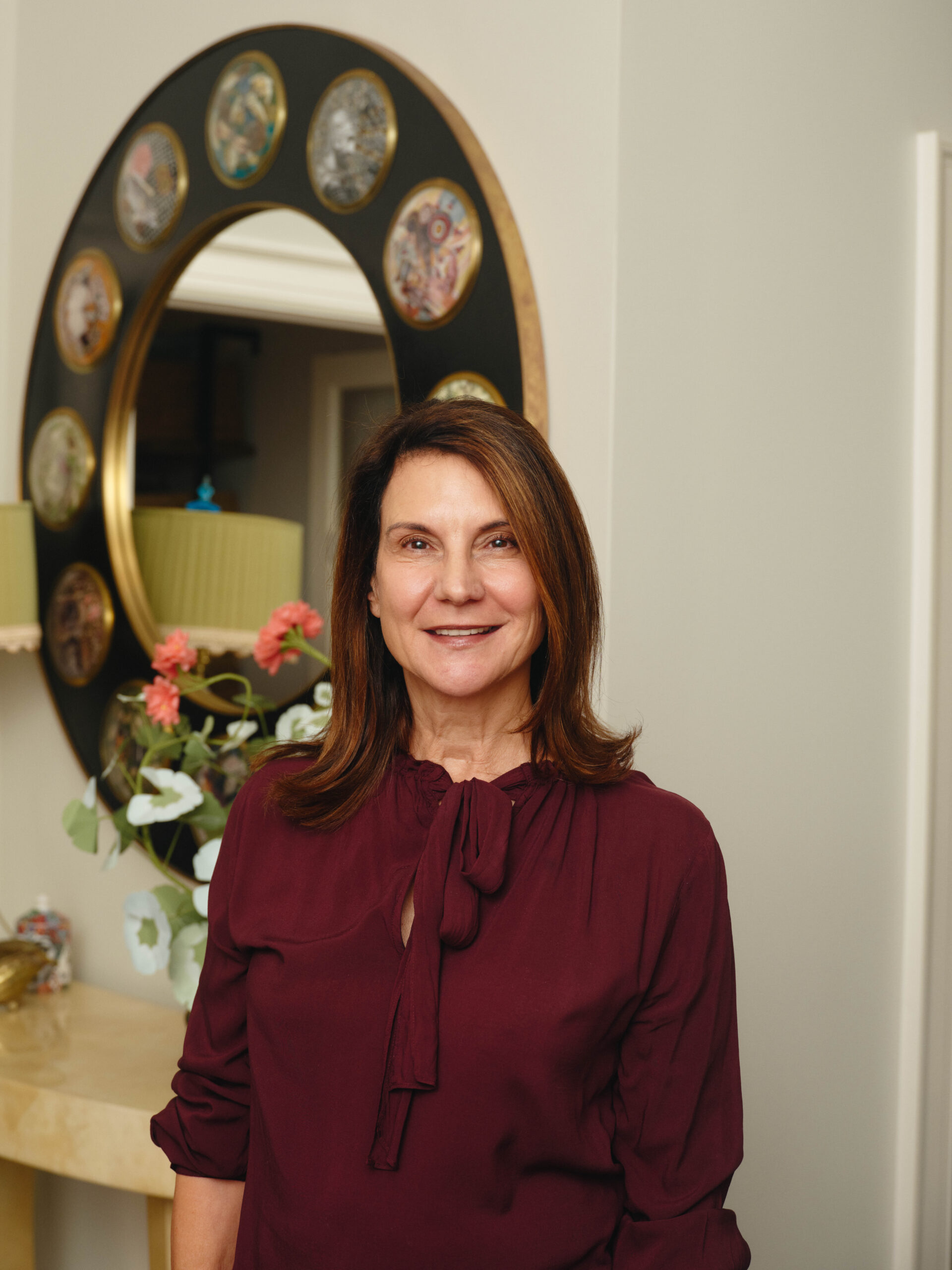
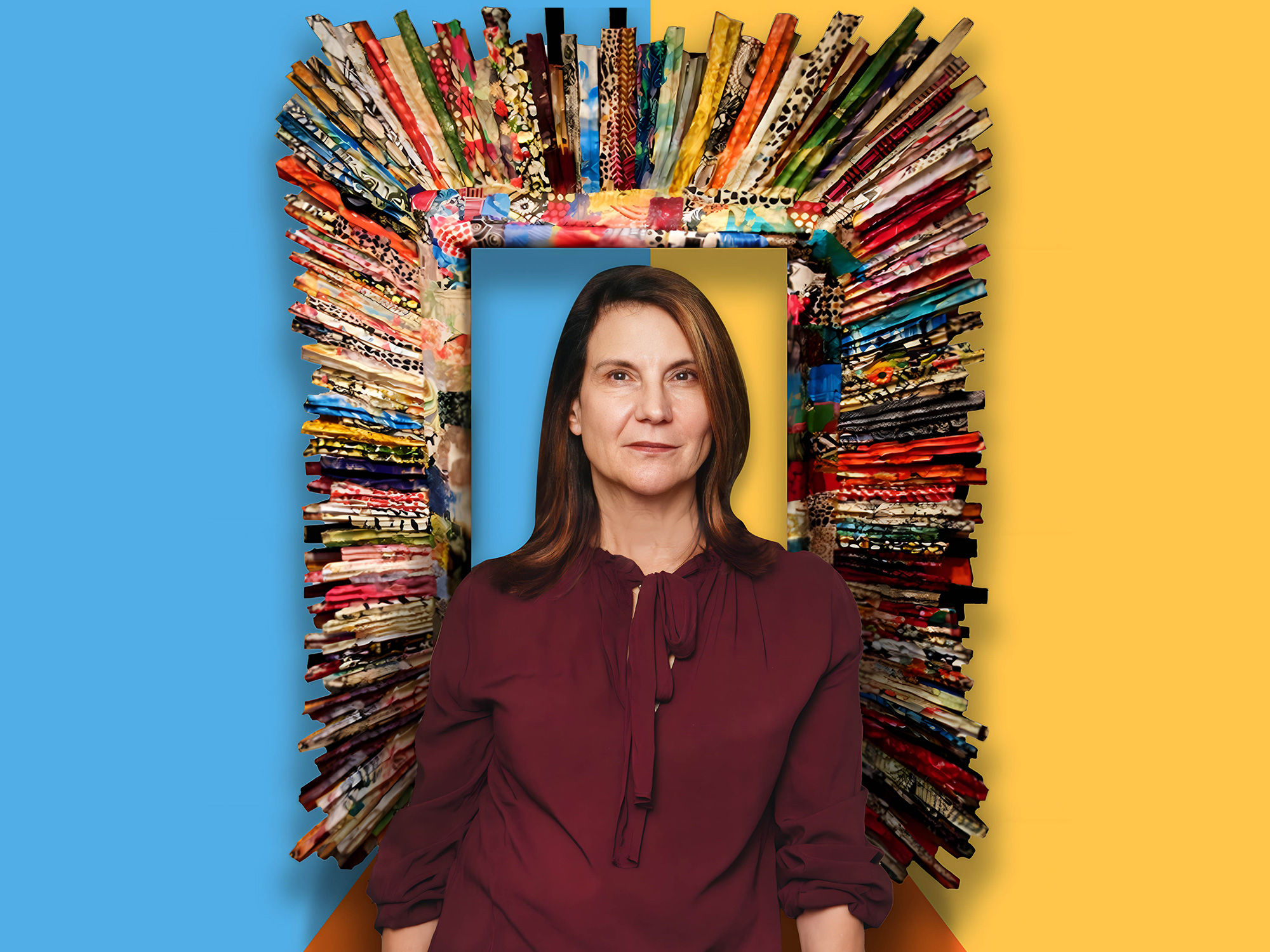
Audrey Zinman.
Making the cut
In the thirty years Zinman has been decoupaging, she has made quite a name for herself. January 2026 will mark the seventh time her pieces will be featured at the Art Show: Bedford, held at St. Matthew’s Church (see 5 Things You Should Know About January/February 2026). In January 2025, Zinman’s work took home the top prize for Best in Show. “I was getting my hair colored when a friend called to tell me I won,” she remembers. “I shrieked so loud. Everyone thought something bad happened!”
Zinman has also received awards for her work in Florida. Last March, Zinman and her partner, Virginia Getz, a talented floral designer and member of the Bedford Garden Club, together won the Best Use of Color Award at the Vero Beach Museum of Art’s (VBMA) Art in Bloom exhibition for their decoupaged vase filled with 3D flowers.
While most artists make a living by selling their work, Zinman asks her customers to donate to their favorite local charity, such as Hope’s Door, New Dawn, The Pantry or other nearby organizations. “Giving to others motivates me,” Zinman says. “And when I sit down every night to start or finish a project, I think about the many places and people my art helps, and it makes me feel full and happy.”
For January’s Art Show: Bedford, Zinman anticipates displaying and selling 30 items, as the show’s proceeds are donated to charity. She says you’ll find paperweights, plates and her latest creation, “After The Storm,” a wall fixture made of sycamore bark Zinman collected on a nature walk, which she then embellished with decoupaged birds, shells and “other things you’d find after a storm.”
Zinman says she’s always thinking up new concepts. “The word ‘idea’ is on repeat in my head,” she says. “I’m always looking for something new to create, such as refurbishing an old safe deposit box. I love decoupaging things people don’t think. It puts me in my happy place and brings me endless joy.”
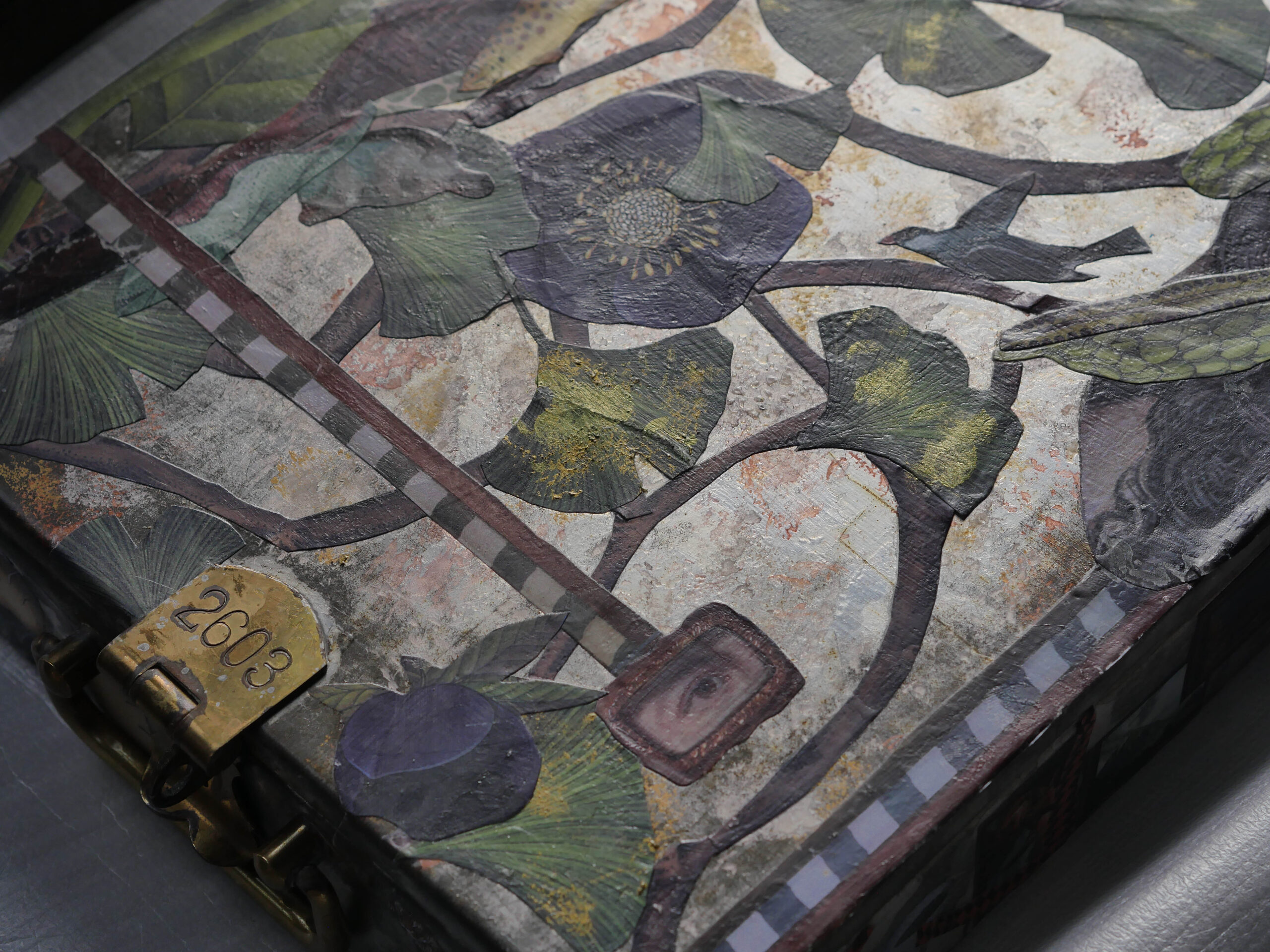
Decoupaged art piece.
This article was published in the January/February 2026 edition of Connect to Northern Westchester.

Ilyssa Panitz
This Rye Brook resident built a reputation for interviewing many Hollywood stars for TV, radio, print & online in addition to covering stories on pets, lifestyle, relationships & women’s issues. She also created a divorce journalism platform, comprised of various columns, a TV series & hosting a weekly radio show.