
Written for teens, by a teen.
Because we all know how important teenage friendships can be.
By Kayla Schmidt
Artwork by Annie Kennedy
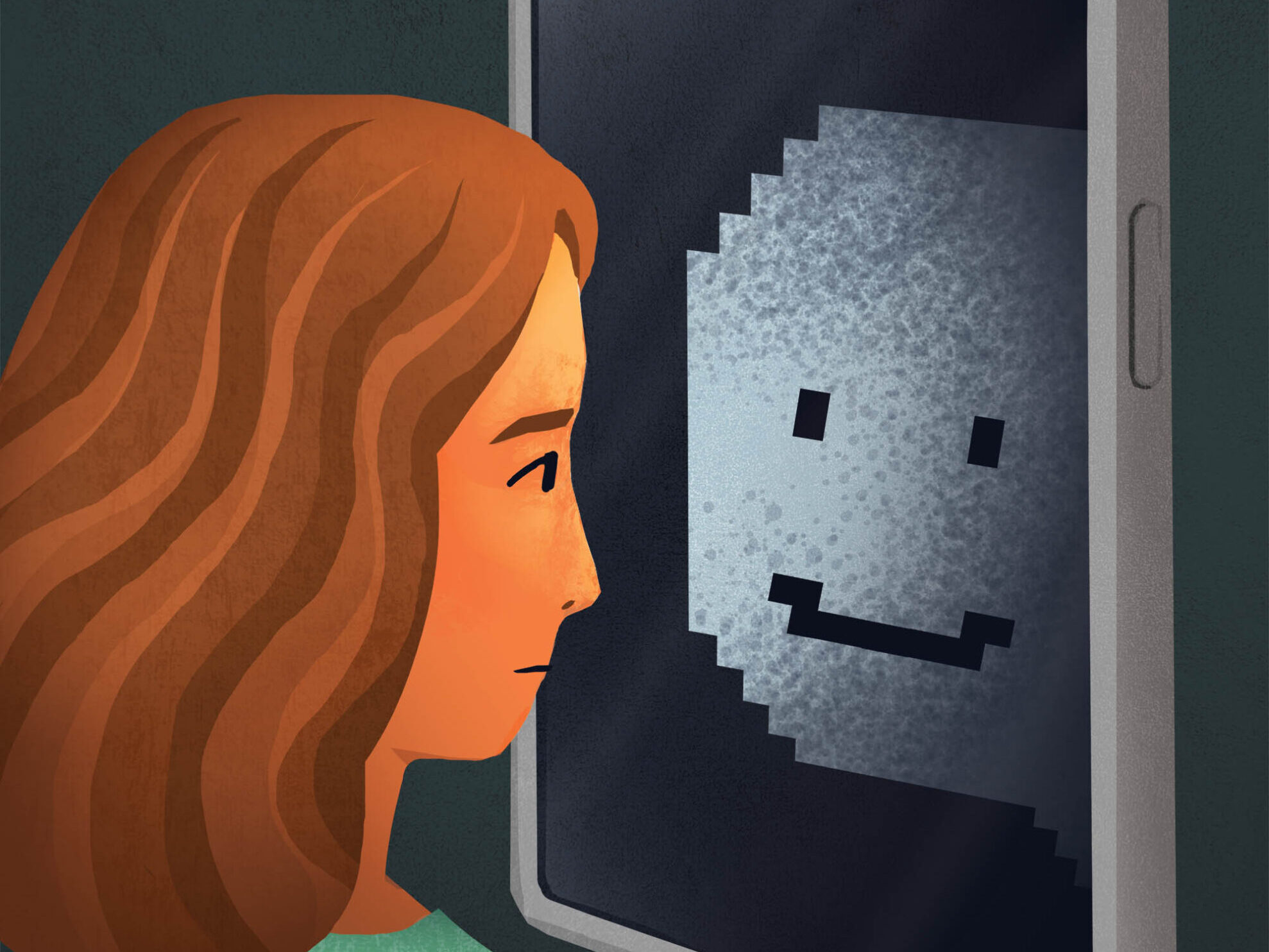
The other day, my friends and I were talking about that rush—that excited feeling we get when our phone dings with a text or snap. It’s that dopamine hit; it’s energizing, even if we’re about to fall asleep. Several questions run through our minds in the two seconds it takes for us to grab and check our phones. Was our chem test graded? Did someone like my post? I hope it’s not that annoying group chat.
But there’s another feeling, a not-so-great feeling, when it’s been a while since our phone has given us a good dopamine hit. And that feeling leads to a different set of questions. Why hasn’t anyone texted me? Did I miss something? Does anyone even care?
In a world that lives online, how do we separate likes and followers from true connections and friendships? Is it enough to only communicate with my camp friends via text? What about the friends I see every day at school? Why is it a big deal if we text each other from the comfort of our own beds instead of hanging out in person on the weekends? Are our parents right? Can’t our memories simply be saved on Snapchat, or do we really need to make them in person?
Real friends > followers
“We live in a world that is primarily impulse-driven; it can be problematic when people seek immediate gratification,” explains Carolyn Grosso, Psy.D., a child and family psychologist with a private practice in Bedford Hills. “Unfortunately, that has been a real negative in relationships; many teens have less patience. Now that we have so many means of communication, some teenagers tend to drop friends if they do one wrong thing. Then they’re on to the next person because it’s so much easier.”
Social media has changed the way humans define the word “friend,” causing us to frequently confuse online visibility with closeness. Ultimately, just because someone likes or comments on your post doesn’t mean they’re your friend.
“If you equate having a lot of friends online with worth, value, importance, or popularity, you may not realize that those online friendships or followers don’t translate into intimate, connected, important relationships—they’re not necessarily the people who are going to be there for you when you’re feeling your worst,” explains Kelly Keck, LMHC, co-founder of Pleasantville Wellness Group. “In the virtual world, people love to be there for the highlight reel, but it’s often a lot harder when life is not going as you want and those people are not showing up for you the same way. This kind of feigned sense of worth can be really dangerous when you’re not in a great place mentally. It feels like, ‘Oh, why don’t any of these people care about me?’ But that may or may not be true. People often think if someone is following them online and taking part in their life, that person must be an important part of their life, yet that’s not always the case. Our circles are a lot smaller than we would believe them to be.”
We are the first generation to really grow up with social media, so there’s no one to guide us; our parents don’t know what half of it means, and college grads are just figuring it out. I’m sure we all think, “If only social media platforms were more transparent,” or “I wish there was a way for older generations to understand what it’s like growing up this way.” These thoughts can cause us to doubt everything: Who are our friends? What’s real and what’s fake? How do we know when someone is a “real” friend, and what does that even mean?
“When someone treats you the same way in private and in public, you can pretty much rest assured they’re a solid friend,” Keck explains. “Or at the very least, they’re reliable, and you can trust that their words mean something. Also, true friends accept you for the hobby you like, the sport you play or the music you listen to. And they do it without judging you; that’s what makes a good friend.”
Experts say in-person communication is critical to our future; real-life connections hold a much deeper meaning than mere online, faceless communication. Eventually, without “soft skills,” it will become harder to earn that job promotion, land the leadership role or even just work alongside others in an office. And when you’re in a real-life disagreement with your spouse, there’s no phone to shut off. So how can we develop critical communication skills without having any practice? If we don’t prioritize these authentic connections now, Grosso warns that as we enter adulthood, “it could be more difficult to socialize in person, look at nonverbal communication, make eye contact, and everything else that goes along with it.”
FOMO is lying to you
People say we’re obsessive posters. But it is okay to want to share what you’re doing. In fact, it’s often fun to post with our friends and add to each other’s feeds. Unfortunately, there is a dark side to this continuous sharing.
“When I was growing up and people hung out together, you didn’t know until someone talked about it at school the next day or the week after,” says Keck, echoing what every adult has told us after complaining we’re “glued to our phones.” But Keck explains that seeing all of your friends are hanging out without you creates an environment where you sit in your hurt. “And when you do that for too long,” she says, “you start to feel like you aren’t worth it or that people don’t like you.”
That FOMO is real, and it’s bad for us. It creates insecurity and jealousy, and it can lead to depression. Then there are the filters, whether on a photo or how someone curates their life. They create a different type of FOMO that forces you to question your worth, appearance and overall life circumstances: I wish I looked like that girl in that post; I wish my life was as amazing as theirs. “But there’s no way that’s all real,” Keck says. “They’re not presenting the negative parts of their lives as much. And comparing yourself to these filtered versions of your peers can leave you feeling more and more depressed.”
Staying connected isn’t always bad
“There is a benefit to social media for some teens, because it allows them to stay connected with their school or local friends more easily and frequently,” explains Grosso, who runs social skills/coping skills groups for elementary and middle school students. “Plus, you can make friends from across the world who like the same things as you.”
This idea has actually been studied. About a year ago, Pew Research Center released a study that found almost 75 percent of teens say social media helps them feel more connected to their friends’ lives. About half of the same teens reported that what they see on these platforms made them feel accepted or supported through tough times. In other words, when our parents tell us we shouldn’t always be on our phones, we now have proof that it’s not really as bad as they think.
Plus, around the same time, a study funded by the Environmental Influences on Child Health Outcomes (ECHO) Program at the National Institutes of Health found that teens with strong, high-quality friendships were more likely to experience better mental health regardless of how much time they spent on social media. “I think we all have to shift the way we view community,” Keck notes. “Now, it can happen online in the same way we used to experience it together in person. And if you can create a safe community online, then you can still grow a beautiful friendship or connection, whether it’s a group of friends or one-on-one.”
Redefining “friend”
Like most things in life, virtual friendships must be balanced with real-life friendships. In 2024, research published in the Journal of Adolescence found that teens’ social interaction skills tend to be stronger when they’re face-to-face. And, if we’re being honest with ourselves, we know that’s true. So, we need to find a balance. To determine if you’re able to balance social media with real-life interactions, Keck recommends you ask yourself a few questions:
- Are you comfortable on virtual platforms and still the person you want to be?
- Can you ask your friends to show up as you want in person and on the phone?
- Can you create healthy life habits (turning off your phone before bed, socializing in person, etc.) with your virtual lifestyle?
- Are you confident you can tell your friends when their online persona differs from their real-life self?
If the answer to half of these questions is “yes,” you’re able to balance this well. If more than half are “no,” then you may want to rethink your relationship with your virtual life.
If you’re still not sure, to figure out where you stand, spend a weekend prioritizing in-person connections over virtual ones; notice whether you feel stressed or content and fulfilled. Ask yourself if your friendships would survive without social media, and be honest about the answer. Pay attention to your mood when you’re scrolling versus when you’re actually living. Your emotional response will tell you everything you need to know about if your virtual life is serving you or holding you back.
“There should also be a balance in how you reciprocate in relationships,” Grosso recommends. “It’s important to ask the other person questions about themselves and not only talk about yourself. You can still talk about yourself and share information; just balance it by asking about them while also sharing about yourself.”
Maybe the question isn’t whether online friendships are real, but whether they’re enough on their own. A text can keep a connection alive, a snap can make us smile and a like can make us feel seen. But they can’t replace the feeling of sitting next to someone, laughing until your stomach hurts or sharing a moment that doesn’t disappear after 24 hours. Sure, the dopamine rush still fades, but the memories made in person don’t. So when my phone buzzes late at night, I still feel that excitement, but I’m starting to realize that the strongest friendships aren’t the ones lighting up my phone—they’re the ones that exist when the phone is face-down and we’re fully present with each other.
This article was copyedited by Rinn Kress and fact-checked by Gia Miller. The artist created her work using ink on paper, watercolors and Adobe Creative Suite for textures.
This article was published in the March/April 2026 edition of Connect to Northern Westchester.

Sophie Abt

Justin is an award-winning designer and photographer. He was the owner and creative director at Future Boy Design, producing work for clients such as National Parks Service, Vintage Cinemas, The Tarrytown Music Hall, and others. His work has appeared in Bloomberg TV, South by Southwest (SXSW), Edible Magazine, Westchester Magazine, Refinery 29, the Art Directors Club, AIGA and more.
Justin is a two-time winner of the International Design Awards, American Photography and Latin America Fotografia. Vice News has called Justin Negard as “one of the best artists working today.”
He is the author of two books, On Design, which discusses principles and the business of design, and Bogotà which is a photographic journey through the Colombian capital.
Additionally, Justin has served as Creative Director at CityMouse Inc., an NYC-based design firm which provides accessible design for people with disabilities, and has been awarded by the City of New York, MIT Media Lab and South By Southwest.
He lives in Katonah with his wonderfully patient wife, son and daughter.