

By Gia Miller
Photography by Justin Negard
If you ask Carl J. Lana, an interior decorator and co-owner of the design consulting firm Sandra Rose Home, about his design philosophy, he won’t launch into the history of a certain design period even though he can speak expertly about them. He won’t bore you with a long list of design influences, even though he worked for some legends in his early days. He won’t even rattle on about color theory (he leaves that topic to the expert—his husband and co-owner, internationally renowned artist whose works you will find at the Forum Gallery, Nathaniel Aric Galka). Instead, he will tell you that good design is a combination of storytelling, craftsmanship, layering and humor. And it’s that seemingly simple combination that makes Lana stand out: he’s a designer who believes a room should be lived in, not on display.
“Let’s use my home as an example,” Lana tells me as we relax in his warm, eclectic living room, sipping hot tea on a bitter cold January day. We’re sitting on a traditional rolled-arm sofa (the craftsmanship) that’s a family heirloom (the story). It’s upholstered in a green striped fabric with a green bullion fringe skirt, draped in a red and pink patchwork bohemian-style quilt from India with multi-colored horizontal bands, and on each side are several pillows (the layers). Perpendicular to us is a white Empire-style daybed (more craftsmanship) partially draped with an embroidered vintage piano shawl and pillows (more layers), which features a small collection of vintage-style stuffed animals (another story) that are perfectly positioned to serve as our audience for this interview (the humor). “When people come in, they’re fascinated with all the aspects that make up this room; almost everything has a story. I cannot stand rooms that, as beautiful as they might be, feel like no one lives in them and no one really enjoys them. Not everything has to be so damn serious.”
His philosophy is something he’s developed over the years, learning from everyone in his life—starting with his mother, who studied fashion illustration in the early 1940s, to his husband, who inspired him to add more texture and layering into his work.
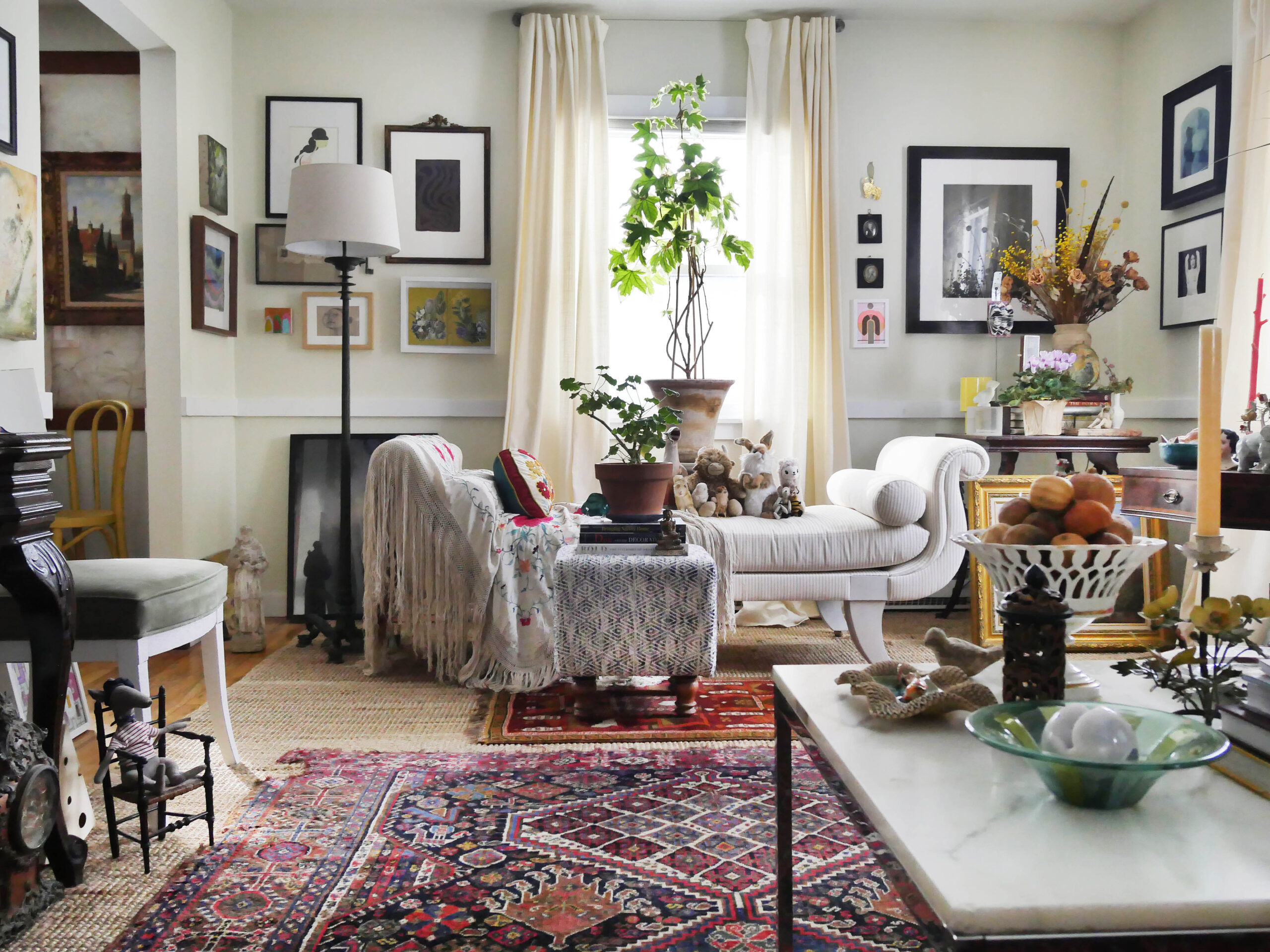
Lana’s & Galka’s living room, illustrating Lana’s philosphy that good design is a combination of storytelling, craftsmanship, layers and humor.
The original Google
“I had a very interesting childhood because I had a very doting mom who was creative person herself,” Lana describes. “We were always involved with some kind of tactile project, mainly for school. She helped me develop and nurture that penchant for creativity and doing things my way.” These three-dimensional art projects included creating the face of the moon out of Plaster of Paris and building a complete maquette of the first settlement in Jamestown. She would take the lead, and Lana would watch and learn, but first, they’d research together.
“I think my mom was the original Google,” he says. “She had a large storage room in our basement filled with boxes of beautiful reference materials. There were boxes about politics, current events, art, history—and every box was labeled. Whenever we had a project to do, we’d go down to the basement, find the appropriate boxes, and bring them up to the living room to do our research. Then we would sit at the kitchen table, sort things out and begin the project. So I was taught the benefit of research very early on, and that’s why I’ve accumulated an extensive library over the years.”
Lana credits the Jesuit-run Saint Francis Xavier High School in Manhattan for making him an “independent thinker,” and at Boston College, he discovered theater. Initially a political science major to appease his mother’s dreams of him becoming a lawyer, Lana quickly pivoted to English and discovered the Boston College Theatre Department. “I loved being behind the scenes,” he explains. “I was involved in theater with lighting and set design.”
After college, Lana returned to New York and found himself working at the Plaza Hotel. One afternoon, while hanging out in a friend’s living room, he began thumbing through a stack of Architectural Digest magazines stashed under a coffee table. “I turned to my friend and said, ‘This is what I really want to do. I love this,’” Lana recalls. “In that moment, I made a connection that I didn’t really realize existed.”
He enrolled at Parsons School of Design, but a conversation with Michael Kahlil, the minimalist designer who also taught at Parsons, changed everything. “After class one day, he said, ‘This is not what I normally do, but I’d like to see you outside of the school because I have something I want to discuss with you,’” Lana remembers. They met for Chinese food, and Kahlil told him, “I see the talent in you. If you want to spend your money and get your degree, that’s totally fine, but you’re ready to leave the nest.”
Lana took the advice. He left school and cut his teeth working for prominent designers like Georg Andersen and Vicente Wolf at Patino/Wolf Associates, learning how to bring “sensuality in a symbiotic way to design.” By the early 80s, he was ready to venture out on his own, building his business from the ground up. His first client was a family in New Jersey who got his name off a referral board at Parsons.
“They were interesting characters,” Lana remembers. “I always seem to gravitate towards people who are extremely animated and very articulate. They had a growing family and an unfinished basement, and they wanted a rec room. It was a period of minimalism, so I created this whole stepped situation that was filled with cushions. The family could sit on the steps and enjoy playing games or watching TV together. From there, I just kept moving forward, building my business little by little, mainly through referrals.”
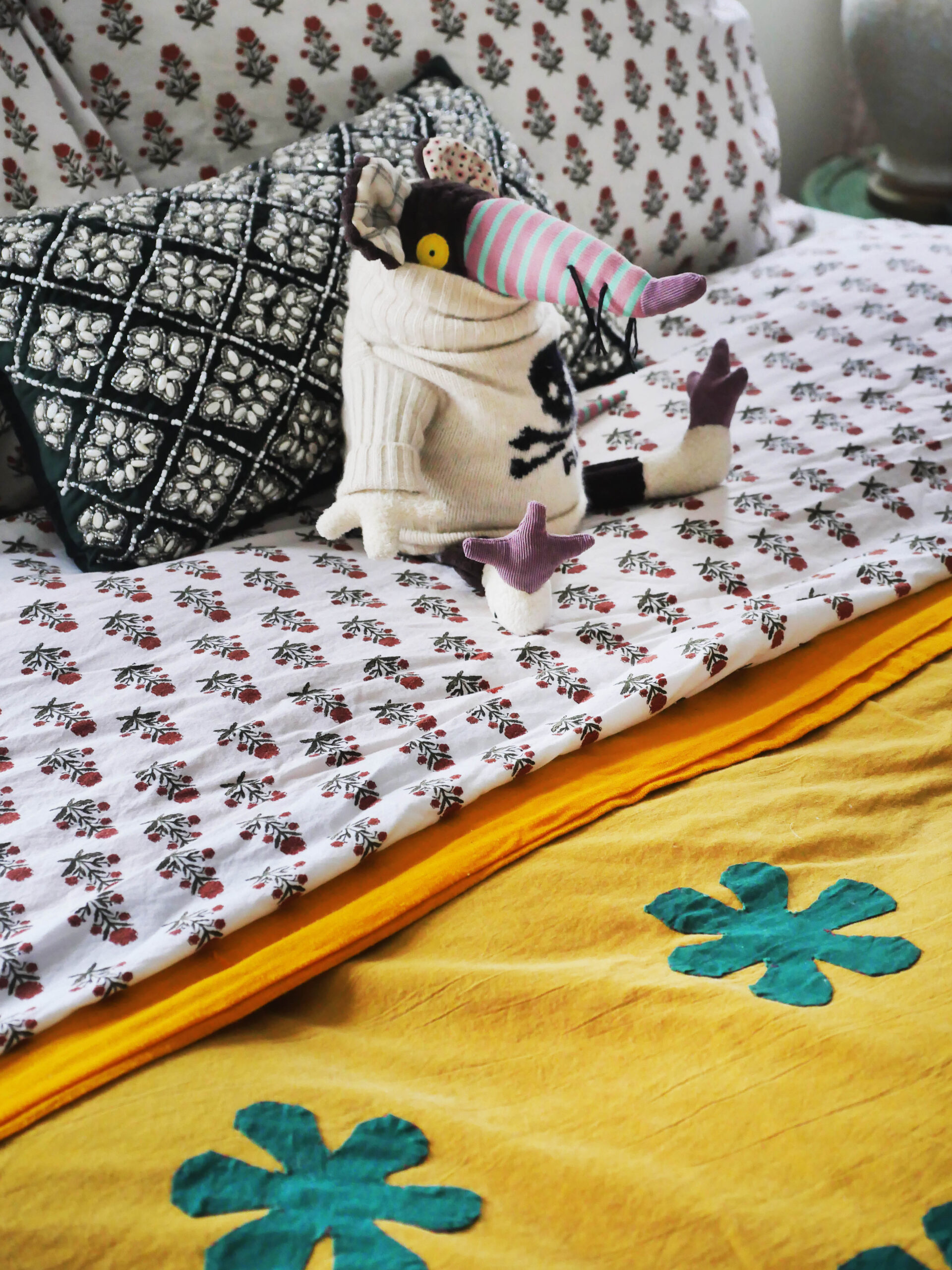
Storytelling, layering and humor on display in their bedroom.
A personal approach
Lana’s approach is as much about psychology as it is about aesthetics. He begins by building a relationship with the client, getting to know them and their interests. “It’s similar to when you start dating somebody,” he describes. This connection allows Lana to create rooms that are a “true reflection of the people who live in them.” He begins by understanding what each person likes and determining how to merge their styles. “I have no formula; it’s just intrinsic,” he says. “My goal is to create this melange, this environment that is inviting and warm and comfortable.”
Sometimes, that means giving a client a persona they aspire to but haven’t quite earned yet. Lana recalls a client in the late 90s named Arthur who insisted on having a paneled library but only owned about six books. “I said, ‘Arthur, we’ve got to go book shopping,’” Lana laughs. “I picked every book personally—I chose biographies, history books, art books, design books. I even bought a collection of Cecil Beaton books for him.” Later, during a party, Lana watched as one of Arthur’s friends pulled a book from the shelf and asked if Arthur had read it. Arthur didn’t miss a beat. “He jokingly said, ‘Oh yeah, I read the book jacket,’” Lana remembers. “He wanted to create a persona for himself of being well-rounded and sophisticated, so that’s what I did.”
Today, with Sandra Rose Home (named in honor of Lana’s mother, Rose, and Galka’s mother, Sandra, an assemblage artist), Lana takes a similar approach. While he will occasionally take on full-scale design projects if the “scope, budget and aesthetic compatibility” are right, his focus has moved toward consulting. Now, he says, he’s an interior decorator, no longer dealing with home additions and architectural plans, although he may still advise when needed. Instead, he’s honed in on helping homeowners find the perfect elements to make a room, or their home, truly their own. “If you tell me you’re looking for new side tables for your living room, and if you have the time, we will go shopping together and look at different options. I’ve trained my eye over the years, so I look at things from the point of view of: will it work? Does it have relevance? Does it serve or suit a function? I have my go-to places for everything, and I act as a tour guide. As we shop, I’ll point things out—like a table that will look really beautiful with a chair you already have—and we’ll fall in love with pieces together.”
Newell Turner, former editorial director for ELLE Decor, House Beautiful and Veranda, once described Lana as being “blessed” with the talent to pull off an eclectic style, noting that in Lana’s hands, a room becomes “far more than its individual parts.” Lana has an almost encyclopedic knowledge of design periods, which he references as he puts a room together. But Lana says he isn’t interested in creating “period rooms” that feel like museums. Instead, he aims for a varied mix where “old, new, high and low are all integral elements.”
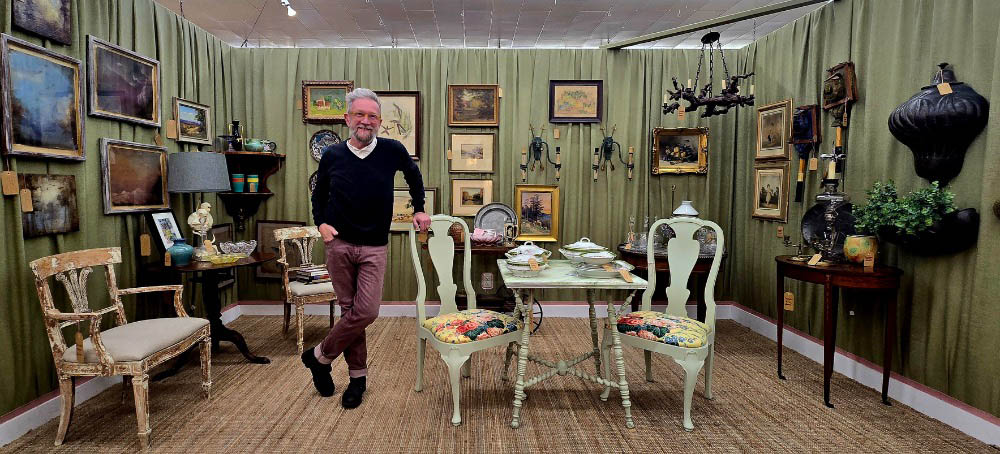
Lana in his antique shop at The Galleries at Knollwood Antiques. (Photo courtesy of Lana.)
It all adds up to this
Lana says he’s had “four major incarnations” as an interior designer. The first was his early career as he built a name for himself. Then, he took on a partner, another designer he worked with at Vicente Wolf. That progressed into other versions of his design firm, and now, the fourth is Sandra Rose Home.
After a full career, Lana is enjoying the role of decorator and the ability to work alongside his husband. “Nathaniel is an expert in color theory and faux finishing,” Lana explains. “He has a great sensitivity to color and adds an atelier aspect to a project.” Lana recounts a recent collaboration for a couple who had separated due to a medical crisis and eventually reunited. The husband’s apartment, which Lana had designed, was stark—lots of black and white. When the wife moved back in, the couple wanted a design that reflected their reunited life. “We added a lot of rose and pink, softened everything, made it more feminine,” Lana says. “Nathaniel created a beautiful wall finish that was similar to a Venetian plaster but matte, for a very strong textural effect. It’s an old-world Italian/country French feeling, but more sophisticated because of the furniture in the home.”
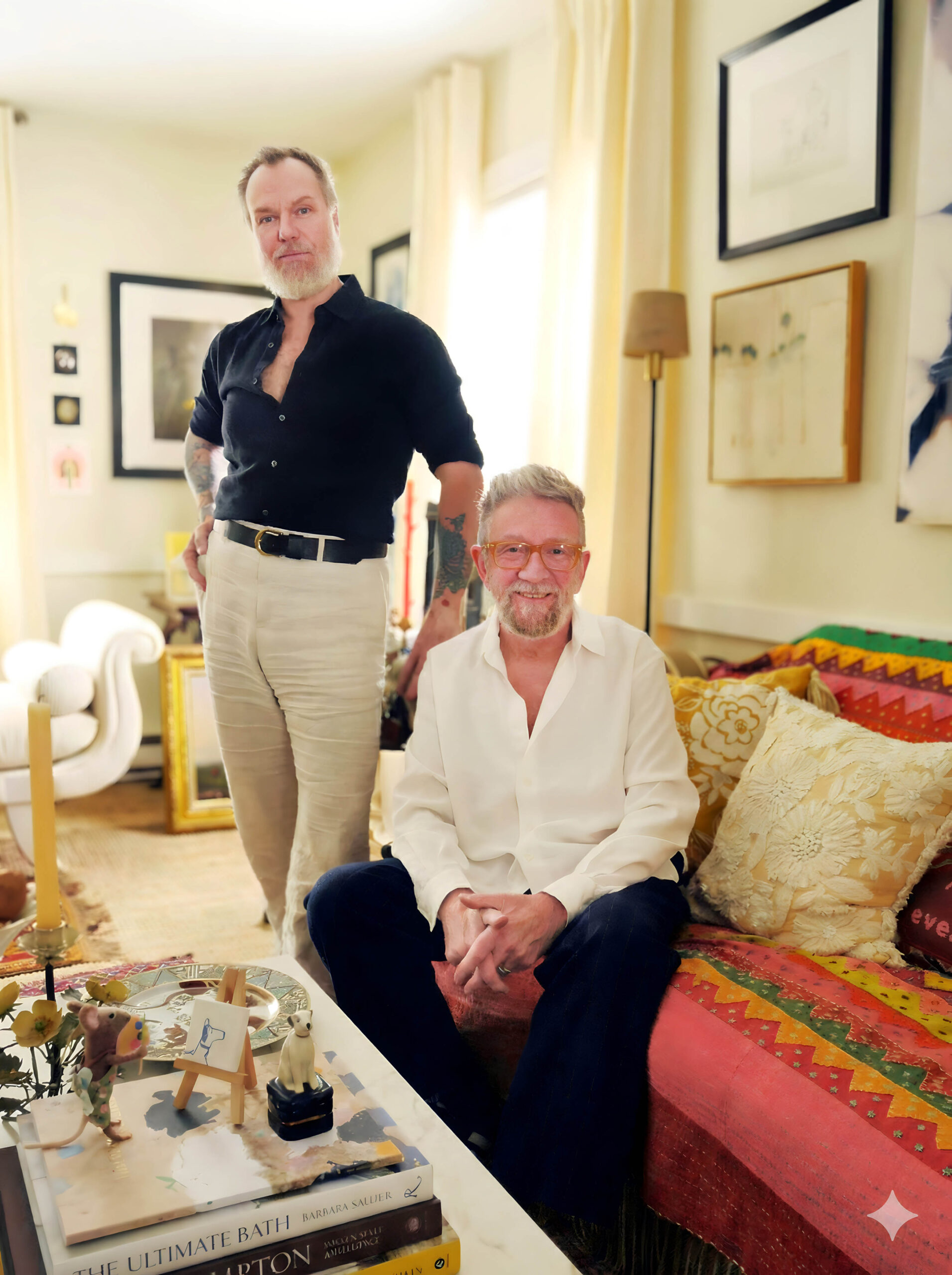
Galka (left) and Lana (right), co-owners of Sandra Rose Home.
Galka’s expertise also comes into play in subtle ways, like moving a beloved chair to a different room to add a warm touch to a space with a cool palette. “It’s such a subtle contrast, but that’s color theory,” Lana explains. Galka also serves as an art consultant, using his vast knowledge and connections to find the perfect pieces for a home. “Together, we can offer a full range of services,” says Lana. “A number of designers focus on the obvious needs but don’t indulge themselves to add the personal flair that breathes life into a home. It’s all about the details to help clients feel confident they invested their money well.”
Galka has even taught Lana a few things about design. Lana credits his husband with teaching him the value of layering. “Adding more texture and layers gives a room an almost historical feeling,” Lana explains. “It’s part of Nathaniel’s style, and we’ve incorporated it into our home because, in a sense, he’s my client.”
The final element of Sandra Rose Home is Lana’s antiques shop, located in a booth he rents at The Galleries at Knollwood Antiques in Lee, MA. “It’s an antique mall, and the owner, Richard, previously had an antique business in the city; I was a good customer of his,” Lana explains. “It’s really beautifully presented—it’s edited, it’s curated, and it’s designed.” Lana’s shop, which is also accessible via the Sandra Rose Home website, features an array of antiques, artwork, curiosities and more that Lana has collected over the years and during his travels. “My ultimate goal is to have a shop here,” he says.
As the interview wraps up, Galka, whose deep connection to nature and animals is prominent in his art (read “A Fairytale Reality” on our website to learn more about him), walks into the living room. He begins sharing stories about the vintage-style stuffed animals, who, it appears, enjoyed our conversation. It perfectly demonstrated Lana’s main goal when working with a client. “I want to make them happy,” he says. “I want them to be proud of what we’ve accomplished together and feel well-rooted in their home. I want them to walk into their living room, their dining room, their bedroom and say, ‘This reflects me; this reflects my interests.’ That’s very important to me.”
This article was edited by Julie Schwietert Collazo and fact-checked by Isabella Aranda Garcia. Photos were taken with Panasonic Lumix optics in Lana’s & Galka’s home.
This article was published in the January/February 2026 edition of Connect to Northern Westchester.

Gia Miller is an award-winning journalist and the editor-in-chief/co-publisher of Connect to Northern Westchester. She has a magazine journalism degree (yes, that's a real thing) from the University of Georgia and has written for countless national publications, ranging from SELF to The Washington Post. Gia desperately wishes schools still taught grammar. Also, she wants everyone to know they can delete the word "that" from about 90% of their sentences, and there's no such thing as "first annual." When she's not running her media empire, Gia enjoys spending quality time with friends and family, laughing at her crazy dog and listening to a good podcast. She thanks multiple alarms, fermented grapes and her amazing husband for helping her get through each day. Her love languages are food and humor.

Justin is an award-winning designer and photographer. He was the owner and creative director at Future Boy Design, producing work for clients such as National Parks Service, Vintage Cinemas, The Tarrytown Music Hall, and others. His work has appeared in Bloomberg TV, South by Southwest (SXSW), Edible Magazine, Westchester Magazine, Refinery 29, the Art Directors Club, AIGA and more.
Justin is a two-time winner of the International Design Awards, American Photography and Latin America Fotografia. Vice News has called Justin Negard as “one of the best artists working today.”
He is the author of two books, On Design, which discusses principles and the business of design, and Bogotà which is a photographic journey through the Colombian capital.
Additionally, Justin has served as Creative Director at CityMouse Inc., an NYC-based design firm which provides accessible design for people with disabilities, and has been awarded by the City of New York, MIT Media Lab and South By Southwest.
He lives in Katonah with his wonderfully patient wife, son and daughter.