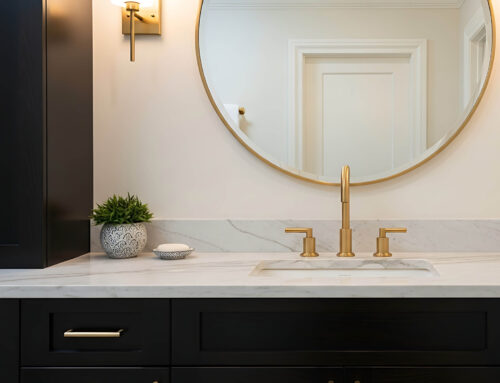


Dimmable lightbulbs with over 16 million colors, cork-infused wood flooring and towel racks that double as support rails are just some of the ways homes can improve the lives of family members with physical or neurological differences while avoiding that “hospital room” look.
By Julie Schwietert Collazo
Design by Justin Negard
While the Americans with Disabilities Act (ADA) was a landmark piece of legislation in 1990 that required larger doors and hallways as well as the addition of ramps and bathroom accommodations in public spaces, those added bits of infrastructure still excluded millions of people. Those with invisible disabilities, such as intellectual or developmental disabilities, or who are neurodiverse did not experience the same kind of “friendlier” public spaces.
Over the years, the notion of “design for all” has left architects, designers, policymakers and end users alike feeling confused about what “inclusive design” means. And disability advocates and activists have rightfully complained that the burden of insisting on compliance all too often fell upon them. In many cases, even people with disabilities, or their loved ones, didn’t necessarily know what accommodations they needed or what resources were available. Thankfully, things have since changed, and today inclusive design offers many “invisible” options that help people with disabilities live more comfortably in their homes without the dreaded “institutional” look.
Good (and inclusive) design includes people. Period.
On a clear, cold January morning, I dial the office of Irina Verona, a New York City-based architect and partner at Verona Carpenter Architects, PLLC. Verona and her business partner, Jennifer Carpenter, who has a child with special needs, focuses on inclusive architecture and design.
It’s a subject Verona could talk about for hours.
The ADA of 1990, she says, “mandates legal requirements for mostly public spaces, which have to do primarily with physical mobility.” While such requirements are an essential part of their work, and “we think that’s really important,” she continues, it’s really just the beginning of thinking about how to create the most inclusive spaces.
For Verona and Carpenter, the definition of inclusive design is simple. “Inclusive design,” Verona explains, “is designing for the broadest range of bodies and minds.” It goes beyond “what’s required by code,” she says, to ask the essential question: “How do we create spaces that really work in multiple ways so people can feel comfortable and be themselves?”
At the heart of this question, Verona explains, is the idea that disability isn’t something that’s “wrong” with an individual. Instead, it’s a limitation within the environment. It’s a signal—and an invitation—to think more broadly and deeply about how to bring more people into a space, along with how that space can be used in a multitude of ways, responding to a diverse array of needs.
Increasingly, Verona says, architects and designers are understanding that some of the most impactful aspects of inclusive design are features that perhaps can’t even be seen, features that have to do with how a space and its possibilities are imagined, especially for people who are neurodiverse. The term, Verona explains, is relatively new, having been coined in the late 1990s to early 2000s. The word and what it represents are exciting, she says, because it “refers to the natural variation in human brains.” “We’re all sensory, processing and cognitive beings, and there’s a natural variation. Some of us are neurotypical—we have a typical way of processing information—and others are neurodiverse.” The category includes people with ADHD, autism, dyslexia, a variety of mental health conditions and more. For people who are neurodiverse, homes that minimize sensory stress, reduce clutter, assist with organization and provide clear, predictable spaces can be a game changer.
Verona explains by way of example. Years ago, she and Carpenter entered an architecture competition that involved the challenge of designing an inclusive school. They won, Verona says, because they questioned all of the conventional thinking about what a classroom is supposed to look like, how it should be arranged, and how learning can occur. “You’re supposed to study sitting down in a chair, right?” she asks, prodding. “But why is that? What if we have spaces where kids can lie down? What if there’s a space where they can rock? Why are a desk and chair the only acceptable furniture? Who do they leave out?” Many of these concepts are now incorporated into classrooms today, but what about at home?
At its heart, Verona says, inclusivity asks the question: How can we imagine something different? “We have to be a little bit more open about our ideas and about what can happen where,” Verona says. Creating truly inclusive spaces goes far beyond thinking about what features need to be added or modified to comply with federal law. What settings and tools allow people to “be comfortable and thrive?” Verona asks.
She suggests that the answer lies in beginning to upend our assumptions about how we do, well… everything.
Little things can change everything
Todd Merritt, Ph.D., BCBA-D, LBA and director of staff development and behavioral services at The Arc of Westchester, agrees. The Arc serves people with intellectual and developmental disabilities across the lifespan in both day treatment and residential programs. Merritt says that being inclusive isn’t about “requiring the person to fit to the space, but adapting the space to best support the person.”
Inclusive design is more than what’s required by the ADA; it can also include accessible features in the home, like adjusting the height of a sink, improving lighting or installing a roll-in shower where a bathtub once stood. These are design elements that The Arc and its clients still rely upon, of course, but increasingly, Merritt says, the question that guides the design of both recreational and residential settings is, “How do we create preferred spaces?” The Arc’s goal, he says, is to create settings where people can be successful throughout their day and as independent as possible.”
Anthony Palladino, founder and owner of Southeast Kitchen & Bath in Brewster, has seen a shift toward inclusive design in recent years—even if he, and his company, don’t refer to it as such. Palladino, who started his business in 1973, says the internet has had a massive impact on what customers want, what they believe is possible and what features they know are available in the market. “People are educated now,” he says, explaining the changes he’s seen in his four-plus decades in the industry. “The internet tells them everything. They have Pinterest boards. Customers come in with portfolios of what they want.”
Palladino’s new, massive 4,000+ square-foot showroom features some of the latest kitchen and bathroom designs. And while the showroom isn’t focused on accessibility, it’s proof that inclusive designs have become more mainstream. There are one-touch dimmer lights (useful for people with weak hands or poor grip strength), touch-to-open cabinets (great for people who are older or who have limited mobility) and folding shower seats (supporting people with balance issues). Palladino and his team will happily demonstrate how these features could work in their customers’ homes, but he says most of his clients are already aware of what they want, and “we make it work well for them.”
Purple and pastel pink pillow on the grey comfortable couch in bright living room interior with pink carpet and coffee table, real photo with copy space on the empty white wall.
Invisible upgrades, real-life impact
There are a whole range of impactful technologies now available for the entire home. These technologies can dramatically improve the lives of people with physical and neurological differences and can also be useful for everyone living in the home. Gone are the days when “adaptive device” meant something clunky or unsightly. To the contrary, supportive technologies and features are now sleek and, in many cases, even invisible.
A kitchen counter that comes to you
Take the adjustable kitchen island by TEAM 7, for example. With just one touch of a discreetly placed button, the kitchen island lifts or lowers to adjust to the user’s preferred height. That means that everyone in a family (kids, adults, someone in a wheelchair) can make the island fit their specific needs and preferences. The company offers a wide range of wood finishes, glass types, colors and drawer pulls—including the one-touch drawer and cabinet feature, which has no handles and thus does not require pulling.
Balance support you don’t have to hide
When it comes to balance, you no longer need to “institutionalize” your home with bright, stainless steel grab bars to make it safely from Point A to Point B. For the bathroom, HealthCraft’s INVISIA line features stealth “grab bars”—toilet paper holders, shower shelving, soap dishes—that can support up to 500 pounds. For the stairs, Promenaid offers code-compliant wooden handrails and guardrails (with optional lights underneath) in various sleek finishes that can easily be customized to the curves and bends of your home.
Lighting and sound on a softer setting
People with autism often struggle with sensory overload from loud sounds and/or bright lights, but today, there’s an ever-widening array of products that can drastically reduce overstimulation. For example, installing anti-vibration “floating” pads around washers and dryers can eliminate the low-frequency hum that can irritate some people. Similarly, cork compound flooring can absorb footsteps, the echo of voices and other ambient sounds. Additionally, today’s “smart” lightbulbs can change brightness and color (think bright white to soft orange) with an app or even your voice.
Because “Did I turn that off?” is exhausting
Lack of executive functioning skills is common for people with ADHD, which can result in starting a new task before finishing the previous one. Unfortunately, in a home, that can be dangerous. For example, they might leave a faucet running or the oven on when they exit a room or even the house. Luckily, auto-shutoff sensors specifically designed for things like faucets and ovens can help prevent floods or fires when someone walks away before a task is completed. Similarly, smart plugs you can check remotely can prevent someone from accidentally leaving their curling iron or a space heater on all day (and potentially burning down the house).
A better way to wind down (and wake up)
For anyone who struggles with sleep transitions, programmable lights from companies like Phillips or Govee can help create consistent sleep and wake times. The lights can dim or change color in the evening, breaking a person’s hyperfocus and signaling it’s time to get ready for bed. Similarly, in the morning, the lights can slowly brighten, helping them wake up. And if that’s not enough, there are products that literally force people with sleep inertia (a.k.a. trouble waking up) out of bed. One example is Ruggie, a small bedside rug with a built-in alarm clock. To turn it off, you must physically stand on the rug for 3-5 seconds, and voilà—now you’re out of bed.
A room that “unplugs” for you
Finally, all of us could probably benefit from less screen time (it’s also a dopamine reset for people with ADHD as well as sensory decompression for people with autism or sensory processing disorder). Fortunately, there’s a growing field of “invisible” products designed to help us cut back and even create “screen-free” rooms. Some are as simple as conductive primers applied under standard wall paint that help block cell tower signals and Wi-Fi. These base coats tend to be infused with carbon black, graphite or metallic particles. If you’re not up for a paint job, there are also Wi-Fi-blocking curtains woven with conductive copper and nickel that block radio frequency signals. Just imagine the peace and quiet.
Side note: We predict many homes will soon feature a screen-free room that provides all residents (neurodivergent and neurotypical alike) with “refuge” spaces—quiet, calm spots where everyone can relax and reset.
Your future self would like a word
The truth is, most of us will have to think about inclusive design at some point in our lives—and many of us sooner rather than later. In Westchester County, the population is aging steadily. The 85+ demographic now stands at over 27,000 people (2.71 percent of residents), up from projections of around 22,000 a decade ago, and older adults overall (65+) represent 17.7 percent of the county—nearing 1 in 5 residents—with nearly 38 percent of them living alone. This means their dwellings and the spaces they access in the community need to reflect their changing physical abilities and mental acuity.
While those of us at midlife may wonder how we got here so quickly—and, by extension, might want to avoid thinking about our golden years altogether—being proactive now can be helpful. Take advantage of inclusive design ideas and have adaptive technologies and features installed before they’re needed. After all, remember Verona’s key observation: spaces should accommodate all of us and all of our needs. Your future self will thank you.
This article was edited by Meryl Kaye and Gia Miller. It was fact-checked by Gia Miller. The photographs were purchased from Adobe Stock (and taken by humans—we checked).
This article was published in the March/April 2026 edition of Connect to Northern Westchester.

Julie Schwietert Collazo

Justin is an award-winning designer and photographer. He was the owner and creative director at Future Boy Design, producing work for clients such as National Parks Service, Vintage Cinemas, The Tarrytown Music Hall, and others. His work has appeared in Bloomberg TV, South by Southwest (SXSW), Edible Magazine, Westchester Magazine, Refinery 29, the Art Directors Club, AIGA and more.
Justin is a two-time winner of the International Design Awards, American Photography and Latin America Fotografia. Vice News has called Justin Negard as “one of the best artists working today.”
He is the author of two books, On Design, which discusses principles and the business of design, and Bogotà which is a photographic journey through the Colombian capital.
Additionally, Justin has served as Creative Director at CityMouse Inc., an NYC-based design firm which provides accessible design for people with disabilities, and has been awarded by the City of New York, MIT Media Lab and South By Southwest.
He lives in Katonah with his wonderfully patient wife, son and daughter.