
Writing and Photography by Justin Negard
“The purpose of architecture is to shelter and enhance man’s life on earth and to fulfill his belief in the nobility of his existence.” -Eero Saarinen, architect of the original TWA Terminal
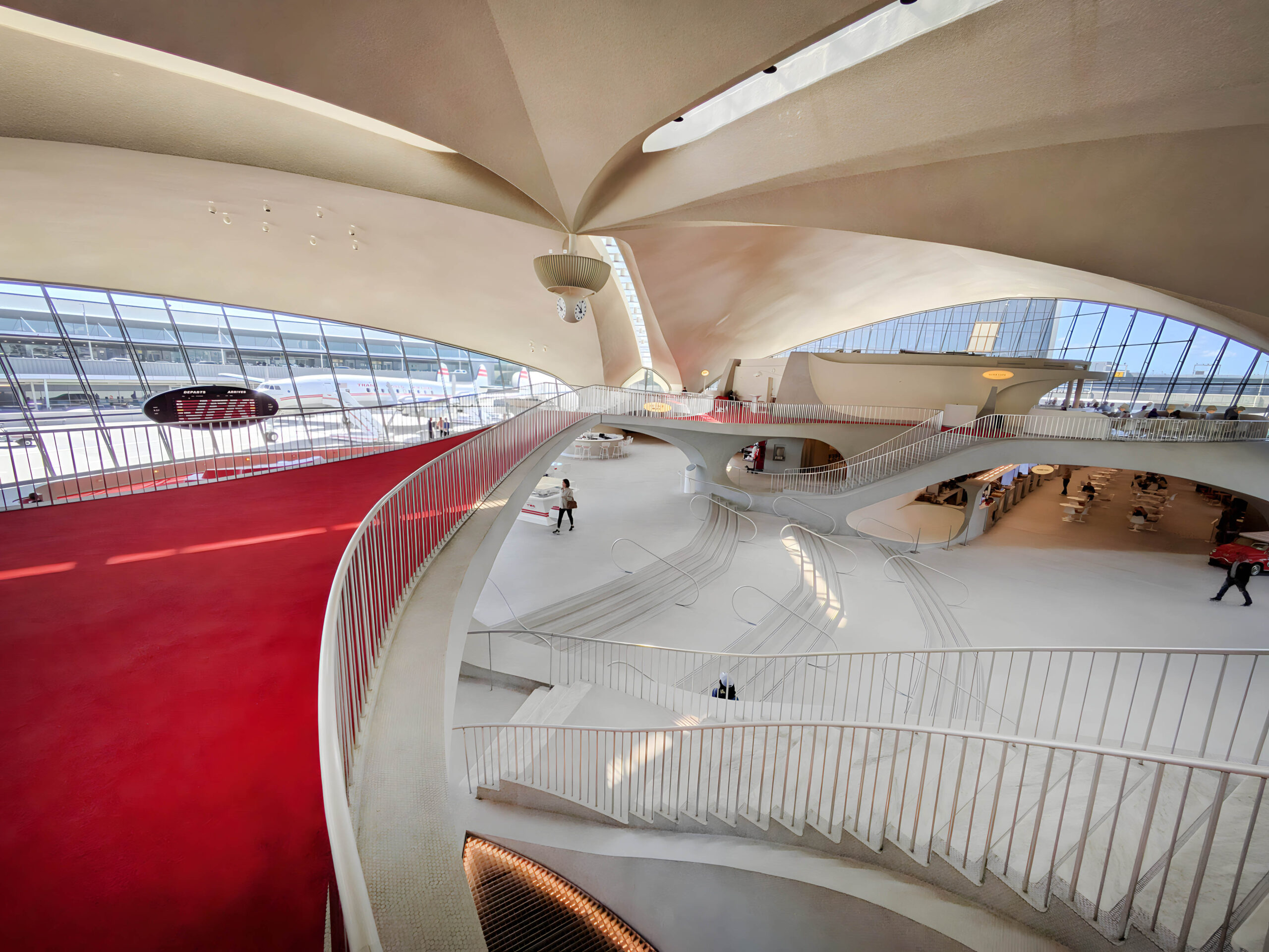
It’s 11 p.m. in the lobby of the TWA Hotel. Frank Sinatra echoes off the curved ceilings of the former airplane terminal, his voice briefly interrupted by the clicking of the Solari departure board as it spells out the word “Frankfurt.” With a cold negroni in your hand, you gaze through the expansive windows to the well-lit runway outside.
Connie, the 86-year-old Lockheed Constellation airliner, sits just beyond the glass. The airplane is now a converted bar and lounge, but you can easily imagine former TWA owner Howard Hughes himself stepping out and walking down the stairs to the tarmac.
The TWA Hotel is more than a place to sleep in between flights—it’s an experience. From the 1962 navy blue Lincoln Continental convertible parked in the entranceway to the pink Sweet’N Glow faux beauty parlor (complete with vintage magazines and retro wigs) in the lobby, there’s an authentic 1960s vibe throughout. Guests can play on the large Twister board in one of the lobby alcoves or admire the old-fashioned payphones hanging on a wall for decorative effect. Even the Chili Pepper Red carpet and couches in the lobby’s sunken lounge perfectly match the ruby-colored Campari in your glass. The details matter here.
The legendary graphic designer Milton Glaser once said, “There are three responses to design—yes, no, and WOW! Wow is the one to aim for.”
The TWA Hotel is certainly aiming for ‘wow.’ It is an amalgamation of art, design and history woven into an active, functioning hotel. The current reception desk was once the baggage claim. The lobby dining area (the Food Hall) is the former TWA Departures Hall. The changes, while significant, remain true to the history of this building and really bring hotel guests into another era. It’s the JFK International Airport in 1963, and you’re ready to fly with Frank Sinatra to a “bar in far Bombay.”
The long flight
In 1955, New York City’s Idlewild Airport (renamed John F. Kennedy International Airport eight years later) finalized its master plan to expand the airport’s footprint. This plan involved many of the major airlines constructing their own terminals, creating a “Terminal City.” In 1956, airline president Ralph S. Damon hired Eero Saarinen to lead the project.
Saarinen and his firm had already designed the Jefferson National Expansion Memorial (a.k.a. the Gateway Arch) in St. Louis, along with the General Motors Technical Center in Michigan and the MIT Chapel and Kresge Auditorium. For the TWA project, Saarinen set out to emphasize what he called “the drama and excitement of travel.” The building featured a curved roof, designed to resemble a bird in motion, complete with two “wings” on each side of the structure. There were very few right angles in the building. Walls, ceilings and walkways were curved; Saarinen’s recognizable flowing style is easily identifiable in this structure.

The Sunken Lounge.
The terminal was fully functional for nearly half a century, eventually closing to the public in 2001 when TWA was purchased by American Airlines.
For years, the Flight Center existed only as a topic of design discussion, cultural gatherings (art exhibits, fashion shows, etc.) and photo or film shoots. You might remember it from the 2002 film “Catch Me If You Can,” which featured Tom Hanks and Leonardo DiCaprio walking down those iconic carpeted flight tubes (a.k.a. hallways).
Declared a New York City Landmark in 1994 and listed on the National Register of Historic Places in 2005, the TWA Flight Center eventually soared into a new era. In 2019, MCR/MORSE Development opened a reimagined version of the iconic terminal as the TWA Hotel, reviving the timeless style of mid-century modern design.
First-class treatment
The TWA Hotel isn’t just a building from another time; it is an ambassador of an era. Through partnerships with the New York Historical Society, the Port Authority of New York and New Jersey, Yale University and others, the terminal is equal parts hotel and museum, reflecting the jet-set culture of the 1960s.
In the lobby, for example, you can view 37 TWA uniforms from the company’s 50-year history created by designers like Valentino Garavani, Oleg Cassini and Ralph Lauren. Stan Herman, who designed TWA’s uniforms in the 1970s (and JetBlue’s today), returned to create uniforms for the hotel’s present-day staff, drawing inspiration from Jacqueline Kennedy Onassis and “Mad Men.”
Before the hotel opened, MCR/MORSE Development collected more than 2,000 TWA artifacts, most of which were donated by former TWA employees and their families or tracked down on eBay. For example, if you take a brief stroll down one of the hotel’s flight tubes, you’ll find a replica of Howard Hughes’ office. From the desk and the drink cart to the airplane photos and movie posters, the museum exhibits reflect that moment in time.
-

- “Even the Chili Pepper Red carpet and couches in the lobby’s sunken lounge perfectly match the ruby-colored Campari in your glass.”
-

- A flight tube at the TWA Hotel.
There are nostalgic nods around every corner, from the line of public pay phones and the split-flap departure boards (specially commissioned and recreated by Solari di Udine of Italy) to the restoration of the original penny tiles that line the floors and walls of the lobby (100,000 square feet of penny tiles line the floors and climb up the walls, according to Tyler Morse, CEO of MCR/MORSE Development).
To create a more authentic look, the TWA Hotel team hired Amish woodworkers in Ohio for the custom millwork. They also brought on designer Michael Bierut (see our article on Bierut) to create a custom typeface, Flight Center Gothic, which was inspired by vintage TWA signage and marketing materials. And Tennessee’s Musgrave Pencil Company created custom eye-catching red TWA pencils (complete with red erasers) that are seen throughout the hotel. Again, the details matter here.
In-flight entertainment
Beyond the aesthetics and nostalgia, a real question emerges: Is this hotel more than a work of art? The answer is yes, as long as your stay is brief.
The hotel is meant for relaxing, and the sunken lounge is the perfect place to do just that. Located in the center of the lobby, this lounge features all the style and comfort from the former terminal. Sure, the allure of staring out of an airport window might not sound appealing right now, but just wait until a cocktail is in your hand and jazz music is softly echoing off the walls of the hotel.
On the lobby’s second floor, the Paris Café by Jean-Georges is the swankiest dining option. Featuring a broad range of choices from black truffle pizza and yellowfin tuna tartare to beef tenderloin and parmesan mushroom risotto, it’s a restaurant reflective of the chef and owner’s namesake.
There are quicker meals to be found at the Food Hall. Also designed to resemble a TWA check-in desk with individual food stands at each counter, you can choose from a selection of paninis, bagels, crepes and other simple bites. Then, you can dine in a Saarinen-designed Tulip Chair and Pedestal Table while admiring the retro travel posters around you.

The 1958 Lockheed Constellation “Connie” Airplane outside of the TWA Hotel.
For a nightcap, head to the Connie Cocktail Lounge. Located inside the Lockheed Constellation airplane parked on the hotel’s tarmac, this propeller aircraft-turned-cocktail lounge is a reference to the plane Howard Hughes originally commissioned in 1939 (this one is actually a Starliner built in 1958), which quickly became a symbol of speed, elegance and style during that time. After decades of use, the airplane was decommissioned by TWA and used for various odd jobs throughout North and South America. MCR/MORSE Development eventually got ahold of Connie and partnered with Atlantic Models/Gogo Aviation to restore it (or “her,” as the TWA Hotel says) and brought the dilapidated airplane (she was missing a nose!) back to the former Flight Center for guests to enjoy.
Beyond dining, there are several additional places you can visit, including a fitness center, event space, gift shop and rooftop pool. The pool has an infinity edge and a view of the nearby runway, which makes for an unusual visual while you go for a swim. And be sure to grab a beverage at the rooftop bar if you want a little extra leisure time at the pool.
-

- The TWA Hotel lobby.
-

- The Paris Cafe.
At the end of the day, this is a hotel, and your room is where you will likely spend much of your time. The hotel offers several options for guests, which range from a standard room all the way up to the Eero Saarinen Presidential Suite (located in one wing and featuring a view of the main structure) and the Howard Hughes Presidential Suite (with a view of active runways). Rooms come furnished with Saarinen-designed furniture, retro magazines and posters, and a working rotary phone (which you will need if you want to call the front desk). Blackout shades and 5-inch-thick windowpanes block out the noise and commotion outside (this is still an active New York City airport, after all). The rooms are simple but filled with enough retro charm and modern amenities to justify a stay.
Carry-ons only
The TWA Hotel is a must for history and design lovers. There is plenty to see, eat and do here for a fun evening or overnight stay. But remember, you’re still at the airport, and this is the only “sight” to see. Yes, kids will enjoy exploring the curved bridges and retro spaces for a couple of hours, but they too may run out of activities after the first night. Plan accordingly.
Despite this, the TWA Hotel is worth the trip. It’s a romantic evening with your significant other or the perfect spot to kill a couple of hours when your friend’s flight is delayed. Whenever you go, be sure to grab a drink, pull up a Saarinen-designed chair and take that trip to another time. Tell Frank we said hello.
This article was published in the November/December 2025 edition of Connect to Northern Westchester.

Justin is an award-winning designer and photographer. He was the owner and creative director at Future Boy Design, producing work for clients such as National Parks Service, Vintage Cinemas, The Tarrytown Music Hall, and others. His work has appeared in Bloomberg TV, South by Southwest (SXSW), Edible Magazine, Westchester Magazine, Refinery 29, the Art Directors Club, AIGA and more.
Justin is a two-time winner of the International Design Awards, American Photography and Latin America Fotografia. Vice News has called Justin Negard as “one of the best artists working today.”
He is the author of two books, On Design, which discusses principles and the business of design, and Bogotà which is a photographic journey through the Colombian capital.
Additionally, Justin has served as Creative Director at CityMouse Inc., an NYC-based design firm which provides accessible design for people with disabilities, and has been awarded by the City of New York, MIT Media Lab and South By Southwest.
He lives in Katonah with his wonderfully patient wife, son and daughter.