

By Liz Colombini
Photography by Justin Negard
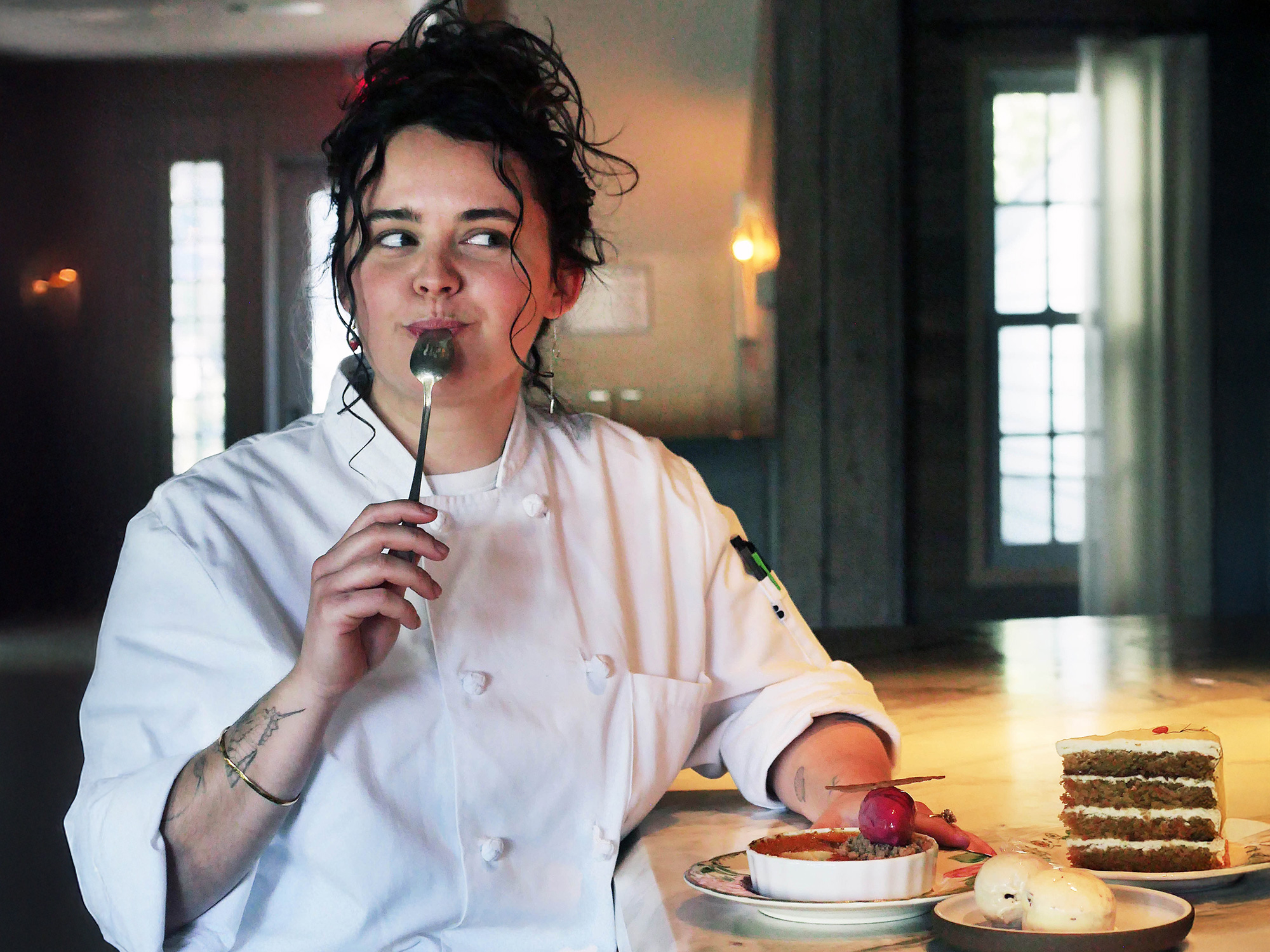
At 27, Olivia Vining stands in the pastry corner of The Inn at Pound Ridge’s kitchen, orchestrating desserts for up to 350 guests per night. Her hands move with precision as she plates salted caramel sundaes topped with caramelized popcorn and house-made fudge. The bursting flavors showcase a culinary mastery made all the more remarkable by a secret from her past: until college, Vining would eat only chicken tenders and pasta. “My parents love to tease me about this,” she laughs. “I never tasted fish. It was just pasta, pasta, pasta. I don’t know what was going on with me.”
What transformed this extremely picky eater into a pastry chef who now experiments with miso meringues and fig leaf syrups? Two simple things: a single cherry tomato, eaten at peak season from a local farm, and her grandmother’s tiny blue kitchen.
The first taste
When Vining was a freshman at the University of Vermont, she was focused on international studies, but she quickly found the subject matter too broad. “I was always intrigued by the professors who talked about the earth, nature and agriculture; they had so much love for the land,” she remembers. “When they spoke about the ways we could have a symbiotic relationship with nature, it was really beautiful and eye-opening. I’ve always been interested in nature, so I decided to switch majors to community entrepreneurship with a minor in food systems.”
During Vining’s sophomore year, she had an internship with an after-school program for middle school students. As part of the program, they visited local farms to learn about how and where food comes from, and it changed everything. “I picked a farm-fresh cherry tomato during peak season, right off the vine,” she remembers. “I ate it, and it was life-changing. This was what a tomato should taste like. All I’d ever had were mealy supermarket tomatoes that didn’t taste like anything.”
That moment sparked her curiosity. “I wondered what else should taste like this? If this is just a tomato, I knew there was so much more to discover.” As someone who considers herself deeply curious, Vining decided right then that she would taste everything the farm had to offer. She began nibbling on baby carrots, including their tops, fresh herbs, etc. Beyond taste, Vining sought to understand the entire food journey, from how it’s cultivated to the sustainability of local farming. “That really opened my eyes to the whole food scene,” she says. “Not only eating it, but understanding how everything’s grown and the whole process. I began researching flavor combinations and flavor wheels.”
When Vining went to visit her grandparents in Florida during her Christmas break, she couldn’t wait to tell her grandmother about her farm-fresh discovery. Her grandmother, who met Vining’s grandfather in New York while she was working as an opera singer, was an excellent cook. “My grandfather was from Turkey and came to the states in his 20s to become a doctor,” she explains. “Once they got married, they lived in Turkey every summer, bringing my mom and all her siblings.” Her grandmother grew passionate about Turkish cuisine, which she expressed and reserved through her cooking. Although Vining was completely disinterested in her culinary heritage as a child, that all changed after the “magical tomato.” “I remember telling my grandmother all about this farm-fresh tomato, just going on and on,” Vining says. “She said, ‘All right, we have some work to do.’”
What followed were lessons that would shape not just Vining’s palate but her entire approach to cooking. “She started teaching me Turkish food in her tiny little blue kitchen decorated with chicken and rooster wallpaper and figurines,” she says. “She taught me her favorite Turkish dishes, and it felt like a little hug, you know? It was part of my heritage.”
Her grandmother, who lived to 91, taught Vining to make simit (a thin, sesame-covered bread sold by street vendors), showed her how to poach apricots for hours in simple syrup with orange blossom and then stuff them with cream cheese and crushed pistachios (called Kuru Kayısı Tatlısı in Turkish), and more. But her grandmother was particularly passionate about a dish called İmam bayıldı. “There is this one eggplant dish she was really obsessed with, and she would always tell me, ‘You have to get really, really tiny baby eggplants because they have more flavor in them,’” Vining remembers. “My grandmother had her own version of this recipe where, after cutting them in half and scooping out the insides, she would fill them with cooked rice, tomatoes, onions, cranberries, raisins and dates. The first time I tasted it, I was like, ‘What is happening?’” The unexpected combination of sweetness from the dried fruit balanced with fresh herbs like mint and dill was an entirely new experience for Vining’s palate. It all came together in a way that surprised her.
Vining’s grandmother was also the kind of cook who never measured anything. “She was that grandma who just cooks and pours things in a pot, leaving me wondering how she knew what to put in there,” Vining says. “She was cooking with love, and that’s why everything tasted so incredible. So when I’m at work, getting lost in a ticket, I think to myself, ‘OK, be intentional; cook with love.’ Because at the end of the day, that is what people can taste. That’s what I live by.”
-
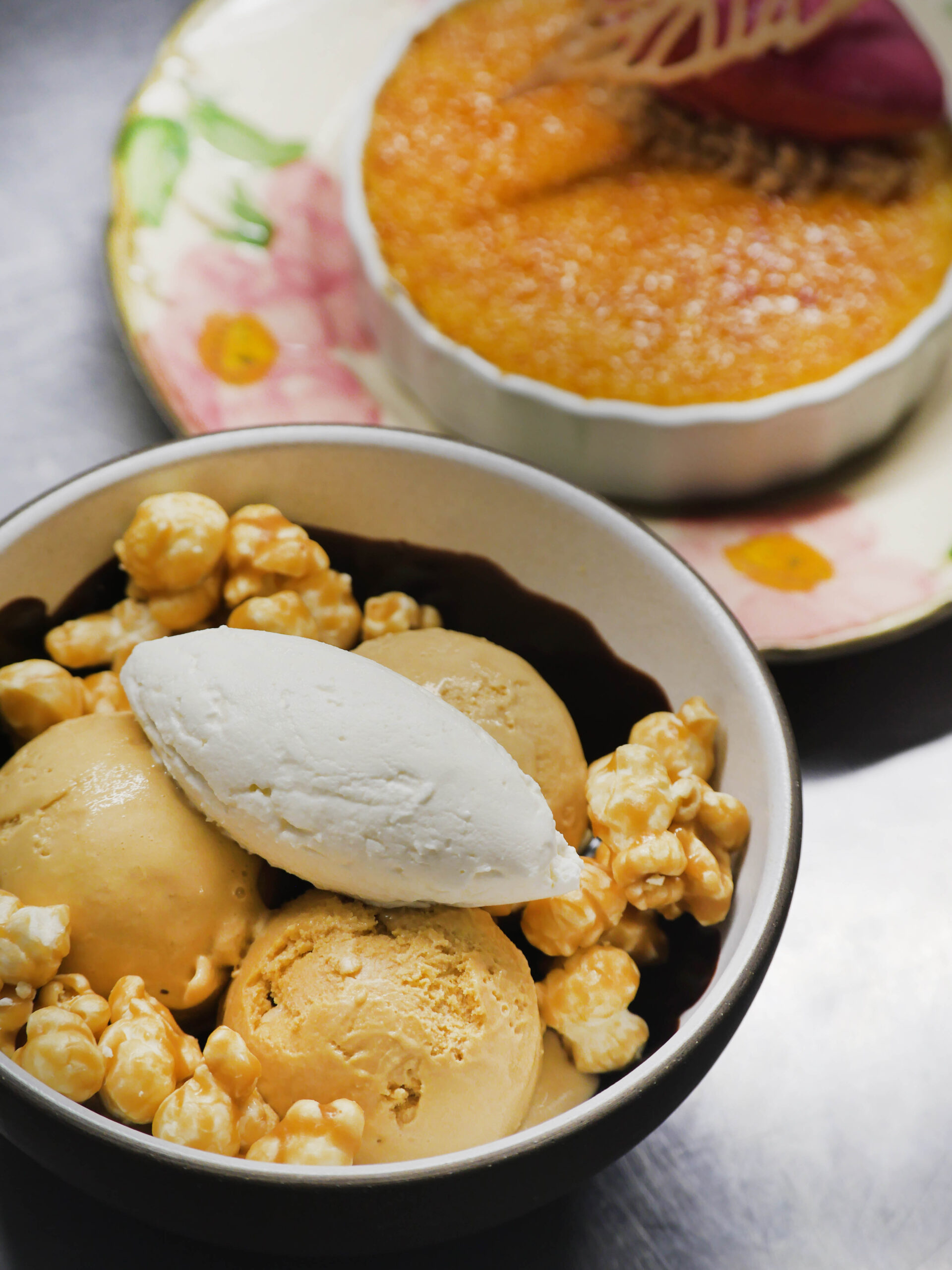
- A salted caramel sundae with caramelized popcorn..
-
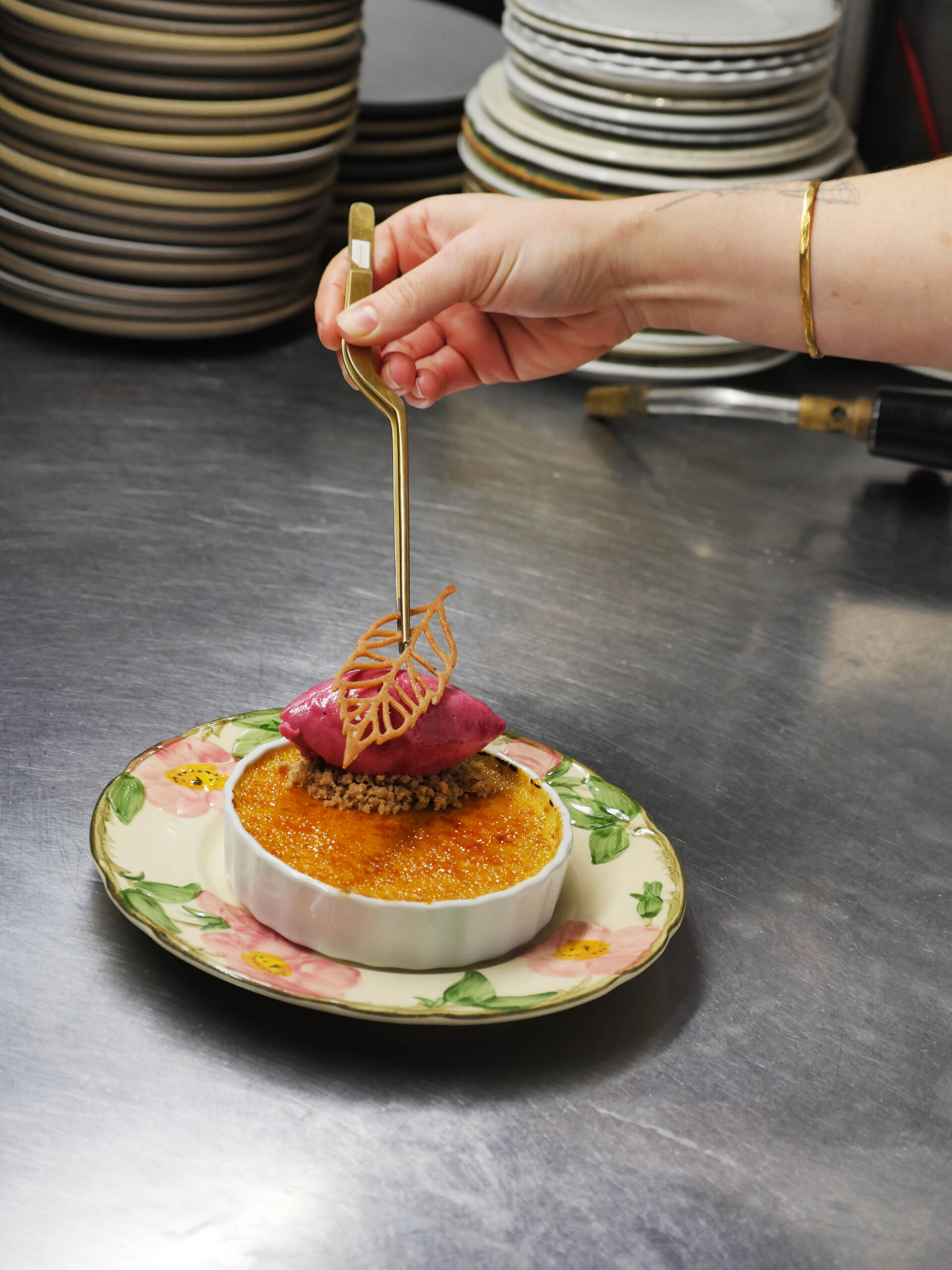
- Creme brûlée.
Drawn to the heat
Her path to becoming a pastry chef wasn’t linear, but Vining’s connection to food seemed inevitable. “I’ve always felt called to restaurants,” she says. “I love everything about food.” Inexplicably drawn to their energy and rhythm, that pull led her to work in restaurants starting at 16. When she moved from Albany to Pound Ridge, right before her senior year of high school, she briefly worked as a server’s assistant at The Inn at Pound Ridge for a few months before beginning college in Vermont.
After college, Vining lived in Queens for seven years while teaching culinary classes to children and adults at a cooking school in Manhattan. When she returned to Pound Ridge, which she now considers home, she also returned to The Inn, again as a server’s assistant—but watching the pastry team work changed everything. “I was in awe of all of these desserts,” she says. The craft appealed to her precisely because it was unfamiliar territory, a skill set she hadn’t explored before. Three months later, Vining transitioned to the back of the house, learning pastry from scratch and eventually working her way up to pastry chef just 1.5 years later. Today, she manages a small team of two.
Vining, who never attended culinary school, learned techniques like quenelle—those elegant oval scoops of whipped cream and intricate chocolate writing—while working in a fast-paced and high-stress kitchen environment. She describes The Inn’s style as “elevated comfort,” a menu that balances staples like warm chocolate cake and carrot cake with seasonal creations like Concord grape sorbet, which is served in late summer. Everything is made from scratch, including all the ice creams and fudges. “I think the general vibe and what we want people to feel when they come into The Inn is like you’re in someone’s living room,” she says. “It is fine dining, but it’s made with a lot of love.”
That emphasis on love and intention isn’t just her philosophy; it’s practical survival in an industry where the stress can be overwhelming. Vining remembers nights early in her tenure when she was the only pastry chef managing 25 dessert tickets on the board with timers going off every 30 seconds and the ticket machine running out of paper. “I’ve had a couple of those nights, and they’re terrible,” she says. ”But I think you have to have those nights in the industry so you can be like, ‘I had my rock-bottom night. Here’s what I can do to never have that night ever again.’ You just have to get into the mindset that people just want dessert. People just want to have a molten cake and that little celebration at the end of the night.”
Her advice to aspiring pastry chefs centers on the idea of presence: “Anything you do, whether you’re cutting a strawberry or baking a cupcake, just do it with full intention. Don’t get lost in the chaos. Be present and just do your best.”
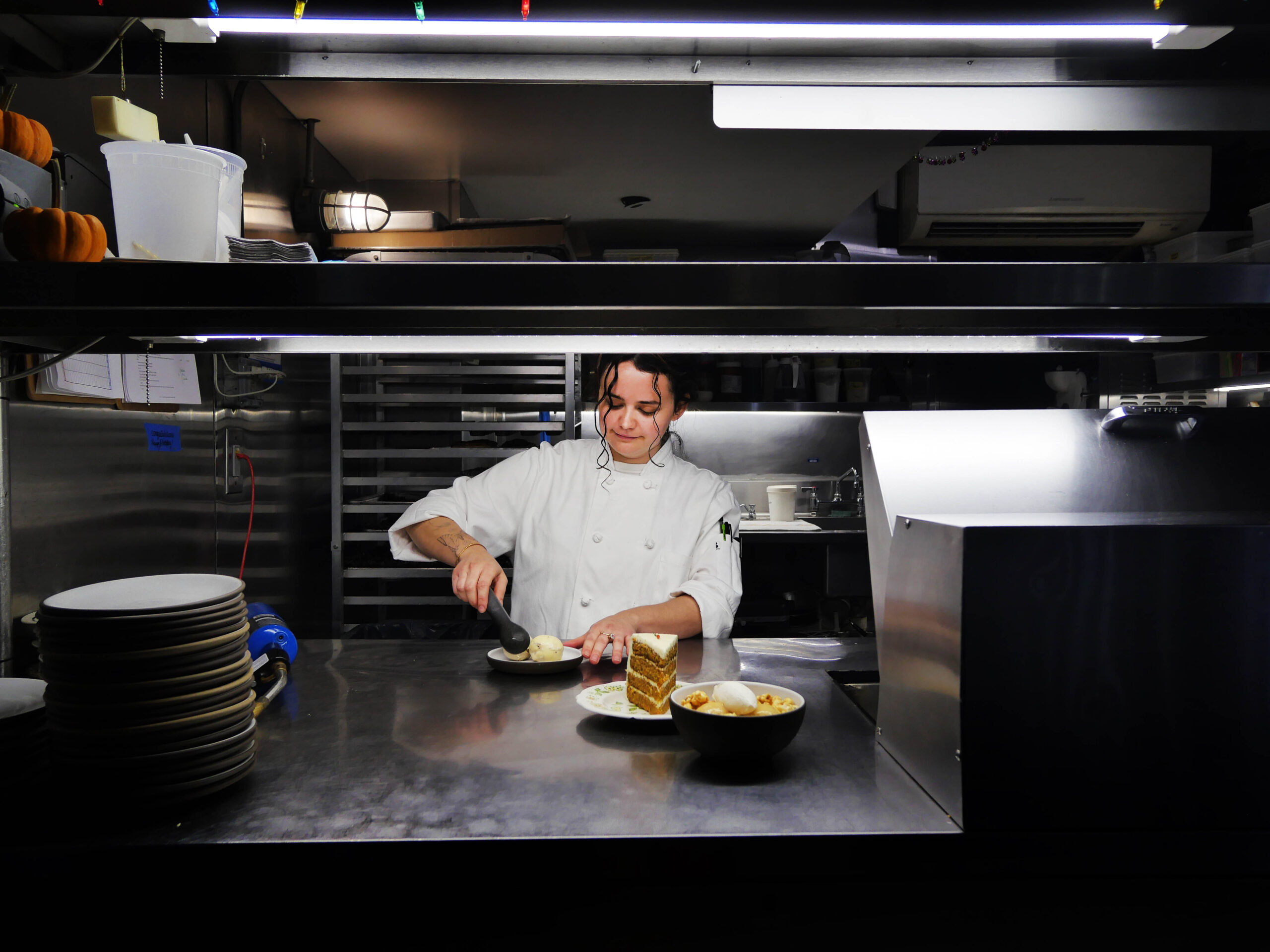
Vining plating desserts at The Inn at Pound Ridge.
The side dish
Outside of The Inn, Vining runs The Olive Vine, which started as a blog experiment three years ago and branched off into creating custom cakes and charcuterie boards for private events and parties. Her first client was a bookstore in Greenwich, where she made two charcuterie boards for a holiday party, and from there it grew. “A couple of months ago, I did an event for about 400 people,” she says. “I just really enjoy making them. I’m putting all these colors and textures together; it’s basically like drawing with food.” Vining, who grew up in an artistic household, says her charcuterie boards became popular because, as she puts it, “sometimes cheeseboards can be a little lacking.”
At home, Vining continues to experiment, crossing the line between savory and sweet with creations like a miso meringue with a toasted lemon tart or desserts infused with gochujang, a savory red chili paste. She’s especially drawn to Basque cheesecakes because of their signature charred tops and soufflé-like interiors, and she envisions making them in black sesame, pistachio and Thai tea flavors.
So how does Vining come up with her new creations? When developing new desserts, she typically starts with a single ingredient. During fig season, for instance, she discovered fig leaves and began infusing them into syrups and ice creams, toasting them rather than simply steeping them in milk. “I take one ingredient, and I think about how many ways I can make it into different components,” she explains. “I think as long as you get really excited by an ingredient, you’ll go pretty far with it.”
Vining also aims to reduce waste. For example, she’s transformed almond pulp from the restaurant’s toasted almond sorbet into an almond horchata by infusing it with milk, heavy cream, cinnamon and spices. It’s an approach that honors her Vermont education about sustainability and the complete food cycle.
At The Inn, one of her favorite desserts to make is the Concord grape sorbet. “We take fresh Concord grapes, steep them, blend them and strain them overnight through cheesecloth,” she explains. “We use all that juice, so it’s essentially just fresh Concord grape juice. It reminds me of being a kid and drinking grape juice. It’s so good.”
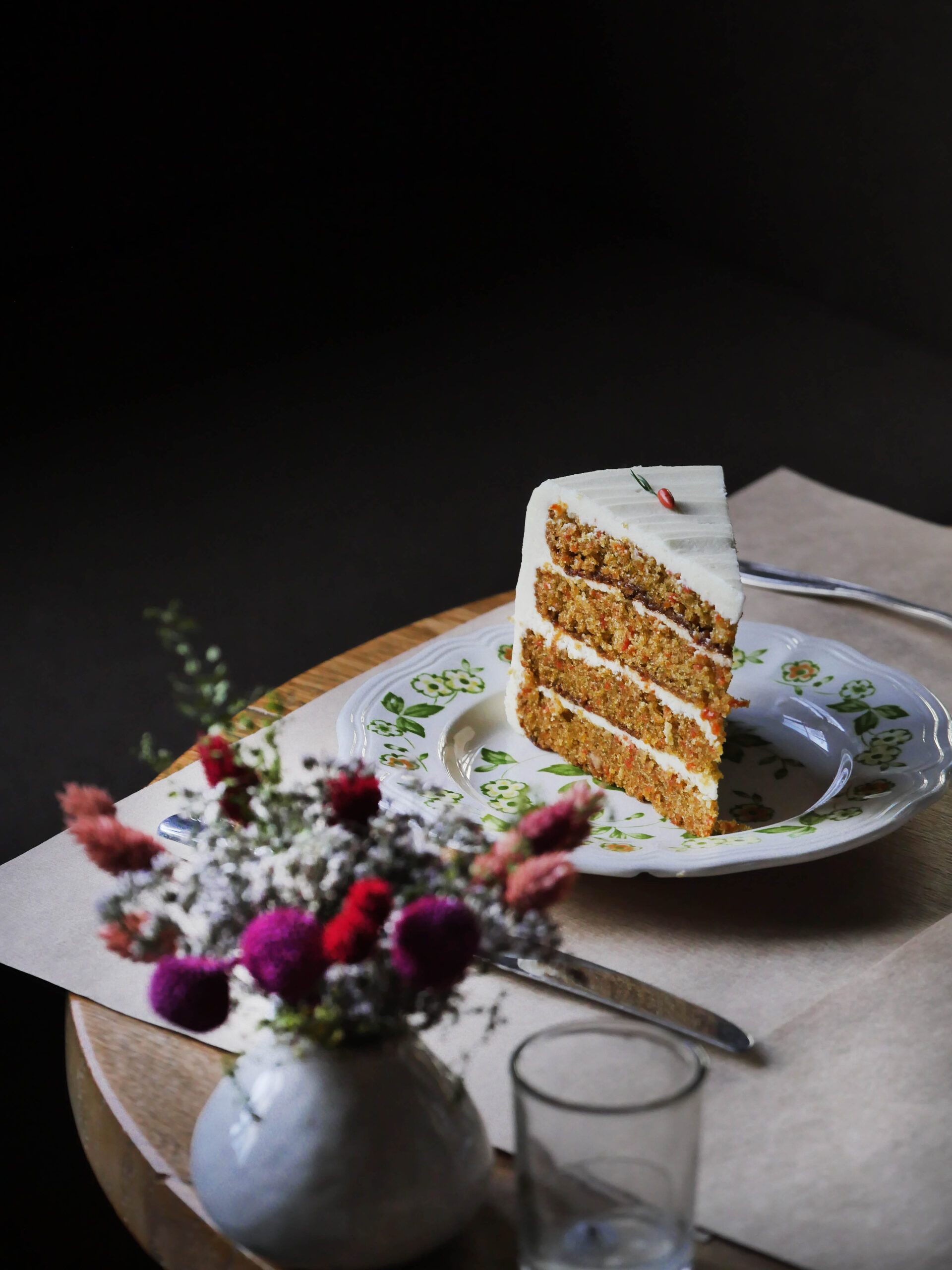
A slice of carrot cake.
Her next course
As for her dream for the future, Vining doesn’t hesitate. She wants to get back to teaching; it’s in her blood. She envisions creating something that connects her community to food and land, whether that’s a school, regular classes or another format entirely. “I want to do something that can connect whatever community I’m in to my abundant knowledge of food and land,” she explains. “That is something I’ve always been passionate about. And every time I talk to people who aren’t in the culinary realm or don’t cook at home, they always seem incredibly interested. While we know we come from the land, I think we’ve lost touch with that over the generations, and many people want to learn about it.”
It’s a vision that connects back to that farm program in Vermont, to the children Vining taught in Manhattan, and to catering for birthday parties, where she still occasionally teaches kids how to make cupcakes. “You know, when I was teaching in Manhattan, kids would come back and be like, ‘Oh my gosh, I made one of the recipes we made three weeks ago for my sister, and she loved it! And now she loves blueberries,’” she recalls. “Those tiny little things where you can tell that you made somebody else excited by something, that’s when you know you succeeded.”
For Vining, that vision is a stark contrast to the demands of her current gig. “The food industry is no joke,” she says. “I’ve had days where I’m at work from 9 a.m. to 12:30 at night, and then you have to wake up and do it again the next day. It’s extremely tiring; it really is. It’s a lot of mental work all the time. You have to be built for it.”
Vining, she says, is built for it. And she’s grateful to be working at The Inn during “a very interesting time” in the kitchen. “Right now,” she says, “it’s run by women. The chef de cuisine is a woman, the sous chef is a woman, and I’m the pastry chef. We’re all pretty supportive of each other and can kind of empathize with each other.” But it’s Vining’s “really deep love for food and the people who we’re serving it to” that keeps her going. When she’s able to step out of the kitchen to say hello to friends and customers dining at The Inn, she knows she’s made the right choice. “When someone tells me their dessert was amazing or it made their day, it reminds me that I’m doing this for love, for passion and for artistic expression; I would feel really lost if I didn’t have this in my life. When I’m making desserts, it comes from my soul.”
This article was published in the January/February 2026 edition of Connect to Northern Westchester.
To view all 2026 Connect to the Best winners, click here.

Liz Colombini

Justin is an award-winning designer and photographer. He was the owner and creative director at Future Boy Design, producing work for clients such as National Parks Service, Vintage Cinemas, The Tarrytown Music Hall, and others. His work has appeared in Bloomberg TV, South by Southwest (SXSW), Edible Magazine, Westchester Magazine, Refinery 29, the Art Directors Club, AIGA and more.
Justin is a two-time winner of the International Design Awards, American Photography and Latin America Fotografia. Vice News has called Justin Negard as “one of the best artists working today.”
He is the author of two books, On Design, which discusses principles and the business of design, and Bogotà which is a photographic journey through the Colombian capital.
Additionally, Justin has served as Creative Director at CityMouse Inc., an NYC-based design firm which provides accessible design for people with disabilities, and has been awarded by the City of New York, MIT Media Lab and South By Southwest.
He lives in Katonah with his wonderfully patient wife, son and daughter.