

By Julie Schwietert Collazo
Artwork by Tara Tassio
If you’ve lived in Westchester long enough, it’s likely you’ve noticed significant changes in weather patterns over the years. Matthew Kavaler, director of Westchester County Emergency Management, certainly has. In fact, Kavaler, who has been with the department since 2014 and has held his current role for the past year, says, “Unscientifically, I’d say we’ve seen more winter storms this year than we’ve seen in a long time.”
And even while you’re eagerly awaiting to see those roses bloom, spring’s arrival doesn’t mean you should let your guard down. Kavaler says emergency-provoking weather events (flooding, severe storms) are common in Westchester County throughout the year. When handling these scenarios (as well as non-weather-related emergencies, such as a house fire), it’s essential to be as prepared as possible.
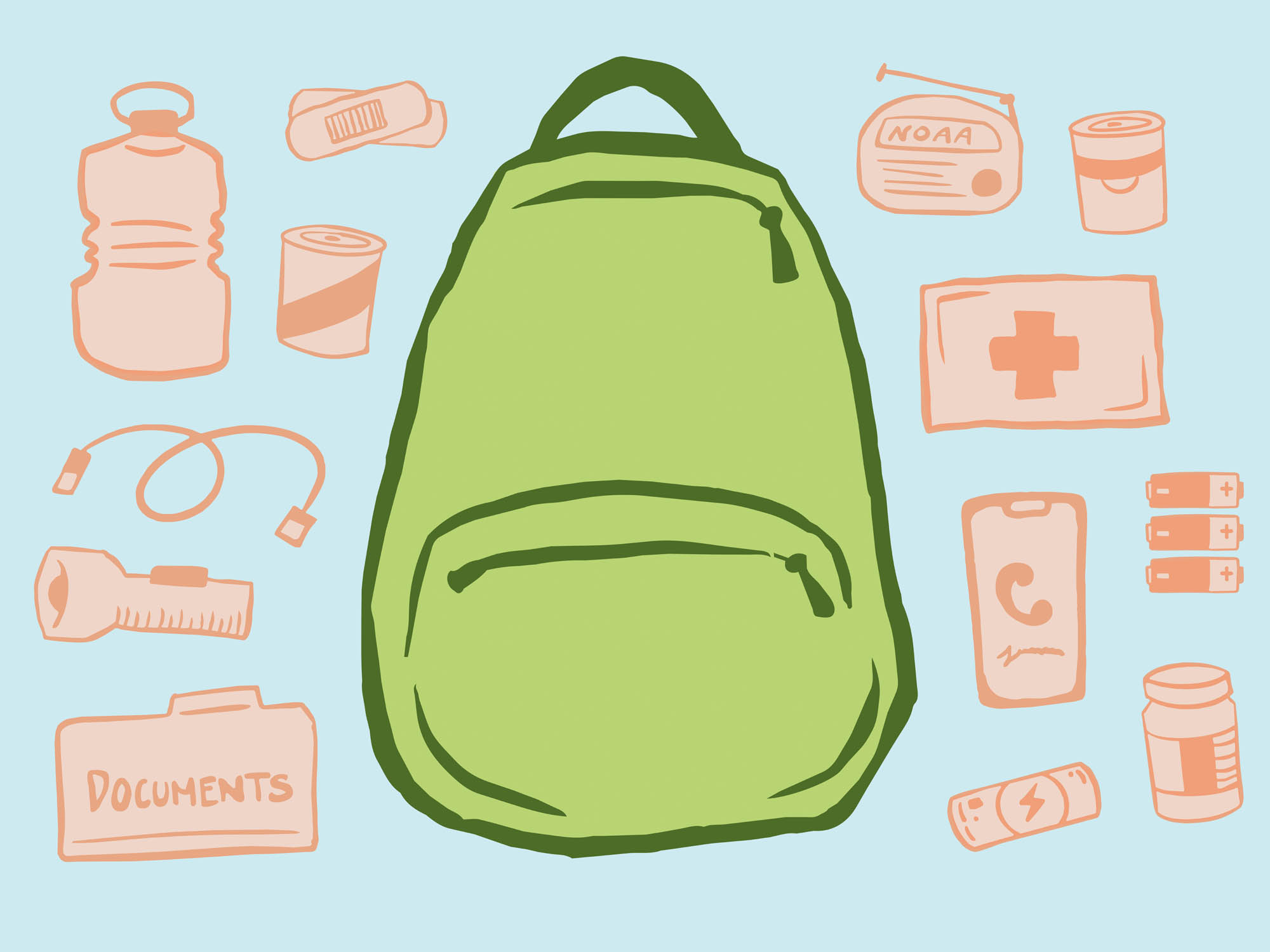
One key part of preparation is to create an emergency kit that’s always up to date. Also referred to as a “go-bag” or “go-kit,” an emergency kit is intended to have all the basics—plus a few comforts—to help you and your loved ones (pets included!) get through 72 hours of emergency and post-emergency conditions.
The right time to build a kit is now
If you don’t have an emergency kit, don’t worry. You can put one together now, and Kavaler, along with other local experts, have shared their top tips to help you prepare. But before you begin buying supplies, you need to purchase the proper containers. An emergency kit is not a small thing, and most people will need more than one container. Depending on the size of your family, it may include several backpacks and one or more storage bins. Durable plastic bins are a popular choice, as are waterproof duffels or backpacks. A range of options exists, and what any given family chooses depends on their living situation and their shared capacity to get the kit out the door when emergency strikes. You may want to divvy up supplies among family members, with each person responsible for hauling their own pack out the door. But this approach depends on the ages of your family members, their preparedness training and their physical abilities.
Once you’ve got your containers, the next step is to get everyone in your family involved. They should know where the kit is and who is responsible for grabbing items in an emergency. Part of stocking your go-bag(s) involves making clear emergency plans that everyone in the family can follow. Numerous resources are available, including Ready.gov’s templates, which include step-by-step guidelines for emergency preparation. Practicing the plan periodically is essential; a quarterly or twice a year cadence is a good standard.
There’s a list of essential items that every family should include in their go-bag. First is water. A good rule of thumb is one gallon of water per day per person, and more if you have pets who are evacuating with you (more on them shortly). Water purification tablets are a good addition to your kit; they don’t take up much space and can ensure a safe water supply if you run out of provisions. Food, of course, is also key: you’ll want three days’ worth of non-perishable food that doesn’t require a heat source to prepare. Canned vegetables and fruits, peanut butter, protein bars, nuts and dried fruits are all good options. (Pro tip: Don’t forget the manual can opener!) To ensure everything is safe to consume, you should check and replace these items as needed (at least annually). (More on this below as well.)
Then, think tech. A battery-powered flashlight and a NOAA weather radio (battery and hand-crank options are available—choose what you prefer) are key. You’ll want a portable charger for your cell phones, too. Once you’re out of immediate danger, make sure you switch devices to low-power mode so you can conserve your battery as long as possible. A solar charger is a beneficial bonus item, as it will recharge your tech when the sun is out. The goal here isn’t to have everyone online for entertainment but to stay connected for essential information and emergency services, so a pocket-sized or trifold solar charger will suffice.
Another necessity for your emergency kit is money. While you may want to keep a credit card in your kit, consider a scenario where credit and debit cards can’t be used and ATM machines can’t be accessed. Kavaler recommends adding small-denomination bills to your kit. In terms of an amount, calculate what you might typically spend in at least three days as a baseline.
Basic first aid items should also be added to the emergency kit: Band-Aids, ointments, common over-the-counter pain relievers and peroxide for minor wound cleaning. Moist towelettes will alleviate a number of uncomfortable personal hygiene issues, and hand sanitizer, disinfecting wipes and trash bags are other key add-ins.
If anyone in your family requires prescription medication, you’ll want to make sure you have an adequate emergency supply. And for babies or young children, be sure to include necessities specific to their needs: formula and diapers, especially.
Kavaler also suggests creating an emergency kit for your vehicle, stored in the car’s trunk, to help with roadside emergencies. In addition to the items in a home go-bag, make sure to include:
- blankets
- cat litter or sand (for tire traction)
- cell phone chargers
- flares
- ice scraper
- jumper cables
- maps
- reflective triangles
Dr. Gilbert Herzberg, a pediatrician with White Plains Hospital Physician Associates, says that when making your car kit, you should also think about basic first aid items that will see you through more common emergencies, like those sustained while enjoying the outdoors. “We have a very active community; many people go hiking in this area,” he points out. He adds that anyone with an allergy to bee stings should include an EpiPen. “The same holds true for people who are asthmatic—bring your inhaler.”
Herzberg also recommends two additional laminated cards for your car and house go-bags: one should list each family member’s prescribed medications, and the other should include emergency numbers, both local crisis response services and personal contacts. It’s easy, in the midst of an emergency, to forget basic information. These cards make sure you can get help quickly and provide essential information to first responders.
Kids, special needs & nice-to-haves
What about the kids? Standard emergency kits often come designed for adults, Herzberg cautions, so if you have young children, consider adding items like children’s pain reliever, allergy care or bandages with fun designs. Families may even want to consider creating emergency kits geared toward children for daycare providers, babysitters or grandparents. And if a loved one has a disability, especially one that requires an assistive device, are they able to access it in the event of an emergency? Accessibility is often overlooked in the emergency planning process, and in some situations, it can be critical.
Similarly, Kavaler says, be sure to plan for anyone who may not speak English fluently. Do they know how to ask for help in English, for example? A small laminated card with basic phrases relevant to an emergency should be tucked into the kit.
And finally, our experts also recommend adding some “nice-to-have” items. Basic hand tools like wrenches and pliers will let you turn off impacted utilities and “fix things in a field-expedient manner,” Kavaler notes. Other items that are considered nonessential but can improve quality of life include paper maps (especially if waterproof), games for children and adults alike (think card games and small, portable, lightweight activities like Mad Libs), books, a journal, and pens or pencils for writing or drawing. Herzberg advises parents to consider packing a duplicate of a favorite toy for kids. While comfort items may add some weight, they can be especially grounding for children in the midst of a crisis, giving them something to focus on besides their fear or anxiety.
Document before disaster
Your emergency kit should also contain some items that won’t necessarily keep you alive and healthy in the immediate, but it will help you navigate the post-crisis process much more easily. A full physical and digital archive of all essential documents for every member of the family (again, pets included) should contain copies of identification documents (driver’s licenses and passports or green cards); insurance policies (health and life; homeowners’ or any specific policies, such as flood or fire insurance; and car) and, for pets, vaccination records. Keep one physical copy in the emergency kit and one with a trusted family member or friend in another state. You should also store a digital copy in the cloud, so you can access it from anywhere.
Kavaler emphasizes, too, how important it is to document your home before a disaster or emergency occurs. You should take photos of every area of your home—inside and out—including the physical space, its key systems and important objects. Draw up an itemized list (with corresponding values, receipts and serial numbers if available) of your key assets, such as jewelry, home accessories, electronics, and anything that would be expensive to replace. Include these images and any related itemized lists in your cloud folder and share them with your trusted out-of-state resource. And don’t forget to update the images and the list when you make significant purchases. This level of preparation will make dealing with the insurance claims process much less stressful.
Don’t forget Fido
Pets, of course, shouldn’t be left out of the family emergency plan. Dr. Andrew Frishman, owner and medical director of Progressive Animal Hospital in Somers, says that prepping your pets’ emergency kit starts with the same basics as your own kit: water and food (and bowls for each); essential medicines and a copy of important identification and medical records (such as microchip number and vaccine certificates). You should also include a laminated card with essential practical information: addresses and phone numbers for a couple of pet-friendly hotels, nearby boarding facilities and emergency vet hospitals. All of these items can be packed in a separate container and stored with the rest of the family’s go-bags in a safe but accessible spot.
Think, too, Frishman suggests, about restraints and transportation needs. At minimum, you’ll need a collar and leash, but you may need a pet carrier of some sort, too. Make sure your pet has proper ID tags with their name and your contact information. Comfort items such as a favorite toy or blanket can help pets calm down during a crisis, but Frishman says if you want to go the extra mile, you can order a “calming collar” (available for dogs and cats) that contains pheromones to help soothe your pet during anxious moments.
What about unusual pets or pets that can’t be moved easily, if at all? For amphibians and reptiles, which are cold-blooded, Frishman recommends investing in a “Jackery,” a relatively lightweight portable power station. “These will help you keep their heat source going,” he explains. For animals that simply can’t be moved, such as fish in large aquariums, he advises making plans to have a generator as your back-up power source.
Don’t “set it and forget it”
Making your go-bag or go-kit is just the first step in emergency preparedness, and all of your hard work will be for naught if you store the kit improperly. Emergency kits need to be refreshed annually at a minimum, but preferably twice a year. Make a calendar note for yourself so you can receive an automatic reminder every six months to be safe. When the “refresh” reminder pops up, take out the water and food and replace them. Make sure documents—including photos of your home—are up-to-date, batteries haven’t died and medicines did not expire.
Where you store your kit depends on your home layout and what’s easiest for you and your family to get it out the door. Don’t, for example, store the kit in a hard-to-reach place like an attic. A closet near the front door is ideal. Just make sure that whatever space you choose is cool, dry and well-protected from rodents and pests.
You’re ready for anything
Kavaler reminds us that even the best emergency kit is only part of crisis preparedness. It’s crucial to avoid being surprised by an emergency. He recommends signing up for NY Alert, the state’s portal for critical news alerts. Users create an account and can choose warning categories ranging from traffic conditions to severe weather—the service is highly customizable. “You can indicate whether you want emails or text messages,” he explains. “And you can schedule vacation alerts so it won’t bother you when you’re away.”
In a similar vein, the state maintains another alert service, which you can tap into by texting your county’s name to “333111.” This system, run by the New York State Division of Homeland Security and Emergency Services, will let you opt into similar emergency messaging on a county-specific basis. Kavaler says it’s less customizable than NY Alert, but no account setup is needed.
Once you’re fully prepared, you can breathe a sigh of relief knowing that if an emergency comes your way, you can leave your home quickly and calmly without worrying about how you will survive.
This article was edited by Rinn Kress and fact-checked by Isabella Aranda Garcia. The artist created her work with Procreate and the Adobe Creative Suite.
This article was published in the May/June 2026 edition of Connect to Northern Westchester.

Julie Schwietert Collazo
Julie Schwietert Collazo is a writer, editor, fact-checker, and translator. She is also author of the travel guidebooks MOON New York State and the forthcoming MOON Hudson Valley and the Catskills.