

By Alex Zodda
Artwork by Annie Kennedy
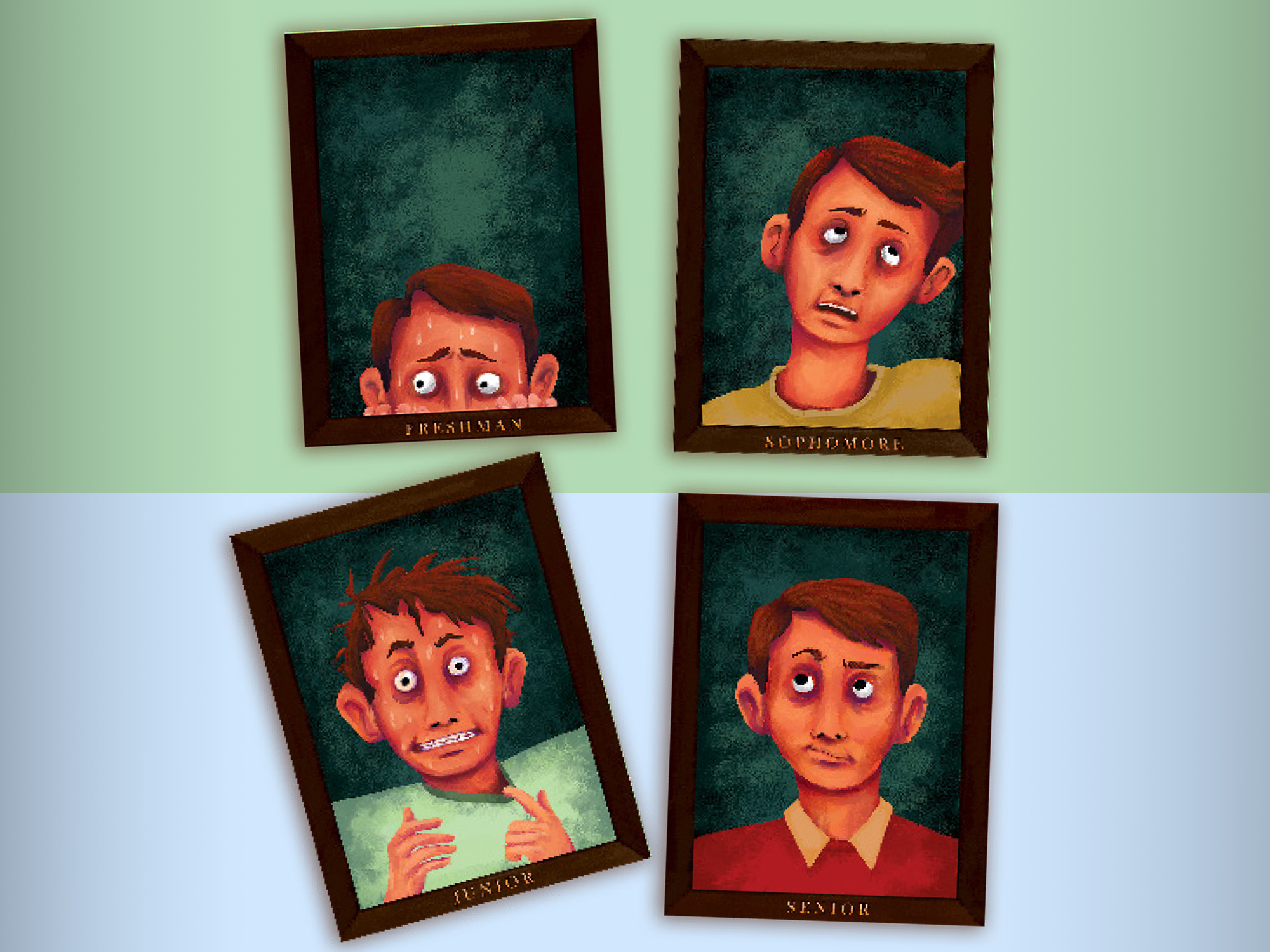
Some call high school the “glory days,” while others view it as the four years we survive without losing our minds. Between grades, college prep and friend drama, it’s easy for a dark cloud to hover over even the best memories. Each grade has its own challenges and nicknames: the freshman fade, the sophomore slump, the junior juggle and, of course, the notorious senioritis.
As a current high school senior, I can attest to each of these phases, and I’ve lived to tell the tale. But, sadly, my editor wasn’t a fan of me just imparting my sage wisdom to all of you, so this article won’t be that. Instead, I spoke to eight teens who have been there/done that themselves and agreed to share their experiences and tips. So get out your highlighter and feel free to take notes in the margins. This article is designed to help you make it through all four stereotypical high school conditions. Class is now in session.
The Freshman Fade
The initial burst of enthusiasm that fizzles out once reality of the workload and/or independence sets in.
Many middle school teachers will say everything changes when you get to high school. I’m not sure if they’re trying to scare you, but it often does. Tyler Beshara, a sophomore at John Jay High School, remembers the anxiety he felt as freshman year approached. “I knew it was going to be very different from middle school,” he says. However, Maddie Gish, a sophomore at Byram Hills High School, had a mix of emotions, feeling extremely excited as well as nervous before high school began.
And with a year under their belts, they agree that high school is very different. “High school gives us more built-in opportunities to connect with others,” says Maddie. “Even during office hours, there’s time to socialize or ask for help.” Plus, there are more class options, but that does come at a price: more to learn.
“The homework was similar to eighth grade, but the studying was very different,” says Tyler. “In middle school, your homework was basically your studying, so it was easy at first. But I soon realized that I needed to look over my notes three nights before a test.” Maddie calls the freshman fade a canon event. “Honestly, the loss of motivation was the actual killer,” she says.
How did they get over the freshman fade and make it through their first year of high school? The key, according to Tyler, is time management. “Looking back, I was really successful when I just came home, got my homework done and studied,” he says. “Then I could do the fun things, like sports and socializing. Maddie, on the other hand, switched up her studying habits. “Every class is different,” she explains. “So I had to implement different methods for different classes, whether that’s flashcards or generating questions.” She also relied on those around her. “Knowing my upperclassmen friends went through the same thing and made it out helped.”
One final piece of advice for those hitting that freshman fade: learn how to adapt. “You can’t think too deeply into anything,” Tyler suggests. “If you don’t get a great quiz score or someone’s not being a good friend, just let it go and focus on the next thing because there are tons of opportunities.”
The Sophomore Slump
A dip in motivation, performance or enthusiasm, often after the excitement of freshman year wears off but before the higher-stakes of junior year kicks in.
Coming into sophomore year, you may have settled into the rhythm of high school. With one year under your belt, the next should be much easier, right? Well, for many students, it’s worse.
Juniper Herbst, a junior at John Jay High School, had heard whispers about the sophomore slump, but she was excited for the additional freedom and class options. She’d moved from California before her freshman year, so walking through those school doors with friends was much more comfortable than being completely new. However, that sense of comfort didn’t last long. “After the honeymoon period was over, it was definitely more challenging,” she remembers. If freshman year was a four in difficulty, sophomore year was a six.
Daniel Krampf, another junior at John Jay High School, says he felt pressure to succeed. “Other students tried harder, which pushed me to do the same,” he explains. “Everyone felt the sophomore slump in their own way, whether it was in sports, academics or something else.” Juniper felt a similar type of pressure. “I felt like I had to be a perfect student who knew everything: how to solve a problem, how to study perfectly, all of it.”
To beat the sophomore slump, they offer different solutions to stay motivated. Juniper recommends changing your mindset. “If you stay positive, even if you’re struggling, you’re going to do better no matter what,” she notes. She also found that rewriting her notes and using Quizlet improved her studying. For Daniel, getting a planner was a game-changer. “It genuinely helps me organize things,” he explains. And they both say that one of the keys to keeping your grades up is figuring out what works best for you. “Don’t feel like you have to stick with whatever your teacher says to study because everyone learns differently,” Daniel recommends. “And you also have to put in the hours to succeed. If you don’t take it seriously and push yourself, you’ll fall into that sophomore slump.”
The Junior Juggle
The attempt to balance AP classes, extracurriculars and something like a social life.
This is where it gets serious. Junior year has one hell of a reputation, which is probably why they call it “hell year.” ACTs and SATs are coming up faster than the Flash, college begins to take center stage, and coursework goes from bad to worse.
Sonia Kulik, a senior at Byram Hills High School, says she imagined a very “adventurous” junior year. “I thought I was going to do very well in my classes, but it was the complete opposite,” she explains. Before she knew it, Sonia went from taking one AP class to three. Even worse, the studying strategies she’d used freshman and sophomore year stopped working. (Sadly, it does happen.) That junior juggle was real, and it wasn’t easy.
Hank Hearon, a senior at Fox Lane High School, was more prepared for the workload that comes with junior year (he had 3-4 hours of homework nightly), but he was surprised by how much he needed to manage the external college pressure. “Everyone started asking me the same question: ‘Where are you thinking of applying?’” he remembers. Hank felt there was a tectonic shift between being an underclassman versus an upperclassman. “Suddenly, it starts to really hit you that the reason you’re working in high school is to send those grades to colleges,” Hank says.
Sonia and Hank agree that those college goals and dreams can split friends apart, creating even more to juggle. They recommend focusing on working with each other to get through that difficult period together. “Make it a priority to communicate with other people,” Sonia recommends. “There’s so much going on your junior year, and being able to share that with people is really important.” Hank also suggests leaning on your guidance counselor and teachers. “I wouldn’t have gotten through the year without them,” he explains. “But there is a light at the end of the tunnel, and senior year is awesome. So good luck!”
Senioritis
A mix of exhaustion and overconfidence that makes students think, “I’m basically done, right?”
You’ve finally made it! After three years of stress and hard work, it’s time to coast through your last year and enjoy all the benefits of being at the top of the food chain. But wait… remember all those hard classes you took last year? You might want to take a few more of those. Plus you’ll have to write a million supplemental essays for colleges. And then comes the worst part: waiting.
Sophie Abt, a freshman at Syracuse University and graduate of Fox Lane High School, says the first few months were very stressful, and so was the summer before. “Once you’ve submitted all your applications, the waiting period starts,” she remembers. “You’re just kind of going through the motions of enjoying your last year of high school. The junior year course load was definitely difficult, but, mental health-wise, I think it was worse waiting to hear back from the places I applied.” But she did enjoy her senior year, which went by way faster than she could’ve ever imagined.
On the other hand, Brian Rippy, a sophomore at the College of Holy Cross and Byram Hills High School graduate, found senior year wasn’t as bad as he imagined. For him, taking the SATs junior year was harder than applying to college senior year. Everyone around Brian experienced senioritis. “People really stopped caring, and they were more focused on enjoying their time and socializing,” he says. That said, it wasn’t all late nights and skip days. Brian, who ran track all four years of high school, served as a mentor for many of the underclassmen on his team.
And when you get to the point where you just want to be done, Sophie says try talking to your friends. “They’re going through the same exact thing as you,” she points out. “You’d be surprised by how many people feel the same way you do.” She also found motivation from her parents. “They would say, ‘You’ve been doing this for three and a half years now; just last a few more months.’”
But if your senioritis goes the other way, and it feels impossible to focus on anything, Brian says make an effort to find that elusive balance. “Just maintain your grades and don’t slack off or skip class,” he advises. “Also, consider taking more AP courses because if you score well on the exam, you can skip the college intro-level class, which is really nice. But do have some fun.”
So, class, let’s recap what we’ve learned. Get a planner. Learn how to adapt to change. Figure out what study habits work best for you, and don’t freak out when that shifts. Accept that you’ll feel the pressure, and be prepared to put in the hours to meet it. Learn how to juggle. Don’t let the exhaustion or overconfidence completely take over—there is such a thing as balance. And, most of all, whether it’s the glory days or four years in survival mode, high school will be over before you know it. So figure out the type of student and friend you want to be, then strive to become that.
Okay everyone, you’re dismissed.
This article was published in the January/February 2026 edition of Connect to Northern Westchester.
To view all 2026 Connect to the Best winners, click here.

Alexandria Zodda
Based in Pleasantville, Alex is a current senior at Byram Hills High School. She can often be found at her school’s speech and debate club, stressing over F1 racing, playing music as a standing string bass player, or hanging out and eating dinner with her mom.

Annie Kennedy
Annie Kennedy is a designer and illustrator based in Brooklyn but born and raised in Lewisboro. Having completed her BFA in communications design at Pratt Institute, she seeks to continue using her work as a means of storytelling. Outside the studio, she spends her time cooking for friends, mask-making and gardening.